
What's Hot

    Ford’s Secret Project Turned Into a Chicago-Themed SUV for the Pope | Invesloan.com

    March 7, 2026

    Your Favorite Restaurant Is Becoming a Tech Company | Invesloan.com

    March 7, 2026

    New Era of Drone Warfare Creates Higher Risks for Civilians | Invesloan.com

    March 7, 2026
    Facebook Twitter Instagram
    Finance Pro
    Facebook Twitter Instagram
    invesloan.cominvesloan.com
    Subscribe for Alerts
    • Home
    • News
    • Politics
    • Money
    • Personal Finance
    • Business
    • Economy
    • Investing
    • Markets
      • Stocks
      • Futures & Commodities
      • Crypto
      • Forex
    • Technology
    invesloan.cominvesloan.com
    Home » Willy Woo Urges Bitcoin Holders to Migrate from Taproot Before Quantum Era | Invesloan.com
    Crypto

    Willy Woo Urges Bitcoin Holders to Migrate from Taproot Before Quantum Era | Invesloan.com

    November 11, 2025Updated:November 11, 2025
    Share
    Facebook Twitter LinkedIn Pinterest Email

    On-chain analyst Willy Woo issued a guide urging Bitcoin holders to move coins from Taproot addresses to older formats that conceal public keys behind cryptographic hashes, warning that quantum computers could compromise exposed keys as the technology matures.

    The Bitcoin community remains divided over the urgency and effectiveness of migration strategies as quantum computing timelines compress toward the late 2020s.

    Woo’s post on X outlined a six-step process for holders to protect their Bitcoin during what he called the “age of big scary quantum computers.”

    Taproot addresses beginning with “bc1p” embed public keys directly into addresses, making them vulnerable once quantum machines develop enough processing power to derive private keys from public ones.

    Meanwhile, he explained that older SegWit formats, starting with “bc1q,” and legacy addresses, beginning with “1” or “3,” conceal public keys behind hashing algorithms that provide temporary protection until transactions are broadcast, exposing the keys in mempools.

    DUMMIES GUIDE TO BEING QUANTUM SAFE.

    In the past it was about protecting your PRIVATE KEY (your seed phrase). In the age of big scary quantum computers (BSQC) that are coming, you need to protect your PUBLIC KEY also.

    Basically a BSQC can figure out your private key from a…

    — Willy Woo (@woonomic) November 11, 2025

    Migration Strategy Sparks Technical Debate Among Developers

    Former Bitcoin Core developer Jonas Schnelli acknowledged that Pay-to-Public-Key-Hash addresses offer “years of protection” compared to Taproot’s immediate public key exposure.

    However, Schnelli warned against calling Woo’s approach “quantum safe,” stating, “the moment you broadcast a spend, your pubkey hits the mempool. A quantum attacker could crack your key and RBF double-spend before your transaction confirms.“

    Good advice for protecting unspent coins – P2PKH gives you years of protection while Taproot exposes your pubkey immediately.

    But don’t call this “quantum safe.” The moment you broadcast a spend, your pubkey hits the mempool. A quantum attacker could crack your key and RBF… https://t.co/s7DGJ7N8xB

    — Jonas Schnelli (@_jonasschnelli_) November 11, 2025

    Anakun from Open BTC offered detailed commentary highlighting Bitcoin Improvement Proposal BIP-360, which implements quantum-resistant ML-DSA signatures approved by the National Institute of Standards and Technology in 2024.

    The migration plan developed by developer Jameson Lopp proposes a phased timeline spanning five years, with Phase A stopping payments to legacy addresses 160,000 blocks after the launch of BIP-360 and Phase B invalidating all non-quantum signatures 110,000 blocks later.

    Anakun explained this proactive approach “prevents quantum computers from stealing vulnerable coins by making them unspendable before quantum computers can access them.“

    Anakun contrasted Bitcoin’s adaptable UTXO architecture with Ethereum and Solana’s immutable smart contracts that permanently verify ownership through ECDSA signatures.

    Hey Willy, appreciate you bringing quantum threats to your audience's attention. Your guide has the right instincts about protecting public keys, but there's a comprehensive migration plan already in motion that changes the whole picture.

    For anyone who needs the basics,…

    — Anakun (@anakun) November 11, 2025

    “When quantum computers break ECDSA, these contracts become vulnerable—Uniswap with $4B locked, AAVE with $12B, Compound with $2B,” Anakun wrote.

    While Vitalik Buterin’s emergency hard fork plan could save ETH in regular accounts, Anakun noted “every smart contract deployed before the fork remains vulnerable forever” because “they all check ECDSA signatures at the contract level, not the protocol level.“

    Industry Split on Timeline and Preparedness

    Capital Markets analyst Charles Edwards sharply criticized Woo’s strategy, stating, “this ain’t quantum safe and if this is the model Bitcoin is doomed.”

    Edwards warned that the approach requires “perfect, meticulous operations from users” while failing to prevent quantum attacks.

    He argued it would “kill adoption completely, like send traffic to zero” and “doesn’t solve the 30% of lost/p2pk coins that will be stolen and market dumped.”

    Edwards insisted “Bitcoin’s only hope is a consensus upgrade to the network, agreed in 2026,” advocating for immediate protocol changes rather than user-initiated migrations.

    Woo defended his guide as an “intermediary measure,” responding to Edwards that “BTC remains the best monetary asset if you take a long time horizon beyond the next 10 years. Quantum will not break BTC because BTC will adapt.”

    He explained that “general consensus among the experts is 2030+” for when quantum computers may threaten Bitcoin, with developers proposing “a 2-year intermediary plan and a 7-year plan.“

    MicroStrategy Chairman Michael Saylor also recently dismissed quantum concerns as “mainly marketing by people who want to sell you their next quantum yo-yo token.”

    Saylor argued that “Google and Microsoft aren’t going to sell you a quantum computer that cracks modern cryptography because it would destroy Google and Microsoft and the U.S. government.”

    Michael Saylor says Bitcoin’s quantum threat is still 10–20 years out

    “By then, Bitcoin will upgrade like everything else”

    “We’ll just upgrade the software, Joe” pic.twitter.com/OJLvmM82u6

    — Bitcoin Archive (@BitcoinArchive) November 8, 2025

    He estimated the threat timeline to be “sometime 10-20 years out” and compared Bitcoin upgrades to routine software updates, stating, “Bitcoin’s a protocol like the English language and base 10 math.”

    Saylor emphasized that phishing attacks exploiting quantum fears pose greater immediate risks, noting, “if I wanted to hack your Bitcoin, I’d send you an email saying a quantum computer can hack your Bitcoin. Click on the link to upgrade now.“
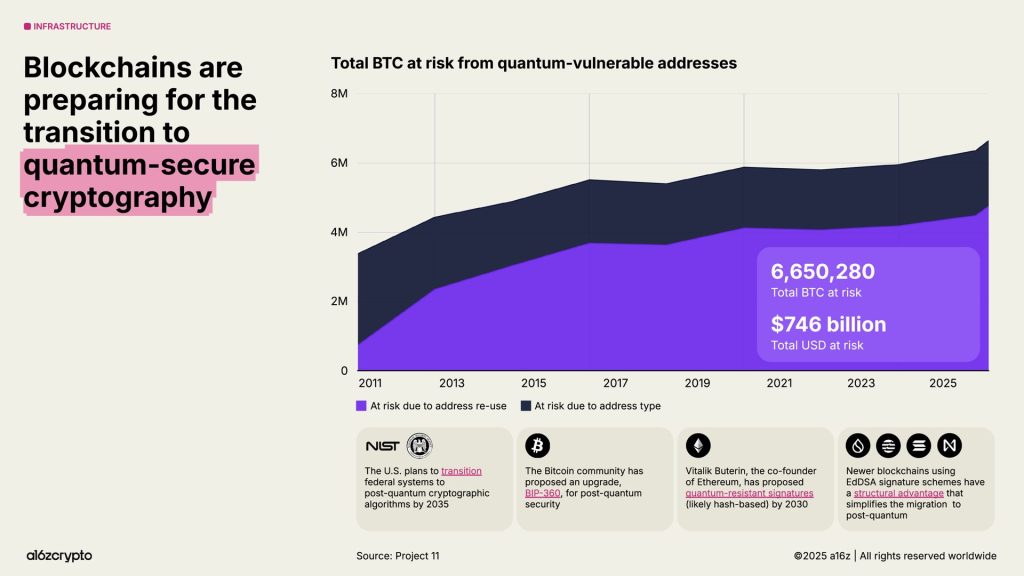
    Willy Woo Urges Bitcoin Holders to Migrate from Taproot Before Quantum Era
    Source: a16z

    This divide and discovery comes as A16z recently declared that $750 billion worth of Bitcoin sits in quantum-vulnerable addresses, with the US government already preparing to transition federal systems to post-quantum cryptographic algorithms by 2035.

    The post Willy Woo Urges Bitcoin Holders to Migrate from Taproot Before Quantum Era appeared first on Cryptonews.


    Share. Facebook Twitter Pinterest LinkedIn Tumblr Email

    Keep Reading

    Bitcoin Price Prediction: Major Miner Just Expanded in Texas: Is a Massive BTC Production Surge Coming? | Invesloan.com

    Crypto Price Prediction Today 25 February: XRP, Solana, Bitcoin | Invesloan.com

    Hong Kong to Link New Digital Bond Platform With Regional Crypto Tokenization Hubs | Invesloan.com

    An AI Crypto Agent Sent a ‘Beggar’ Six Figures, Then He Lost It All This Way | Invesloan.com

    Ethereum Locks In FOCIL for 2026 as Foundation Moves $6.8M ETH to Staking | Invesloan.com

    Bitcoin Price Prediction: $400 Million Suddenly Pulled From ETFs — Is Smart Money Quietly Exiting BTC? | Invesloan.com

    Crypto Price Prediction Today 24 February – XRP, Bitcoin, Ethereum | Invesloan.com

    XRP Price Prediction: Arizona Just Named XRP in a State Crypto Reserve Bill — Is Government Adoption Beginning? | Invesloan.com

    Bitpanda Offers €15 in Silver to New Users Trading €50 in Metals | Invesloan.com

    LATEST NEWS

    Ford’s Secret Project Turned Into a Chicago-Themed SUV for the Pope | Invesloan.com

    March 7, 2026

    Your Favorite Restaurant Is Becoming a Tech Company | Invesloan.com

    March 7, 2026

    New Era of Drone Warfare Creates Higher Risks for Civilians | Invesloan.com

    March 7, 2026

    Subscribe to learn | Invesloan.com

    March 6, 2026
    POPULAR

    China’s first passenger jet completes maiden commercial flight

    May 28, 2023

    Numbers taking US accountancy exams drop to lowest level in 17 years

    May 29, 2023

    Toyota chair faces removal vote over governance issues

    May 29, 2023
    Advertisement
    Load WordPress Sites in as fast as 37ms!
    Facebook Twitter Pinterest WhatsApp Instagram
    © 2007-2023 Invesloan.com All Rights Reserved.
    • Privacy
    • Terms
    • Press Release
    • Advertise
    • Contact

    Type above and press Enter to search. Press Esc to cancel.

    invesloan.com
    Manage Cookie Consent
    To provide the best experiences, we use technologies like cookies to store and/or access device information. Consenting to these technologies will allow us to process data such as browsing behavior or unique IDs on this site. Not consenting or withdrawing consent, may adversely affect certain features and functions.
    Functional Always active
    The technical storage or access is strictly necessary for the legitimate purpose of enabling the use of a specific service explicitly requested by the subscriber or user, or for the sole purpose of carrying out the transmission of a communication over an electronic communications network.
    Preferences
    The technical storage or access is necessary for the legitimate purpose of storing preferences that are not requested by the subscriber or user.
    Statistics
    The technical storage or access that is used exclusively for statistical purposes. The technical storage or access that is used exclusively for anonymous statistical purposes. Without a subpoena, voluntary compliance on the part of your Internet Service Provider, or additional records from a third party, information stored or retrieved for this purpose alone cannot usually be used to identify you.
    Marketing
    The technical storage or access is required to create user profiles to send advertising, or to track the user on a website or across several websites for similar marketing purposes.
    • Manage options
    • Manage services
    • Manage {vendor_count} vendors
    • Read more about these purposes
    View preferences
    • {title}
    • {title}
    • {title}