

The job market is looking brighter, but some places are a better bet if you’re looking for stability than others.
It’s especially tough if you’re looking for work in the tech- and media-heavy information sector. Major tech companies have laid off workers due to AI and automation.
Other sectors offer better career security or are more resilient to economic cycles. That includes many healthcare roles. “It doesn’t matter how the economy is doing. We will always need doctors. We always need nurses,” Loujaina Abdelwahed, the head of economic research at Revelio Labs, said.
Below are some of the more and less secure kinds of work.
More secure: Healthcare
The healthcare sector has typically been adding jobs each month, making up about 20% of overall net job growth in May. Daniel Zhao, the chief economist at Glassdoor, said turnover can be pretty high in healthcare, but so is worker demand, making it easier to get a new job compared to in some other sectors.
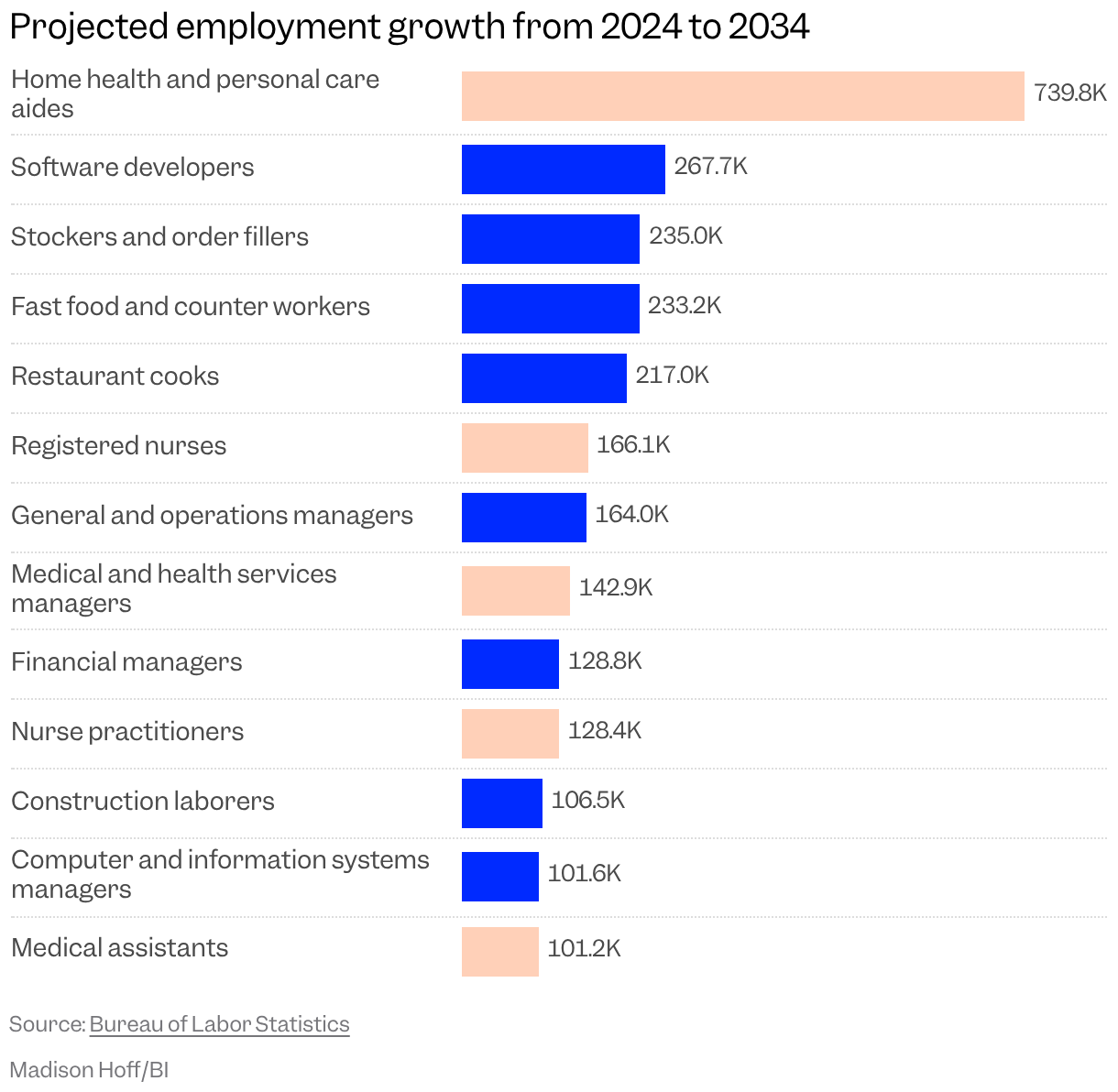
Based on Bureau of Labor Statistics employment projections, several healthcare occupations are projected to increase a lot from 2024 to 2034. Home health and personal care aides and registered nurses are projected to experience robust demand to help care for the aging population. BLS projected large job growth in medical and health services managers, as more healthcare demand means more people are needed to oversee work.
New college graduates will likely have an easier time navigating the job market if they’re on a more rigid path, like the requirements and schooling for doctors, nurses, or teachers.
“Graduates in education and healthcare, where there are licenses or pathways into a job, it’s a lot easier right now,” Cory Stahle, senior economist at Indeed, said. Meanwhile, computer science majors are more likely to be affected by job market fluctuations and can have a more flexible post-college path, which can lead to greater uncertainty.
Within healthcare, security can vary. Zhao pointed to the difference in nursing assistants and anesthesiologists, where the latter requires specific expertise, medical school, and completion of an internship and medical residency. Bureau of Labor Statistics data showed there were over a million nursing assistants as of May 2025, compared to about 39,000 anesthesiologists.
“Generally speaking, having more education, more experience, more credentials helps you define a rarer set of skills and helps that thus create more job security,” Zhao said.
More secure: Skilled trades
From electricians to plumbers, skilled trades are another more secure career option; Zhao said these jobs won’t be replaced by AI and are geographically spread out.
“It’s not nearly as concentrated as some white-collar sectors, with tech or finance that tend to be concentrated in the big cities,” Zhao said. “So in that sense, there is more flexibility and more security in that.”
Electricians are projected to be a fast-growing job, and they typically are paid well. Employment is projected to grow 9% from 2024 to 2034, and plumbers, pipefitters, and steamfitters are projected to grow 4%, just above the projected 3% for all occupations.
Skilled trades can also be an opportunity for being your own boss, said Ed Brady, president and CEO at Home Builders Institute. “Once you master that skill, once you perfect that skill, now you know what you’re doing, you can hire people, you can build your own business and become an entrepreneur,” he said.
Working in skilled trades can take time, including attending trade school and thousands of hours of on-the-job training to become an electrician, a career guide from Indeed showed.
“If you’re working your way up in one of the skilled trades, those early years, you might feel very insecure or very unstable,” Zhao said. “And in fact, there’s even a higher cost of switching at that point because you’ve sunk that time and effort into going down that path.”
Less secure: Leisure and hospitality
Despite the flashy headlines of white-collar layoffs, lower-paying service work in sectors like leisure and hospitality has historically been much less stable.
“It tends to be blue-collar workers who face the most instability and insecurity,” Zhao said. “If you think about hospitality, for example, which would include restaurants, hotels, and workers at those sorts of firms, those tend to be some of the places where you see the highest amount of uncertainty and insecurity.”
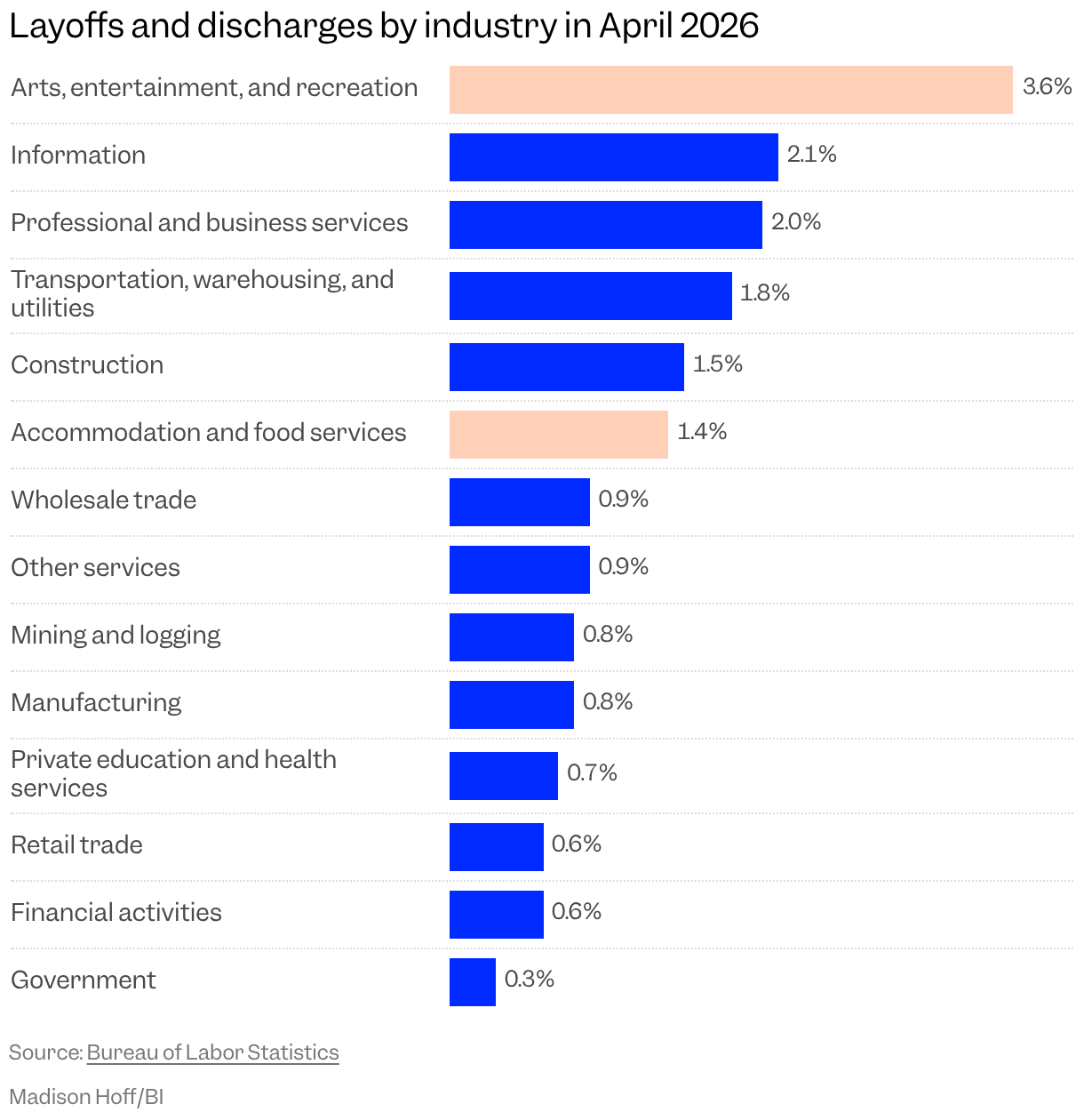
The leisure and hospitality sector tends to have a high quits rate, and the arts, entertainment, and recreation subsector tends to have a high rate of layoffs and discharges.
Less secure: Tech
Abdelwahed said data scientists and software engineers are among the “nice to have” jobs for many businesses, where adding new hires might not be essential for them if there’s economic uncertainty going on.
Employment in the computer systems design and related services sector has generally been falling, down 1.5% from a year ago as of May. Employment in computing infrastructure providers, data processing, web hosting, and related services was down 3%.
“Many computer science and computer engineering graduates are still holding out for the tech job market to turn around, and they have a degree that, in theory, should be valuable once this downturn in the tech market ends,” Zhao said.
Zhao said people in tech can branch out to employers in industries that are looking more stable and that need workers with technical skills. Still, job seekers may prefer being in tech. Zhao said maybe someone wants to join a startup, hoping it becomes the next unicorn and offers high compensation.
“For some workers, they might have more appetite for risk in their careers and be willing to really try to make it work in the tech sector, knowing that there is this higher risk if the economy slows down,” Zhao said.