




When my parents and I immigrated from Liberia to the US in the 1990s, our first home was my grandmother’s two-bedroom, one-bathroom apartment in Worcester, Massachusetts.
Her house became a refuge as my parents found their footing in a new country. Living with her gave them childcare help and the breathing room to find work, save money, and eventually move into a place of their own. In turn, she benefited from their companionship.
In many cultures around the world, multigenerational households — in which grandparents, parents, and grandchildren live under one roof — are a way of life. Though American culture has long prized independence and individualism, many families in the US are now embracing this way of living.
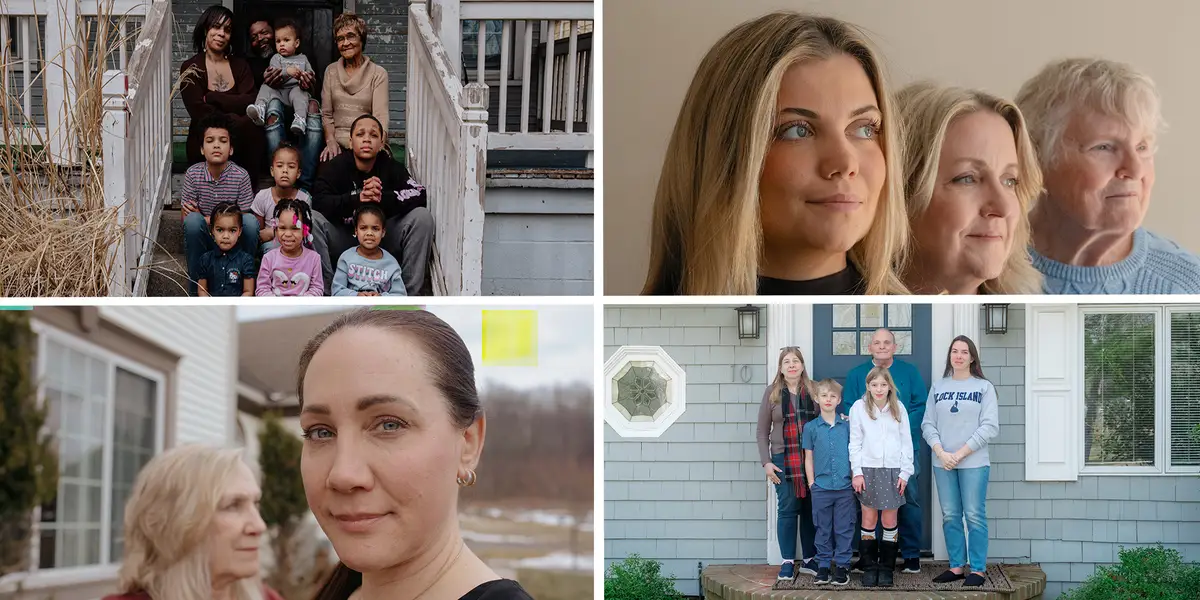
June Boyd, for example, is 90. After a series of health scares in her family, Boyd’s Toldelo, Ohio, home now includes 13 people — her children, grandchildren, and great-grandchildren, ranging in age from 3 to 69. Together, they care for the young children and split the home’s $700 monthly rent.
“In our case, there are no downsides to multigenerational living. The main thing is that it reduces the cost of living, given how high prices are.”
Whatever the setup, many families like Boyd’s are finding that living together and pooling resources is the best way to cope with an economy that has made raising children, caring for aging parents, and affording a home more difficult.
American family structures are changing
If you grew up on cable TV, you probably know the trope of the perfect middle-class, nuclear family living in a large house with a white picket fence. It’s the classic setup: a married mom and dad, and, if the kids are lucky, maybe a dog or two — the kind of household seen in 1980s sitcoms like “Family Ties” and “Growing Pains.”
That script no longer holds for many families.
It is easy to see why. Over the years, inflation in the US has made everyday necessities like groceries, gas, and electricity more expensive. At the same time, wages have not kept pace with rising childcare and housing costs.
A higher cost of living also means that, for many older Americans, retirement savings are falling short.
Natasha Pilkauskas, an associate professor of public policy at the University of Michigan, added that the growing share of children born to unmarried parents, who don’t live in the same household, is also helping drive growth in multigenerational living.
“A lot of it is driven by changes in family structure,” Pilkauskas told Business Insider. “You do see that there are much higher rates of multigenerational households among divorced families than among married families.”
When Vanessa Gordon’s 13-year marriage ended in 2024, the mother of two had to leave her marital home and look for a new place to live in East Hampton.
Gordon found a rental within her budget, but setbacks like a broken car made daily tasks difficult. To ease the burden, her parents moved into a secondary bedroom in her home and now pitch in with childcare.
Jeremy Garretson for BI
“Multigenerational living isn’t necessarily a step backward,” Gordon, 37, told Business Insider. “Support systems can be strategic.”
Still, Pilkauskas said multigenerational living often isn’t a household’s first choice, and that for many families, the traditional nuclear family model remains the ideal.
“I still think people would desire the ‘Leave It to Beaver’ lifestyle,” she said. “I think that this is coming from necessity, more than preference.”
Younger generations are now able to buy homes thanks to their parents
In 2015, Juli Ford bought a home in the Boston area with a basement apartment, so her widowed mother could move in with her and her family.
Ford’s mother contributed to the down payment on the $630,000 home and has, over the years, pitched in for utilities and other household expenses. The arrangement has helped Ford afford the purchase of two other properties. But one of the greatest benefits has been living closely with her mother, now 82, as she ages.
“I cannot imagine how much harder it would be to be a daughter of an aging mom if we weren’t in the same house,” Ford, 57, told Business Insider.
Ford’s decision to move in with her mom is a choice many households are making in today’s real estate market.
Data from The National Association of Realtors’ 2025 Home Buyers and Sellers Generational Trends report shows that between July 2023 and June 2024, 17% of all home buyers purchased a multigenerational home. That’s an increase from 14% the previous year.
Tali Berzak, a New York-based Compass agent, told Business Insider that in the Brooklyn brownstone neighborhoods where she works, including Bed-Stuy, Bushwick, Crown Heights, and Clinton Hill, it is common to see multiple generations of a family living in the same home or on the same block.
“What we’re seeing more now are situations in which parents are helping their adult children buy a home. The parents may live in one of the units, while the adult children occupy one or two of the others,” she said.
She recently worked on a three-family property where a father used one unit as his secondary apartment in the city, and his two children lived in the others.
Homebuilders are designing for multigenerational living
Jené Luciani-Sena’s mother paid $200,000 to build a separate, but attached apartment onto her daughter’s home. The 900-square-foot apartment has its own bedroom, bathroom, and living room.
“The kids love having ‘Nema’ around all the time; Mom joins us for meals,” Luciani-Sena, a mother of four, told Business Insider. “I love having an extra person to help with housework, such as grocery shopping and the occasional laundry, and shuttling kids to and from various events and practices.”
Luciani-Sena said the apartment also increased the property’s value by about $75,000.
Adrianna Newell for BI
Houston-based Newmark is one homebuilder that designs and builds houses for multigenerational families.
The company offers one- and two-story floor plans for 40 to 100-plus-foot lots, with homes ranging from about $350,000 to $3.2 million, including closing costs.
Rodney Mican, Newmark’s director of product development, told Business Insider that buyers in multigenerational households often ask for features such as larger bedrooms, oversize bathrooms and showers, and second kitchens.
Courtesy of Newmark
Newmark’s Umbria floor plan, for example, offers a “dual home” option. Similar to Luciani-Sena’s mothers’ apartment, it’s a separate living space within the home that has its own bedroom, bathroom, kitchen, and living room.
Berzak said her multigenerational buyers are especially drawn to homes with separate apartments because they offer both togetherness and privacy. They also work well for grandparents helping with childcare.
“People are looking at childcare in a different way,” she said. “Instead of bringing a nanny or someone who isn’t part of your family into your home, having a parent live within the home feels more connected.”
Mican said homes like the Umbria resonate because they are built around that very sentiment. “Human nature has not changed for millennia; families will always take care of their loved ones if they can.”