

Pylon CEO Marty Kausas had to make a difficult choice: scale back token spending, or stomach a $1.4 million bill.
Kausas said that his AI software company was fast approaching 150 employees on its Anthropic plan earlier this month, a point where the bill would more than triple. That realization got Kausas to declare the era of unlimited spending over — and he decided to set ceilings for tokens, the units of data that determine how AI is priced, for some of his non-technical employees.
Pylon’s VP of finance is now exploring “where we should set caps,” Kausas said. “This is just the start.”
Leaders like Kausas are weathering a massive workplace shift, as more workers learn to love improved AI tools. Over the past few months, usage has moved from something bosses felt they had to incentivize to something they had to limit, due to skyrocketing costs and the realization that unlimited spending didn’t always yield meaningful results.
Janice Chung for BI
OpenAI CEO Sam Altman said earlier this month he was blown away by how fast the conversation around AI budgets had changed. At the beginning of the year, “people were totally happy with the amount they were spending,” he said. Now, these costs are “a huge issue.”
It’s not just CEOs and CFOs navigating these new corporate dynamics. For rank-and-file software engineers, part of their job now involves advocating for the compute they need to succeed. Meanwhile, some managers have to barter for their team’s tokens, pitching like “Shark Tank.” And, to poach red-hot AI talent, hiring managers are guaranteeing candidates tokens to spend.
A cutthroat Hunger Games for AI compute is fast approaching, one where everyone — from the C-suite to junior developers — is a player.
Token-fever whiplash
Max Kan’s official job title is “tokenomics analyst.”
At the data provider SemiAnalysis, Kan helps build token models for hedge funds and hyperscalers. When I called Kan in May, he was bullish on the impact that deep token budgets could have on the workforce. “It’s basically true for everyone that, if you have an employee that’s making $100,000 a year, you can probably make them 2x more productive with $10,000 worth of tokens,” he said.
Janice Chung for BI
Those were the days of tokenmaxxing, when companies sent their engineers diving into token pools like Scrooge McDuck. Companies encouraged token leaderboards, where those at the bottom of the rankings felt pressure to use more AI, and executives across a range of industries couldn’t stop talking about it.
The word “tokens” was used in 129 earnings calls in Q2 of 2026, up from 57 calls the prior quarter, according to an analysis performed for Business Insider by business intelligence platform AlphaSense.
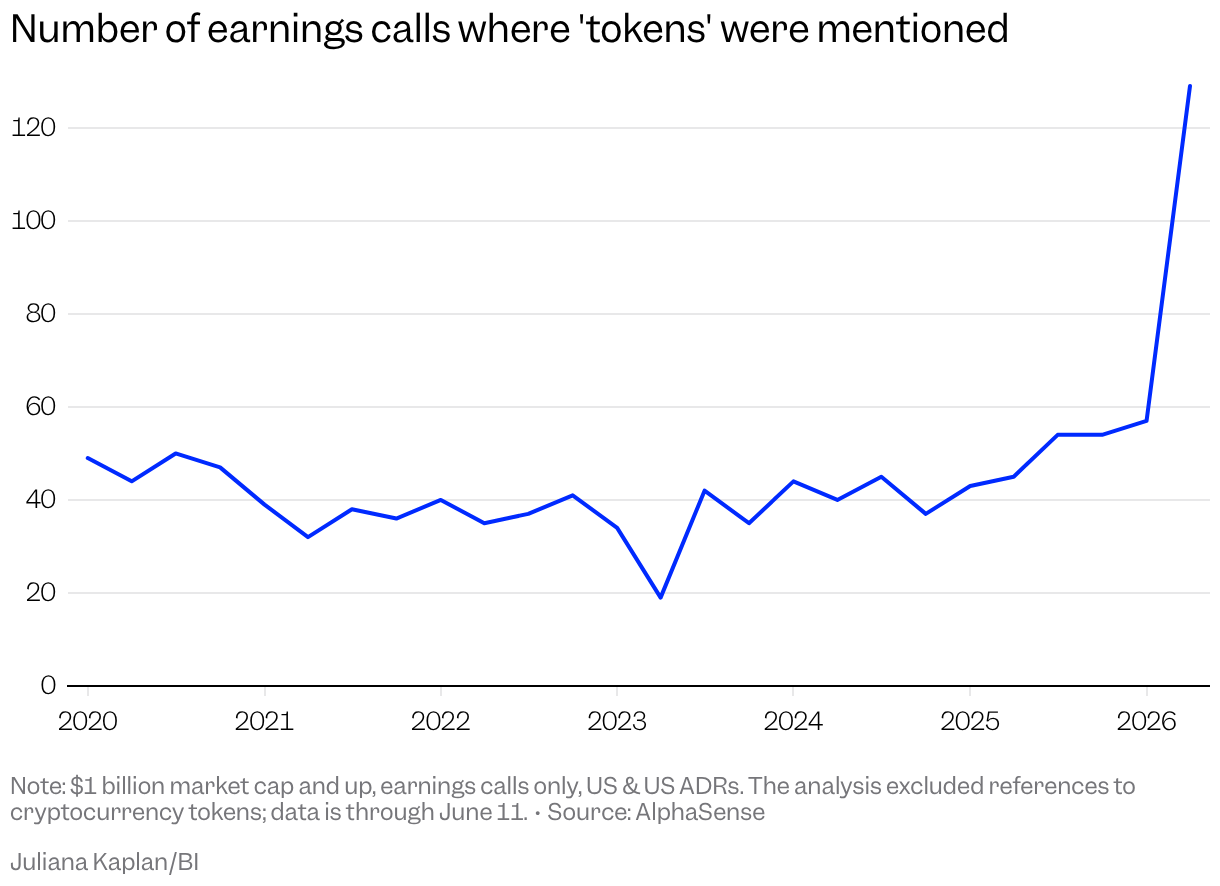
Within a matter of weeks, the belt-tightening began. Companies began putting AI budgets on a diet and setting token limits. Coinbase set a cap; so did Walmart. Amazon shut down its internal token leaderboard.
Kan still advocates for big per-engineer allowances — and wonders what workers will think of the rapid discourse shift. He worried that engineers would think: “My boss is adamantly pushing me to do one thing, then I did that thing, and now I’m getting yelled at because I did that thing too well.”
“I would definitely feel confused and angry if I were an engineer in those positions,” he said.
Leaders across industries — from financial giants like JPMorgan to media conglomerates like Disney — are working to develop cohesive, effective AI policies.
Some firms have always been anti-tokenmaxxing. The enterprise software company Pega is one of them. When I hopped on the phone in May with its CFO and COO, Ken Stillwell, he called the trend an “incredibly self-serving” narrative by the AI companies. His company didn’t set numerical token caps, but it did throttle requests that would spend in excess.
When we spoke a month later, as the discourse shifted, Stillwell felt vindicated. “We’re quite happy that we’re one of many talking about this,” he said.
AI spending also continues to soar
Technology and media companies spent an average of $66.29 per employee on AI in May, up from $58.84 in April, according to Ramp’s AI Index.
Ara Kharazian, its lead economist, told Business Insider he expected this metric to keep rising, but he spotted early signs of tightening, such as increased use of model routers, which can help better manage costs.
Some companies aren’t cutting AI budgets just yet, but they are thinking critically about head count. For instance, MindFort, a Y Combinator-backed AI startup, has six employees. Its CEO, Brandon Veiseh, said the company would’ve needed 20 employees pre-AI to reach its current scale. Where have those funds gone? Tokens.
Morgan Lieberman for BI
“We have to weigh our token-to-people ratio,” Veiseh said. “It’s not something we think is particularly comfortable or a great feeling to say.”
Even though token costs are expected to come down as AI companies like Google increasingly compete on price by offering smaller, more efficient models, these sorts of tradeoffs aren’t likely to go away. Often, the cheaper a resource is, the more of it is consumed.
For now, companies are thinking more critically and sometimes taking strategic steps back — but they’re hesitant to move too quickly. Kausas, Pylon’s CEO, said he wants to prioritize making sure there’s a return on investment — and avoid engineer backlash.
“If we told engineers that they were not allowed to use AI products, they would not work here,” he said. “It would feel like you were in the Stone Age.”
Dawn of the token Hunger Games?
As engineers increasingly learn they might have to battle for their token allocation, team infighting could grow.
Some have compared this to a survival-of-the-fittest scenario. “Coding is now cockroach protein bars and we’re all fighting for crumbs,” said one coder on X, comparing the dynamic to “The Hunger Games.”
Developers are also asking more about tokens during job interviews. Kausas said that applicants had asked him about budgets. AI advisor and AWS alum Allie K. Miller had heard of interviewees getting into the nitty-gritty: “What tier of model will I have access to? Do you have partnerships with AI labs that get us relatively early access?”
Morgan Lieberman for BI
It’s a sign of a new era where tokens — or at least the number workers want — aren’t guaranteed.
Max Christoff, the CTO of legal tech company Everlaw, made the case for giving engineers token caps, but letting them negotiate for bigger budgets. He compared it to using cellular data before unlimited plans. Sometimes you need to spend big on the data, but other times you mindlessly scroll, not realizing how much you’re wasting. Christoff wanted all of the former and none of the latter.
“We want to make it easy to ask for more if you can actually use it,” Christoff said.
If a company doesn’t set token caps, it may also set model restrictions. Russ Franklin, the founder of Larridin, a platform for tracking AI use, was emphatic. “Of course, they will limit who gets to use these tools. It’s not even a question,” he said.
Franklin compared allocating model access to taking a trip on the company dime. Many are allowed to book an economy flight, but few — if any — are allowed to charter a jet, he said. Access to cutting-edge AI models may be equivalent to the private jet: so expensive that only a few all-stars can do it.
Engineers have good reason to fight for their tokens. Having limited AI access could hurt them in the long run, leaving them less skilled or less marketable in future job searches.
Brock Simon advised companies on AI for Bain & Company before he founded his own startup, Native. He watched as some companies were slow to adopt the technology or restricted access to specific tools and agents, leaving their employees behind the curve.
“It really hurt some people’s careers,” he said.