
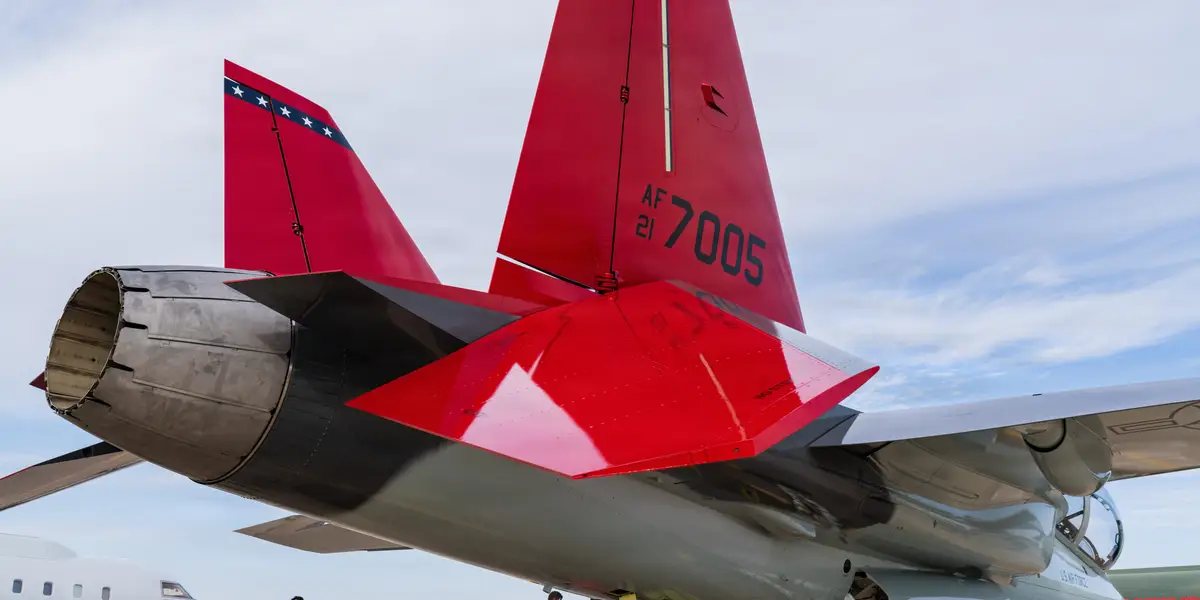
US Air Force pilots have a new training aircraft, the T-7 Red Hawk, promising to prepare them to fly fifth-generation fighters, stealth bombers, and the US’ planned sixth-generation fighter.
The first T-7 Red Hawk trainer, made by Boeing, arrived at Joint Base San Antonio-Randolph in Texas this month. The new training aircraft will replace Northrop Grumman’s T-38 Talon, which pilots have been training on for six decades. The Air Force no longer deems the trainer sufficient for preparing the service’s pilots for future warfare. That’s why replacing the outdated Talon has been on the Air Force’s to-do list for years.
“The T-38 has been life-extended multiple times,” said Brig. Gen. Matthew Leard, director of plans, program, requirements, and international Affairs for Air Education and Training Command, in a statement. “There’s an escalating cost of retaining the airplane and keeping it flyable,” he said, adding that the plane “is no longer aligned with current or future aircraft.”
In 2023, the Government Accountability Office, a government watchdog agency, reported the Air Force was relying on the aging T-38 as a new flight simulator was delayed by a decade and new training aircraft were being developed. The aircraft, the GAO said, “is increasingly expensive to maintain and is no longer reflective of modern combat aircraft.”
The Air Force sees the transition to the new T-7 Red Hawk as a fundamental shift in how pilots are trained for high-stress, modern air combat.
“From day one, students won’t just be learning to fly,” Maj. Gen. Gregory Kreuder, the 19th Air Force commander, said in a statement. They’ll be learning to manage information, interpret data from advanced sensors, and make critical decisions in a complex environment, all from within the trainer.”
“This aircraft,” he said, “enables us to close the gap between basic pilot training and the realities of fifth generation plus warfare, producing more capable, intuitive warfighters right out of the gate.”
US Air Force photo by 2nd Lt. Connor Brezenski
The new T-7 Red Hawk will teach pilots how to fly some of the most advanced aircraft the US has, like the Lockheed Martin F-22 Raptor and F-35 Lightning II stealth aircraft.
And under the hood of the sleek, red-tailed trainer is a flexible open design that can be updated with new features as they arrive. The trainer will also prepare pilots to fly aircraft still in development and testing, such as the new B-21 Raider stealth bomber and the upcoming sixth-gen F-47, which is being built by Boeing.
Along with the T-7 Red Hawk, new ground and maintenance training systems will help pilots build skills and keep aircraft mission-ready. A live-virtual-constructive setup — which links real flights and simulators into the same scenarios — will let the Air Force update training with new threats, platforms, and weapons without needing a new aircraft.
The Air Force still has several steps to take before the T-7 Red Hawk becomes operational.
The jet is still in development, and both pilots and maintenance personnel will need training on the systems. Instructor pilots will fly it first, with students following after. The T-7 is expected to reach initial operational capability in August 2027, with 14 aircraft expected at the 99th Flying Training Squadron at Randolph Air Force Base later that year. Until then, pilots will train on the T-6 Texan II.
Other Air Force bases, like Columbus in Mississippi, Laughlin in Texas, Vance in Oklahoma, and Sheppard in Texas, will get more T-7 Red Hawks in the following years.
“The aircraft delivery is the first physical representation of progress within the program,” Leard said.