
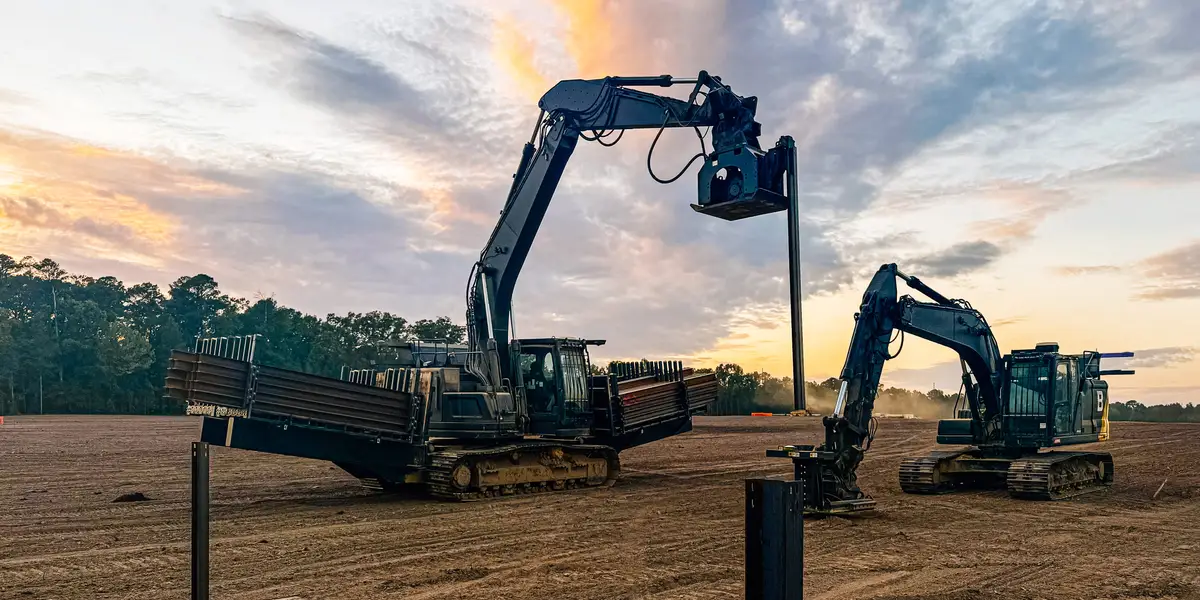
In a swampy stretch of northeastern Louisiana, large robots have taken over some of the grueling, repetitive work at a solar construction site spanning more than a mile.
The 72-ton machines are retrofitted with software and hardware from Built Robotics and can work upward of 12 hours a day, picking up and driving 200-pound steel beams into the ground.
Noah Ready-Campbell, the company’s cofounder and CEO, told Business Insider they are laying the foundation for the solar power infrastructure tied to Meta’s massive Hyperion AI data center in Richland Parish.
“The pressure is on to build out the grid at a pace we’ve never seen before,” Ready-Campbell said.
The Louisiana project is a glimpse of the future of construction unfolding in the present, with fewer workers handling dangerous, repetitive tasks by hand, and more autonomous machines taking them on to quickly build out new infrastructure.
Founded in 2016 and based in San Francisco, Built Robotics develops what Ready-Campbell called a “physical AI upgrade” for heavy equipment. The startup installs a mix of sensors, cameras, GPS, and software on machines from major manufacturers, including Caterpillar, enabling them to operate autonomously within defined work zones.
Built has completed over 40 deployments, primarily in utility-scale solar and data centers. The modified machinery can handle tasks such as pile driving, trenching, and pre-drilling — monotonous work that can come before installing solar panels or paving roads.
Courtesy Built Robotics
Built Robotics’ latest commercial milestone is a $75 million contract with Blattner Energy, a major renewable energy construction company. With Blattner, Built Robotics has been deployed across seven projects, and the latest deal will expand its nationwide deployments.
Robots working in knee-deep mud
One of Built’s current projects includes a solar power site that Ready-Campbell said will help power Meta’s Hyperion data center. The computing facility, which spans 3,650 acres, is expected to require roughly 2 gigawatts of power during the initial operating stage. Built is not a direct contractor for Meta.
A Meta spokesperson did not return a request for comment.
About 10 robots are working on a solar project in bayou country, handling more than half of the pile-driving scope and driving nearly 1,000 piles, or steel beams, a day, Ready-Campbell said.
The work can be physically demanding when done conventionally. A typical steel beam can be 14 feet long and weigh 200 pounds each. Ready-Campbell said workers may slide the beams off heavy equipment by hand or lift them just enough to rig a sling underneath before a pile-driving machine hoists them into place.
“This guy’s effectively having to deadlift half the weight of this beam,” Ready-Campbell said. “It’s really hard on your body.”
Built’s robots remove the workers from that process. No human is handling the beams, Ready-Campbell said.
The Louisiana site has also become a test of where robots can work when conditions are unsafe for people. Ready-Campbell described the location as a low, wet area, where workers can find themselves knee-deep in mud. The construction crews decided to put Built machinery in the swampiest parts of the project “because the robots don’t care.”
The autonomous machinery can work in the heat, darkness, and during a “lightning stand-down,” Ready-Campbell said, when crews pause work because of lightning risk. Human supervisors can monitor the machines from a safe location, such as a trailer.
Courtesy Built Robotics
The equipment does not operate fully independently of people. Ready-Campbell described the human’s role akin to a “robot foreman” — someone who manages and maintains the fleet, keeps the machines supplied with fuel and steel piles, and thinks ahead to keep production moving.
Built’s system also stops if a potential person is detected in the work zone.
“We have an AI model that we run on the robots,” Ready-Campbell said, “and we have it tuned deliberately to be, I would say, on the conservative side. So if it sees anything that it thinks might be a human, it’ll just stop the robot.”
Labor shortage drives adoption
With 10 robots at the Louisiana site, Ready-Campbell said a project with a conventional crew would require about 3 to 4 times as many crew members to complete the same amount of work.
The CEO stressed that Built’s pitch is not that construction work disappears. Instead, he said scarce workers will be shifted away from dangerous, repetitive work, while contractors can take on more projects.
It’s a viewpoint that robotics companies tackling other verticals, such as warehousing and manufacturing, have shared — an upskilling of the existing workforce while robots fill the labor gap.
The Associated Builders and Contractors estimated in January that the construction industry will need to attract 349,000 net new workers in 2026 to meet demand. A survey conducted by the Associated General Contractors of America last year found that construction workforce shortages are the leading cause of project delays, as recent Immigration and Customs Enforcement efforts affect nearly one-third of firms.
“I’ve been on projects where I’ve seen ICE come and pick people up,” Ready-Campbell said. “The labor shortage is a huge, huge problem.”
Courtesy Built Robotics
The AI boom has simultaneously put new pressure on the power grid as tech companies race to build out massive data centers. Ready-Campbell said developers are now looking for power “behind the meter,” or through dedicated energy infrastructure, because they can’t get enough electricity from the grid.
Demand is only part of the reason solar has become a natural beachhead for Built. Solar work is repetitive, large-scale, and the sites are often in remote locations. Solar is also a relatively new technology, Ready-Campbell said, meaning developers are better positioned for adoption.
“Since it’s a relatively newer type of construction, the people who are decision makers there are also a little more open-minded,” Ready-Campbell said.
Built Robotics has also tackled oil and gas, heavy highway construction, and residential and commercial building projects. Ready-Campbell said his startup’s work is part of a longer arc in construction, where new tools have gradually made back-breaking labor less punishing.
“A hundred years ago, if you needed to dig a trench, you’re probably going to do it with a pick and shovel and a bunch of guys and a wheelbarrow,” he said. “Nobody really wants to go back to that.”