
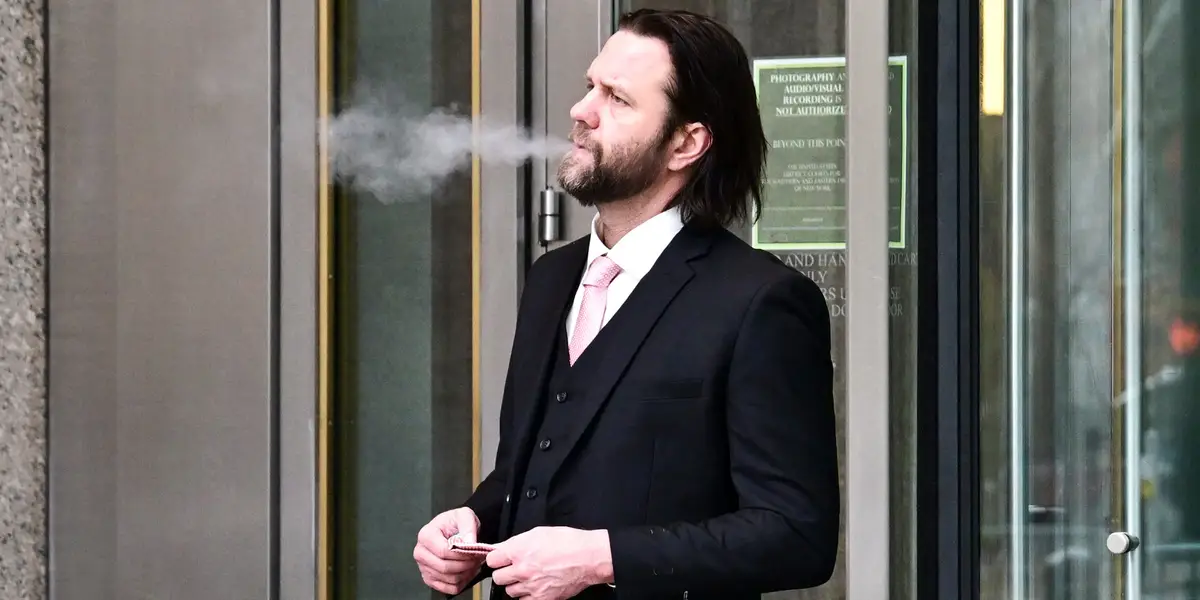
After Carl Rinsch got an infusion of $11 million from Netflix to finish his passion project — a futuristic television series — he could sleep well at night.
That’s partly because he bought a $439,000 handmade mattress on what prosecutors say was on Netflix’s dime.
At Rinsch’s criminal fraud trial in Manhattan federal court on Friday, jurors heard more about the director’s spending spree from some of the people who witnessed it firsthand. His former personal assistant testified that he compared himself to a character in a movie who had 30 days to spend $30 million — or lose it all. Prosecutors also called to the stand a salesman who waxed on about the handmade Swedish mattress he sold Rinsch, complete with a “sleep doctor” to massage it for him.
Rinsch liked the Hästens Grand Vividus mattress so much that he decided to buy a second one, the salesperson testified Friday.
Prosecutors in the US Attorney’s Office for the Southern District of New York allege Rinsch defrauded Netflix by misusing funds for the production of “White Horse” — a show about artificial beings who create their own society on Earth after a schism with humankind. Rinsch filmed portions of “White Horse,” but went over budget and never finished a single episode.
On Friday, jurors heard more testimony from Maria Skotnikova, who worked as a personal assistant for Rinsch and made logistical arrangements for the filming of “White Horse.”
Skotnikova said Rinsch made multiple luxury purchases after Netflix gave him an additional $11 million in March 2020 to finish the project, including a rush to buy Hermes goods.
“Get all that Hermes stuff now,” Rinsch told Skotnikova in one August 2021 text message sent to the jury.
“This is your job,” he texted her a short while later. “We have to do this. Or else the money goes bye-bye. Get it.”
According to Skotnikova, Rinsch compared his situation to “Brewster’s Millions” — the 1985 movie about a man who learns he received a $30 million windfall from a family member but must spend it all within 30 days. Skotnikova also testified Thursday about driving to meetings in Ferraris and Rolls-Royces, vehicles an FBI forensic accountant said Rinsch purchased using money that originally came from Netflix.
Skotnikova said Friday that Rinsch tried to purchase a large amount of furniture from the French designer Jacques Adnet, which he considered “interesting and underappreciated.”
Rinsch, known for directing “Ronin 47” with Keanu Reeves, wanted to have a “monopoly” on the designer’s furniture pieces so he could “control the price,” Skotnikova testified.
The spending spree also included over 480 food takeout orders on Postmates and Uber Eats in a six-month span in 2022. The FBI forensic accountant previously testified that Rinsch moved the funds from Netflix through different accounts, invested a portion of it in the stock market and cryptocurrency, and spent other amounts on what appeared to be personal uses.
‘Very special beds’
Later Friday, jurors heard from Johan Ericsson, who served as the top Hästens salesperson on the West Coast of the US. He said he met Rinsch in 2021, when the director went to the brand’s Los Angeles store.
Rinsch purchased four mattresses for a total of $617,610.66, records show. He received a discount because he bought floor models rather than having them individually handmade in Sweden, Ericsson said.
TORU YAMANAKA/AFP via Getty Images
The highlight was the Grand Vividus in the “black shadow” colorway. It was the top-of-the-line model that took over 700 hours to make, Ericsson said.
The Grand Vividus is not just a mattress, but a “sleep instrument” that includes a base and leather headboard, and comes with a “bed doctor” who visits your house to massage the mattress, according to Ericsson.
Rinsch was so pleased with it that he later modified his order to get an additional Grand Vividus mattress rather than three lesser Hästens models, according to Ericsson.
“These are two very special beds,” Ericsson said.
US District Judge Jed Rakoff, who is overseeing the trial, chastised prosecutors for allowing Ericsson to spend so much time on the witness stand waxing lyrical about the qualities of Hästens mattresses.
“I was going to call it a sales pitch, but he obviously deeply believes in the brilliance of these mattresses,” Rakoff said.
Ericsson said that Rinsch never spoke with him about using the mattresses for the production of “White Horse.”
Rinsch’s defense lawyers say he’s innocent, and the case is really about a “creative genius” who was overwhelmed by the challenges of the project and didn’t get the support he needed from Netflix.
In a deposition for a separate legal proceeding, which was entered into evidence in the criminal trial, Rinsch was asked why he purchased “a mattress that costs $450,000 for this production.”
“Because it retains value,” Rinsch said. “And a mattress that you spend $30,000 on is worth zilch, but a mattress that you spend $450,000 on — guess what? It’s worth a hundred grand more now. So hey, what are you gonna do?”
Prosecutors told Rakoff they expect to finish presenting their case on Monday. Rinsch — an engaged and jittery presence in the courtroom — hasn’t said whether he will take the witness stand while his lawyers present his defense case.