
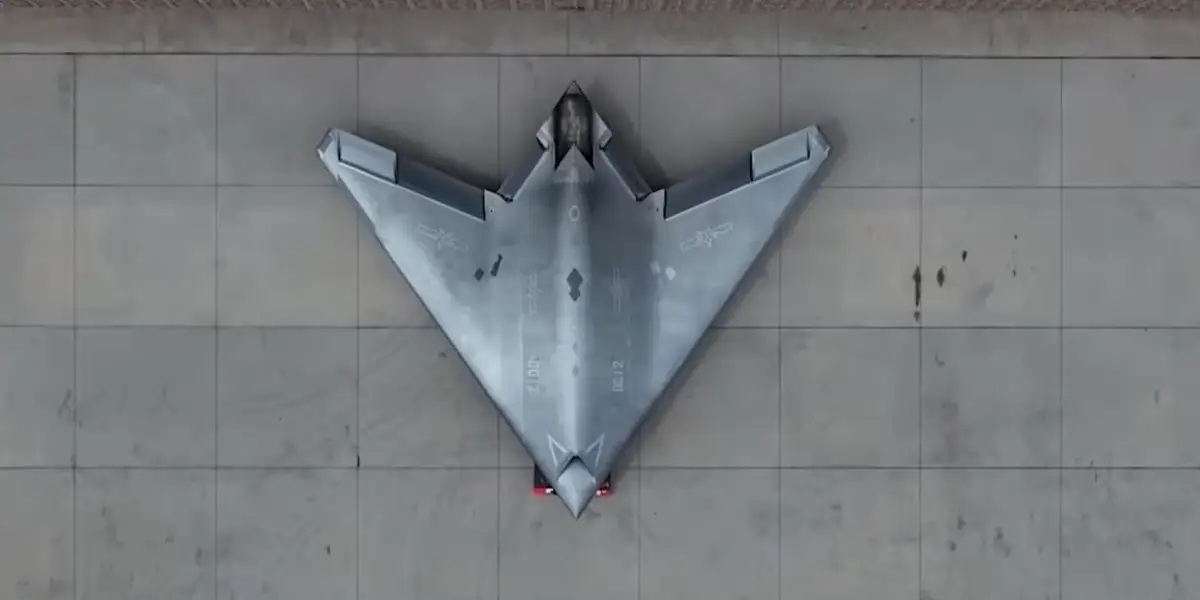
China has released its clearest footage so far of its high-end stealth strike drone, a system class that the US shelved about a decade ago.
State media outlet CCTV aired segments this week featuring the Gongji-11, or GJ-11, which translates to “Strike-11,” showing off its weapon bays, nose-mounted sensor, and landing gear.
Chinese forces first unveiled the tailless drone in 2019 at a national day parade in Beijing, then indicated in 2025 that it was in service by releasing footage of the GJ-11 flying alongside fighter jets.
But much of the drone had, until now, remained a mystery. This is the first time the People’s Liberation Army Air Force is publishing multi-angle, close-up views of the GJ-11, both on the ground and in flight.
With an estimated 47-foot wingspan, it has a stealthy airframe loosely similar to that of the B-2 Spirit bomber, sporting a flying-wing shape, a smooth, blended body without external weapons, aligned edges along its structure to reduce radar reflections, and an engine tucked inside.
What we can tell about China’s strike drone
Available information suggests Beijing wants this drone to primarily strike ground targets deep behind enemy lines.
In a TV segment aired on Wednesday, state media presenters said the GJ-11 can carry multiple guided bombs and precision-strike munitions for fortified ground targets such as command posts or air defenses.
While the new footage didn’t show the types of weapons the GJ-11 can carry, several clips did display the drone’s twin bay doors, which had sawtooth edges to help break up radar signals.
A nose-mounted sensor, which state media said was electro-optical and infrared, looks similar in shape and placement to sensors mounted on fifth-generation fighter jets such as the F-35 or China’s J-20.
People’s Liberation Army Air Force/CCTV Military
That can help the GJ-11 fulfill recon missions, which state media presenters said the drone could help crewed fighter jets with.
While China is touting the GJ-11 as a stand-alone strike platform, the drone is also designed to be a “loyal wingman,” working alongside crewed aircraft such as the J-20 stealth fighter.
People’s Liberation Army Air Force/CCTV Military
However, it’s unclear whether the drone is meant to engage in, or directly assist with, air-to-air combat. In the Wednesday segment, state media presenters said that when the GJ-11 is teamed up with a fighter jet, the crewed aircraft would clear the skies while directing the GJ-11 to hit “high-value targets.”
It’s also unclear whether the drone has any autonomous capabilities, a major priority for emerging air-war tech. Notably, this week’s published footage showed ground crews monitoring and controlling the GJ-11 from a mobile command trailer.
In fact, a separate CCTV report on Monday highlighted the role of human crews for the GJ-11, featuring two of the PLAAF’s first female drone operators launching a live-fire strike test with the system.
In October, China said it had developed a naval version of the drone, called the GJ-21, that successfully took off from an amphibious assault ship and returned. Its forces did not publish footage of said incident.
The American alternative
The US had explored similar stealth strike drones for decades.
The furthest it got — at least publicly — was with a demonstrator built by Northrop Grumman, the X-47B, which the Navy used to prove that a flying-wing stealth drone with internal weapons could take off from an aircraft carrier and refuel autonomously.
A successor built for military service was planned. But in 2016, the Pentagon shifted the program toward making a refueler aircraft, the MQ-25 Stingray, after much debate over whether a high-end, high-cost strike drone was needed.
Washington is now focusing on developing Collaborative Combat Aircraft, or sidekick drones for crewed fighter jets, flying ahead to engage air and ground targets, help surveil a larger area, and saturate the skies with more airframes for enemy defenses to deal with.
Stéphane Mouchmouche / Hans Lucas / AFP via Getty Images
Unlike a typical high-end stealth drone, these are meant to be attritable and mass-produced.
Russia, meanwhile, is looking into its own stealth deep-strike drone, the Sukhoi S-70 Okhotnik-B. While sporting a similar design, the Okhotnik appears to be in an earlier stage of development than the GJ-11.
In 2024, a prototype for the drone was mysteriously shot down over Ukraine by a Russian fighter jet. Western intelligence said it was likely Russia lost control of the Okhotnik-B and shot it down before it could travel further into Ukrainian territory.