
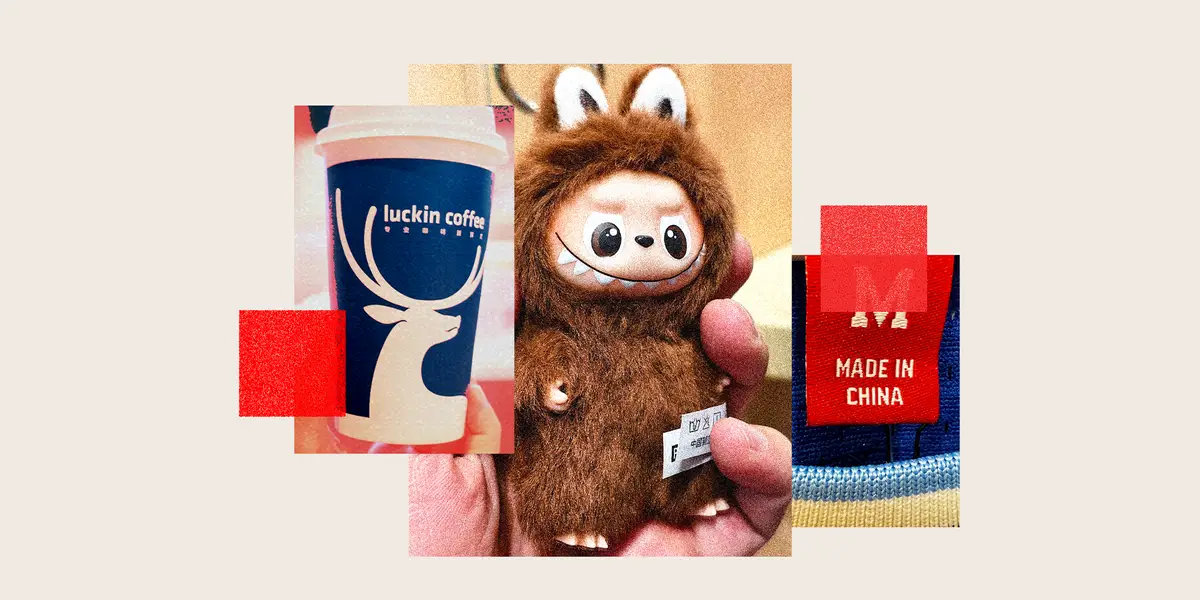
For nearly half a century, China has been the factory floor of the world, producing everything from iPhones to cheap sweaters. While the stamp “Made in China” has been ubiquitous on consumer products, the companies assembling the goods have been relatively obscure. Now, some of China’s hottest brands want you to know their names. They’re moving from the background of global commerce to the center of it, competing directly for consumers in the US, Europe, and beyond.
“They are already a major threat,” says Nirgunan Tiruchelvam, the head of consumer and tech equity at Hong Kong-based investment advisory firm Aletheia Capital.
The Fujian-province-based Luckin Coffee is testing markets long dominated by Starbucks, like New York, with app-based ordering and innovative limited-edition flavors like blood orange cold brew in America and pandan coconut latte in Southeast Asia. Fashion brands like Urban Revivo and Songmont are competing with global mid-end brands like Zara and Polène by offering lower prices. Pop Mart is transforming from a toy company to a global cultural force via their tiny, cute collectibles — most notably Labubus.
This isn’t the first time Chinese companies have tried to remake the global business landscape. In the 2000s, Beijing pushed some of its less sexy but state-backed industrial giants, like China National Petroleum Corporation and China Railway Construction Corp to “go out “abroad to secure resources and build infrastructure. In the 2010s, Chinese firms went on a global buying spree, snapping up everything from AMC Theatres to the Waldorf Astoria. More recently, companies like electric vehicle maker BYD and drone maker DJI proved that Chinese firms could compete globally by providing cutting-edge technology — not just lower prices.
The new vanguard of Chinese brands heading out to conquer the world is attempting something harder than getting in with the lowest price or newest tech: being cool.
The challenge of crafting an identity
If there is one thing that Chinese brands are known for around the world, it’s rock-bottom prices. The country’s best-known consumer brands, Shein and Temu, have gained a following for their lightning-fast delivery times and low cost. Despite tariffs, privately held Shein was expected to double its profits last year, while revenue for Temu parent PDD Holdings grew 10% — though profits fell 12% — over the same period.
Other Chinese brands trying to make the leap abroad have similarly gained attention for their value. Nowhere is this clearer than on social media, where users post unboxings of their Songmont bags, $1.99 Luckin beverages, and $1.19 Mixue ice cream.
“For the price, honestly not bad at all,” said Jon Barr, a New York City TikToker with 105,000 followers, after trying a $3.99 Taro milk tea and a $1.19 soft serve from fast-food chain Mixue that he said beat McDonald’s. He said he would be back.
Turning homemade brands into global cultural powers is also a survival tactic. China remains mired in a drawn-out economic slowdown, and its birthrate tumbled to a record low in 2025. China’s consumer market, once a seemingly endless engine of growth, has become crowded and unforgiving. Relentless “involutionary” price wars are eroding margins at home. Looking abroad is necessary if these companies want to grow.
Consumers are looking for something new, cool, and fresh, the country of origin is not very important.
Many of these companies are set up for success from an operations standpoint: Years of surviving one of the most competitive markets in the world have made them experts in manufacturing, sales, and scaling.
“China is transforming itself from a low-priced manufacturer into a producer of brands with unique personalities and storylines,” said Eunkyu Lee, a marketing professor at Syracuse University.
But whether they can become household names in categories where brand, identity, and perception matter is a different challenge.
National identities can help to turn mere merchandise into objects of meaning and desire, building geopolitical influence through commercial means. European houses have long hung their identities on heritage, craftsmanship, and luxury, while American brands export innovation, freedom, and optimism. Some of China’s neighbors have developed a national brand more recently. From the 1960s to the 2000s, Japan and South Korea moved from low-cost manufacturing to brand-led competition, à la Sony, Samsung, Nintendo, and Uniqlo. Japanese brands became synonymous with minimalism and precision. South Korean brands rode a wave of trend-driven pop culture.
China is now trying to do the same, but at a faster pace and without a clear answer yet to what the defining identity is. That matters because identity is what allows brands to move from being chosen for price to being chosen for passion.
Winning over global culture
So far, Chinese companies appear to be taking two distinct approaches toward globalizing their brands.
On the one hand, some companies are trying to soften or minimize their Chinese identity. Some of China’s biggest global consumer successes, from Shein to TikTok, became internationally popular not by emphasizing their origins, but by presenting themselves as internet-native global platforms. That strategy works especially well in an online culture where hype travels faster than provenance.
For younger consumers, the search for the new is constant. Brand discovery happens on TikTok, Instagram, RedNote (named Xiaohongshu in China), and other platforms. In that environment, it doesn’t matter where the product is from, as long as it’s hot.
“They are looking for something that is new, cool, and fresh,” Lee, the Syracuse professor, says. In that context, “the country of origin is not very important.”
Sportswear brand Li-Ning has gained visibility by sponsoring NBA players like Jimmy Butler and CJ McCollum, bringing Chinese-designed sneakers onto a global stage. That kind of cultural crossover is how brands begin to matter. Meanwhile, Pop Mart has collaborated with Disney and Sanrio’s Hello Kitty, placing its characters alongside some of the most recognizable names in global pop culture.
Winning attention is one thing — sustaining it is another. Many Chinese brands still rely on a familiar formula: good design, acceptable quality, lower price. That is enough to attract customers. It is not always enough to keep them. Even Pop Mart shares are already 20% lower this year amid fears it could be a one-trick pony built on Labubu.
“The danger is if you try to take on these Western brands with a me-too approach instead of coming up with your own answers,” Aletheia Capital’s Tiruchelvam says.
Michael Simon/Getty Images for POP MART
Meanwhile, other brands — Songmont, Laopu, and the tea chain Chagee — are doubling down on Chinese aesthetics, heritage, and ritual. A growing wave of online fascination with Chinese lifestyle and aesthetics — dubbed “China-maxxing” — suggests global consumers may be more open than before to brands that foreground, rather than soften, their origins.
There are signs that global players are starting to take notice. Songmont, an affordable luxury bag brand whose minimalist leather bags top out at around $800, draws inspiration from Chinese roots, with designs inspired by the roofs of a Buddhist temple and traditional kites. The 13-year-old brand has drawn the attention of LVMH CEO Bernard Arnault, who visited a Songmont shop — and bought two bags — during a September visit to Shanghai. During his trip, Arnault also visited Laopu Gold — dubbed the “Hermes of gold” in China — a jewelry shop specializing in handcrafted 24K gold pieces inspired by Chinese culture and symbolism, such as dragons and gourds. In mid-April, Gucci’s owner, Kering, announced that it would acquire a minority stake in Shanghai fashion brand Icicle — a high-end label often compared to Max Mara.
Both approaches can work — especially in an online culture that rewards what feels new, distinctive, and shareable.
Politics can’t stop personal choices
There is, of course, another issue that could complicate Chinese brands’ efforts to win over customers outside their home country: politics. Trade tensions have reshaped supply chains and put Chinese tech companies, such as TikTok, under scrutiny. BYD has expanded rapidly in Europe and South America, but is still locked out of the US due to prohibitively high tariffs. Tariffs have hit companies like Shein and Temu, but they haven’t stopped them. Instead, these companies are adapting — localizing operations and finding ways to stay competitive.
The new wave of Chinese companies attempting to crack the American and Western markets is better positioned — because they are also increasingly able to sell products as desirable cultural goods with real pricing power. And at the end of the day, policy can only slow desire for so long.
Governments will probably find it difficult to stop consumers from embracing Chinese brands, Lee says, in part because “these brands are largely detached from political issues.”
While politics may be a short-term hurdle, long-term success will depend on whether Chinese brands can cross over from being chosen because they are cheap or a novelty to being chosen because they are desirable brands.
“Success would be some of the brands achieving premium brand recognition among global consumers and being able to command a price premium,” Lee says.
That will take time, but the direction is clear: China has already changed how the world makes things with its ultra-efficient supply chains. Now it is trying to compete for what the world wants.
Huileng Tan is a senior business reporter based in Singapore, covering markets, the economy, and commodities.
Business Insider’s Discourse stories provide perspectives on the day’s most pressing issues, informed by analysis, reporting, and expertise.