
Starbucks receives more than a million job applications a year, the company’s Chief People Officer says one reason is a quietly powerful lure: the promise of a fully-funded bachelor’s degree from Arizona State University.
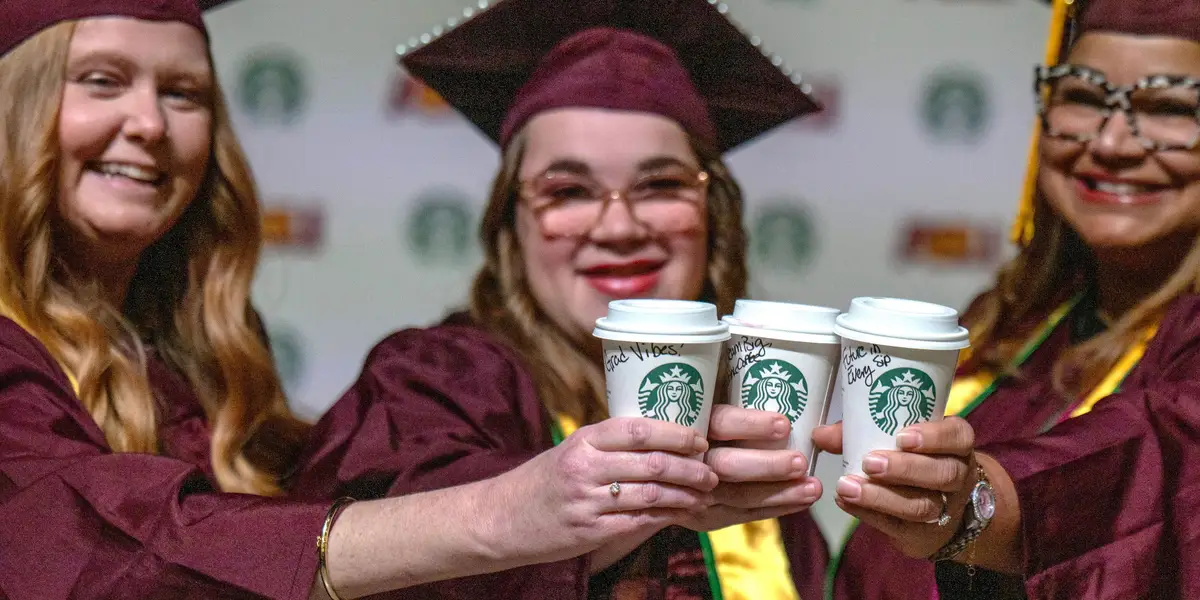
For Brea Yancey, a barista in Washington state who has worked at the company for eight years, that benefit hasn’t just reshaped her future — it reshaped her family’s. She enrolled, then inspired her mother, a Starbucks store manager, to join her, turning a workplace perk into a two-generation push toward a goal neither woman thought was financially in reach.
“I didn’t think college was going to be an option because of how much it costs with loans and things like that,” Yancey, who celebrated her graduation on Monday, told Business Insider. “I know it’s going to make all the difference in the world not having to worry about that.”
Yancey pursued a degree in interdisciplinary arts and performance, with the goal of becoming a music teacher. Her mother graduated last semester with a degree in interdisciplinary studies, concentrating in sales, marketing, and project management.
“I’m glad that she got to finish school, because that’s all she ever wanted, and she stopped originally because she got pregnant with me, but now we finished it together,” Yancey said.
As college costs have soared, so has enrollment in Starbucks’ College Achievement Plan (SCAP) program, Chief People Officer Sara Kelly told Business Insider. The program, which began in 2014, offers eligible employees 100% upfront tuition coverage for their first bachelor’s degree, facilitated through online classes at ASU.
“Over the last five years, we’ve seen a 60% increase in participation,” Kelly said. “We have 13% of our partners participating as scholars today.”
That represents at least one enrolled Starbucks staff member at about 90% of its coffeehouses, Kelly added.
Starbucks isn’t the only retail or Fortune 500 employer offering education benefits. Amazon, Walmart, and Chipotle also offer similar programs. However, compared to most programs in the US retail sector, Starbucks doesn’t require reimbursement of tuition payments or require students to stay with the company for a certain amount of time after graduation.
Younger students are increasingly questioning the value of a college degree. A May 2024 Deloitte survey found that a third of Gen Z and millennials chose to skip higher education due to rising costs, and the average price of attendance for a student living on campus at an in-state public 4-year institution is $108,584 over 4 years, according to Educationdata — so you can’t beat free.
“This started over 10 years ago, all in service of creating access to education, and the importance of creating access to education,” Kelly said. “College is incredibly costly, and so how do we create access to that education for all of our partners? So we’re really proud, because we see this as one of the most powerful expressions of our investment in our partners.”
Starbucks has expanded the SCAP program in recent years, offering access to more than 150 degree pathways, providing enrolled students with a broader range of fields to pursue than in the program’s early years. They’ve also added a “Pathway to Admission” support route for partners who don’t initially qualify for university admission, allowing them to take preparatory courses and earn their way into ASU. Additionally, a “plus-one” benefit is available for eligible military and veteran partners, extending SCAP to a qualifying family member.
This year, Starbucks introduced new study abroad and coffee education opportunities, offering a hands-on sustainability immersion at Hacienda Alsacia in Costa Rica, where scholars study climate, agronomy, and the future of coffee at their global research and development farm.
Of course, the students aren’t the only ones benefiting. The program is a significant retention win for Starbucks. Turnover is at record lows, Kelly said, and baristas who have spoken to Business Insider frequently cite the SCAP program as a reason they’ve stayed with the company.
The program also helps to strengthen Starbucks’ talent pipeline, as the company has committed to a 90% internal hire rate or fill rate for its retail leadership roles.
“Our Starbucks college achievement plan partners are part of our pipeline for those management roles, and we’re very excited about that,” Kelly said. “But do they have to stay with Starbucks? No.”
Starbucks has never considered adding a retention requirement to the program, Kelly said, because the company wants “to offer access to education that people can take with them on their journey, no matter where it takes them.”
For Yancey, her Starbucks journey is winding down, but it’s not over. She continues to work part-time as a barista and has a second job as a music instructor, while planning her next career moves.
“They find a way to make it work for whoever wants to go into the university through the SCAP program; they find a way for you to complete it,” Yancey said. “I don’t think finances or learning ability should hold anybody back, and they really delivered on that.”