
It takes airline pilots years to go from their first discovery flight to sitting in the cockpit of a commercial jetliner — and even then, the training never stops.
Much of a pilot’s professional life is spent outside the cockpit in high-tech simulators that mimic real flights. These giant boxes mounted on hydraulic legs allow pilots to safely train for stalls, engine fires, and other emergency scenarios in a controlled environment.
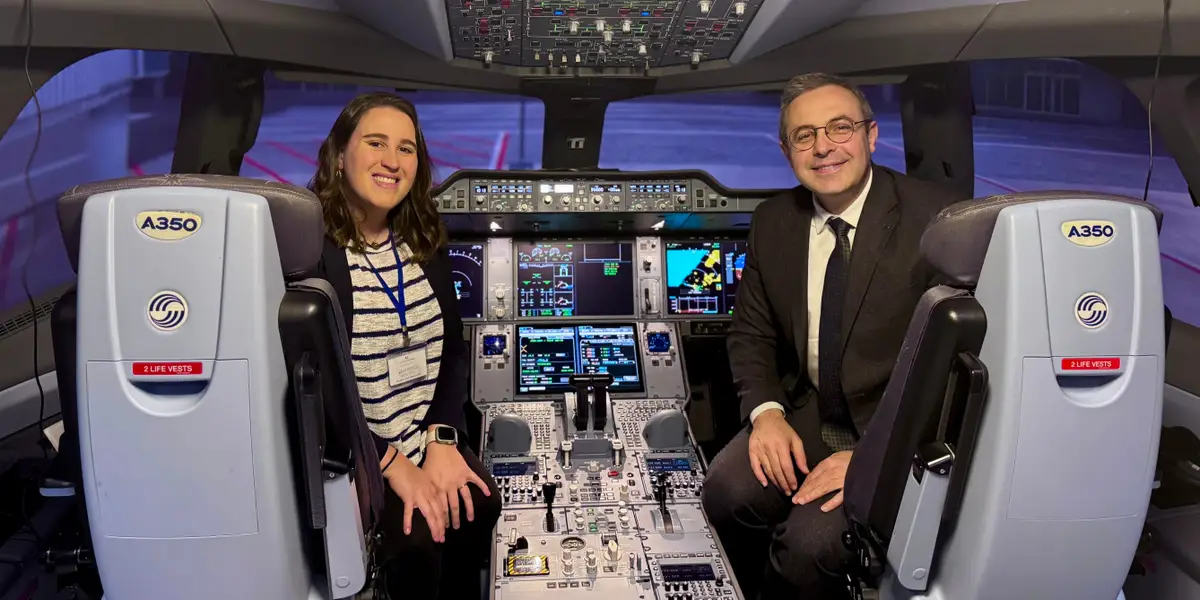
I recently flew an Airbus A350 simulator at Turkish Airlines’ flight training center in Istanbul. With the help of Captain Fatih Altunok, the SVP of flight training, I navigated airports, severe weather, traffic conflicts, and turbulence, and practiced takeoffs, landings, and emergency scenarios.
Taylor Rains/Business Insider
Like other major airlines worldwide, Turkish Airlines’ pilot training program is built around international standards that require thousands of hours of flight time, regular medical exams, and recurrent simulator checks to expose them to rare but high-risk scenarios.
Altunok said Turkish Airlines’ over 5,000 pilots (including 320 foreign pilots from 58 countries) each spend months in initial training before flying passengers, and must complete four hours of simulator training every 6 months for recurrent training.
US regulators mandate recurrent simulator training for airline pilots every six to 12 months, typically in one or more four-hour blocks.
Taylor Rains/Business Insider
Altunok said the flight simulator mirrors the exact configuration of a Turkish A350. I noticed that every switch, button, lever, screen, and alarm is carefully calibrated, and the legs tilt and lift the simulator to create lifelike movements throughout every phase of flight.
The wraparound screens were my only cue that it was fake. The visuals — simplified clouds, terrain, roads, buildings, and airports — aren’t photo-realistic, though that’s by design.
This imagery prioritizes stable frame rates and low latency while providing pilots with the critical visual cues needed to judge things like altitude, runway alignment, and weather.
Taylor Rains/Business Insider
Altunok said the simulator’s hydraulic system can’t reproduce every sensation of flight, but it uses a combination of motion, visual, auditory, and tactile cues to trick the brain, from normal takeoffs, landings, and turbulence to more extreme maneuvers — including flipping the jet upside down, which he even demonstrated.
The simulator I used was one of about 30 in use, run by a team of about 650 instructors. They run seven days a week, 365 days a year. The airline said in 2025 alone, the simulators trained 7,500 pilots individually (some more than once) and collectively ran for 160,000 hours — or over 18 years.
These sessions let airlines regularly assess pilot proficiency and reinforce their safety culture, while crew can fine-tune their skills. Here’s what it felt like to be at the controls.
The simulated jet felt massive and loud, even in the box
Even routine tasks revealed how technical the job is. Taxiing a half-million-pound plane from gate to runway requires constant adjustments, and the takeoff was more intense than I expected.
I fly as a passenger at least twice a month, so I know the feeling of a jet barreling down the runway, but the simulated engines felt surprisingly loud and powerful in that training box.
Altunok took the right seat and let me sit in the captain’s position on the left, talking me through the takeoff. I felt the runway bumps and a brief G-force as we lifted off — though even in an A350, you pull back on the sidestick more gently than you’d think.
Once in the air, we flew a virtual circuit around Istanbul. The screens recreated the landscape below, letting me look down on the city and the Bosphorus Strait as if I were actually above it.
Taylor Rains/Business Insider
I was given a very simple setup: just keep the plane on course using the sidestick while Altunok — who has flown Airbus and Boeing jets at Turkish Airlines for 20 years — handled the flaps, engine power, and the myriad other tasks required of the crew.
He eventually let autopilot take over. It was fun to watch the process and experience flying from a perspective that few travelers ever get.
I noticed the muscle memory pilots must develop between actually flying the plane, quickly flipping to certain checklists, and reacting safely to sudden alerts and emergency situations.
The instructor, who sits behind the cockpit with their own computer setup, sent a few my way.
I got a traffic alert that another plane came too close for comfort after takeoff. Sometimes this is just an alert; other times, the pilots are given a command to change altitude or adjust speed to avoid a collision.
When we were returning to Istanbul Airport in rough weather — turbulence and all jolting the jet — a loud, red “windshear” alert blared in the cockpit. Windshear is a sudden change in wind speed or direction, often near the ground, that can cause a rapid loss of lift and has caused past plane crashes. Airbus makes the warning nearly impossible to miss.
Taylor Rains/Business Insider
This alert cues a go-around, and Altunok instructed me to push the engines to full throttle and climb away from the runway; I could feel the engines rev. Pilots must instinctively do this within just a few seconds, then reconfigure the aircraft and communicate with air traffic control for another landing attempt.
Simulators also train pilots on automated systems. On one landing, Altunok set up and executed an auto-landing. Watching him manage it showed how pilots must prepare for low-visibility approaches and constantly monitor the technology.
Knowing that turbulence often feels more intense than it actually is, I asked the instructor to show me what extreme turbulence would be like.
I was bouncing in my seat, but it wasn’t difficult to keep my hands steady on the controls. The autopilot helped keep the jet stable, and we weren’t losing hundreds of feet of altitude with every bump, as some passengers fear.
Taylor Rains/Business Insider
Altunok said that in turbulence, the pilots’ main goal is to find smoother air — both to keep passengers comfortable and to avoid spilling coffee on their uniforms.
The rigorous simulator and overall training programs directly feed into the airline’s safety record. Turkish Airlines was named the safest in Europe and the 12th safest globally for 2026 by the aviation ranking website AirlineRatings.
The list considers factors like the number of flights, fleet age, safety audits, turbulence prevention, and pilot training. The carrier hasn’t had a crash in 17 years.