
What's Hot

    DOT Sec. Duffy sees “room” for extra airline M&A (DAL:NYSE) | Invesloan.com

    April 7, 2026

    Scranton Mayor Paige Cognetti faces scrutiny over border reversal | Invesloan.com

    April 7, 2026

    Anthropic Says Its Latest AI Model Is Too Powerful to Be Released | Invesloan.com

    April 7, 2026
    Facebook Twitter Instagram
    Finance Pro
    Facebook Twitter Instagram
    invesloan.cominvesloan.com
    Subscribe for Alerts
    • Home
    • News
    • Politics
    • Money
    • Personal Finance
    • Business
    • Economy
    • Investing
    • Markets
      • Stocks
      • Futures & Commodities
      • Crypto
      • Forex
    • Technology
    invesloan.cominvesloan.com
    Home » Inside the Pink Salt Mine Fueling a $500 Million Market | Invesloan.com
    Money

    Inside the Pink Salt Mine Fueling a $500 Million Market | Invesloan.com

    April 7, 2026Updated:April 7, 2026
    Share
    Facebook Twitter LinkedIn Pinterest Email

    Marketed as a premium, natural alternative to table salt, pink Himalayan salt can sell for up to 30 times the price. However, this salt doesn’t actually come from the Himalayas.

    Instead, the world’s largest deposit of pink salt — the Khewra salt mine — sits about 155 miles west of the Himalayas in Pakistan’s Punjab province, in a region known as the Potohar Plateau.


    Rolling hills of the Pakistan's Punjab province.

    Pakistan’s Punjab province where most pink salt comes from. 

    Business Insider


    Most of the salt mined in Khewra is exported to markets like the US and Europe. There, it’s often branded as “Himalayan” pink salt, named for the broader region than its exact origin.

    Still, demand for this premium product continues to grow. The global market for Himalayan salt was $523 million in 2025 and is projected to reach nearly $700 million by 2030, according to Grand View Research.

    Its popularity is driven in part by marketing. Influencers and wellness companies have promoted claims that pink salt can regulate blood sugar, improve sleep, and detoxify the body. However, scientists say there is no solid evidence to support this.


    Jars of Pink Himalayan salt branded with a picture of the Himalayan mountains.

    Don’t be fooled by the mountains on this packaging. 

    Business Insider


    Regardless, pink salt’s supply isn’t expected to go away anytime soon. The Khewra mine alone produces close to 400,000 tons of salt each year, and the reserves are large enough to last for centuries at current extraction rates.

    Business Insider visited the mine late last year to see how this salt is extracted, processed, and shipped to more than 80 countries worldwide for use in a wide range of goods, from edible salt to bath products and decorative lamps.

    The Khewra mine has been a source of salt for generations


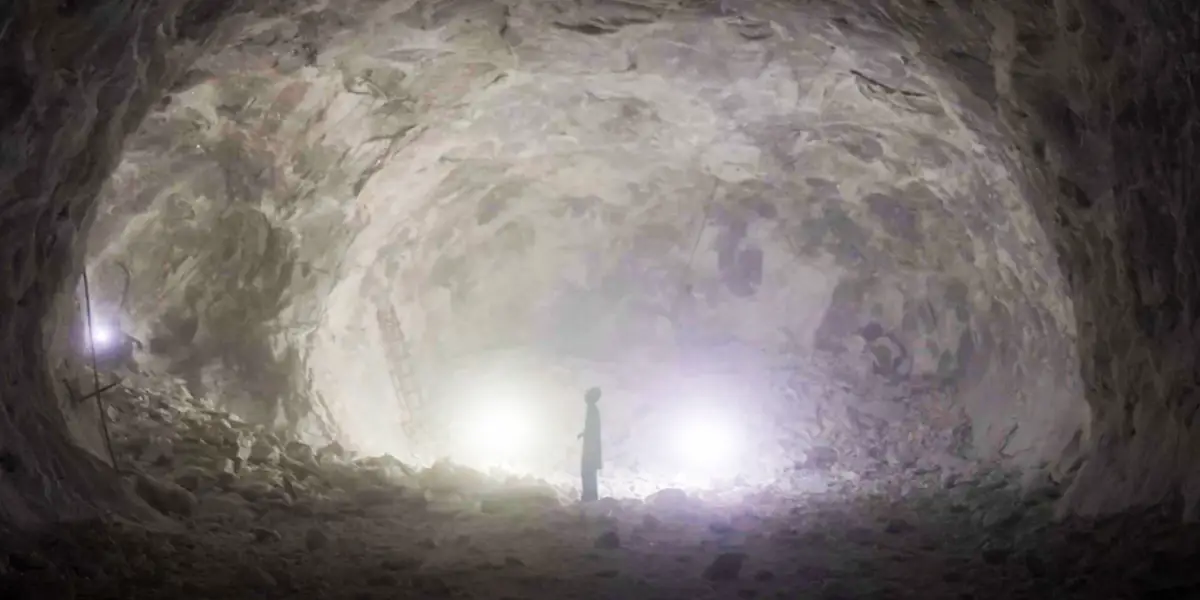
    A person standing in a salt mine in Pakistan.

    Workers blast open giant tunnels in search for premium pink salt deposits. 

    Business Insider


    Industrial-scale mining began in the 1870s during British colonial rule. After Pakistan gained independence in 1947, the government took ownership of the mine and continues to lease sections to private companies.

    Today, miners do not remove all of the salt; large portions are left behind to support the tunnels and prevent collapse.

    Inside, workers rely on a mix of modern geological surveys and techniques passed down through generations to identify high-quality deposits. Once they find one, workers drill holes about 4 feet deep into the rock and pack them with explosives by hand to blast the salt rock loose.


    Worker in no shirt and yellow helmet packs explosives into the side of a salt mine.

    A worker in the salt mine packs a hole with explosives. 

    Business Insider


    It’s a risky process and workers must wait about 30 minutes after each blast before reentering tunnels to check for misfires or unstable rock.

    After drilling and blasting, the large blocks are transported out through an extensive network of tunnels that spans about 25 miles across 17 levels. Some of the raw salt blocks that come out can weigh over 1,700 pounds, making them too heavy to lift without machinery.


    Trucks move large deposits of pink salt in Pakistan.

    Trucks and machinery help transport the giant salt blocks from the mines to processing plants. 

    Business Insider


    The risks don’t end in the mine

    Workers involved in processing the salt are also exposed to fine particles released during cutting and shaping.

    At one factory, drilling and cutting salt blocks can produce what workers describe as “salt fumes.” Over time, those particles can collect in the lungs and make it harder to breathe.


    A man cutting a pink salt block surrounded by debris and dust in the air.

    Cutting salt blocks kicks up a lot of debris into the air that workers breathe in. 

    Business Insider


    Workers use protective measures like water sprays, masks, and goggles to reduce exposure.

    Some of these blocks can still weigh up to 220 pounds, requiring careful handling to avoid injury. Workers use diamond-tipped blades to slice through the salt.

    Factories have begun automating parts of this workflow to increase output. The Ittefaq salt facility can process nearly 350 metric tons of salt per day.

    Pakistan’s fight for its share of the market


    Pile of pink salt blocks ready for processing.

    Blocks of pink salt prior to processing. 

    Business Insider


    For years, Pakistan exported much of its pink salt in its raw form, limiting the value it captured in the global market.

    Large volumes of unprocessed salt were shipped to India at low prices. There, it was refined, packaged, and sold to Western markets as a premium product — sometimes even labeled as “Made in India.”

    That meant much of the profit was generated later in the supply chain, outside of Pakistan, once the salt had been processed and branded.

    This dynamic began to shift in 2019, when political tensions between India and Pakistan escalated over the Kashmir region. Pakistan suspended bilateral trade, cutting off a key export route for raw salt.

    In response, local companies expanded their own processing capabilities.


    A person chisels down a piece of pink salt rock.

    More places in Pakistan now produce finalized pink salt products, like lamps. 

    Business Insider


    Instead of exporting raw blocks, more businesses began investing in equipment to grind, refine, and package the salt domestically. That allowed them to produce finished goods that could be sold directly to international buyers.

    It’s a gradual transition. Earlier processing facilities were less modern and, in some cases, lacked basic safety measures.

    Still, the shift marks a broader effort to retain more of the industry’s profits within Pakistan — moving from a supplier of raw materials to a producer of higher-value products in a growing global market.


    Share. Facebook Twitter Pinterest LinkedIn Tumblr Email

    Keep Reading

    Anthropic Says Its Latest AI Model Is Too Powerful to Be Released | Invesloan.com

    A-10 Warthogs the Air Force Wants to Retire Flew Iran Rescue Missions | Invesloan.com

    Bankrupt Saks to Sell Its Corporate Jet for $6 Million to Cut Costs | Invesloan.com

    Kanye West Blocked From Traveling to UK, Wireless Festival Canceled | Invesloan.com

    How I Got My 10-Year-Old Daughter Off Screens — Without the Tears | Invesloan.com

    Things Not to Do When Starting a New Job, According to Etiquette Experts | Invesloan.com

    Software Isn’t Dying, It’s Just Disappearing From Our View | Invesloan.com

    Why the US Would Risk so Much to Save a Pair of Downed Airmen | Invesloan.com

    Claude: What to Know About Anthropic’s ChatGPT Rival | Invesloan.com

    LATEST NEWS

    DOT Sec. Duffy sees “room” for extra airline M&A (DAL:NYSE) | Invesloan.com

    April 7, 2026

    Scranton Mayor Paige Cognetti faces scrutiny over border reversal | Invesloan.com

    April 7, 2026

    Anthropic Says Its Latest AI Model Is Too Powerful to Be Released | Invesloan.com

    April 7, 2026

    Ray Dalio says the Iran battle might evolve into the following world struggle | Invesloan.com

    April 7, 2026
    POPULAR

    China’s first passenger jet completes maiden commercial flight

    May 28, 2023

    Numbers taking US accountancy exams drop to lowest level in 17 years

    May 29, 2023

    Toyota chair faces removal vote over governance issues

    May 29, 2023
    Advertisement
    Load WordPress Sites in as fast as 37ms!
    Facebook Twitter Pinterest WhatsApp Instagram
    © 2007-2023 Invesloan.com All Rights Reserved.
    • Privacy
    • Terms
    • Press Release
    • Advertise
    • Contact

    Type above and press Enter to search. Press Esc to cancel.

    invesloan.com
    Manage Cookie Consent
    To provide the best experiences, we use technologies like cookies to store and/or access device information. Consenting to these technologies will allow us to process data such as browsing behavior or unique IDs on this site. Not consenting or withdrawing consent, may adversely affect certain features and functions.
    Functional Always active
    The technical storage or access is strictly necessary for the legitimate purpose of enabling the use of a specific service explicitly requested by the subscriber or user, or for the sole purpose of carrying out the transmission of a communication over an electronic communications network.
    Preferences
    The technical storage or access is necessary for the legitimate purpose of storing preferences that are not requested by the subscriber or user.
    Statistics
    The technical storage or access that is used exclusively for statistical purposes. The technical storage or access that is used exclusively for anonymous statistical purposes. Without a subpoena, voluntary compliance on the part of your Internet Service Provider, or additional records from a third party, information stored or retrieved for this purpose alone cannot usually be used to identify you.
    Marketing
    The technical storage or access is required to create user profiles to send advertising, or to track the user on a website or across several websites for similar marketing purposes.
    • Manage options
    • Manage services
    • Manage {vendor_count} vendors
    • Read more about these purposes
    View preferences
    • {title}
    • {title}
    • {title}