
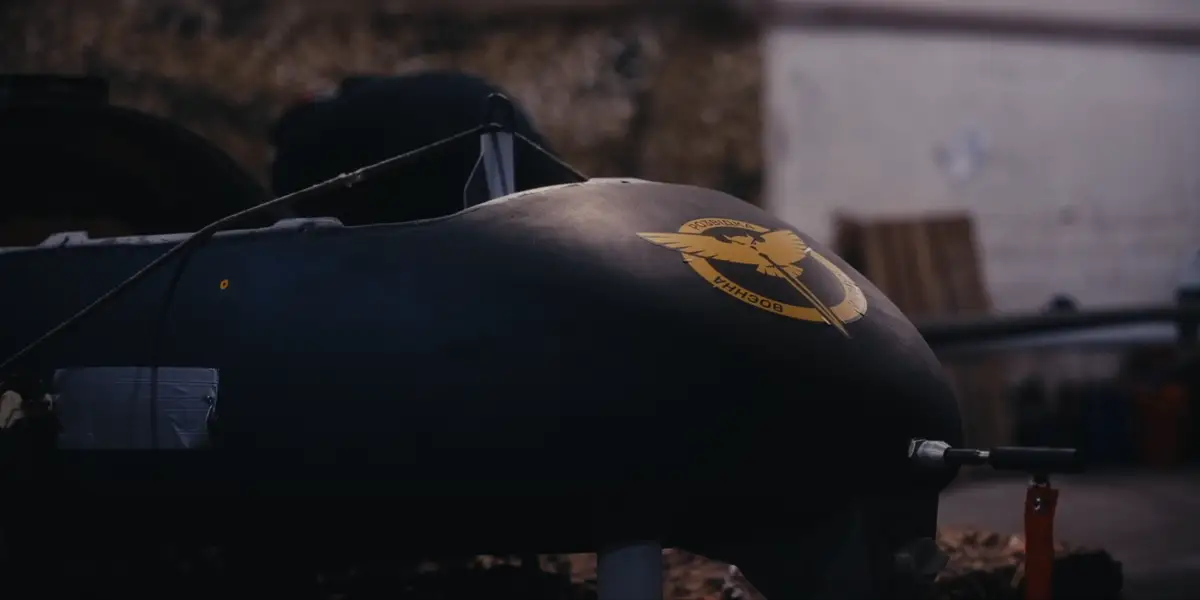
UNDISCLOSED LOCATION, Ukraine — At a secret warehouse, in the darkness of night, masked specialists from Ukraine’s military intelligence service GUR drill and hammer as they assemble a line of 15-foot-long aircraft. These are Ukrainian Liutyi long-range kamikaze drones, carrying explosive payloads of up to 150 pounds and capable of traveling nearly 1,300 miles. Later that night, they will be launched toward targets inside Russia.
“They are now our most important card in this war,” says a Ukrainian commander using the call sign “Vector,” as he taps the wing of one of the drones. He leads a unit specializing in so-called deep strikes — attacks conducted far behind Russian lines.
A drone campaign that began in early 2024 with only a few dozen aircraft per month has evolved into a large-scale operation. President Volodymyr Zelenskyy’s forces are now launching an average of 200 to 300 drones against targets in Russian territory every night.
On Thursday, Ukraine unleashed its largest attack yet deep inside Russia, targeting an oil refinery near Moscow. The explosions sent plumes of black smoke billowing above the capital’s suburbs and shut down flights at four airports for hours. Russian officials reported downing hundreds of drones in the skies above Moscow and other cities.
A reporting team from the Axel Springer Global Reporters Network, which includes Business Insider, was granted permission to observe one night of mission preparations earlier this month under restrictions aimed at protecting the unit’s security: Mobile phones were prohibited, the faces of intelligence personnel could not be filmed, and their voices must be altered in any video.
The intelligence officials explained that the attacks rely on a difficult-to-counter combination of explosive-laden long-range kamikaze drones, decoy drones designed to confuse air defenses and missile-type drones. Their primary targets are military installations and oil facilities — sites crucial to both the conduct and financing of Russia’s war effort.
“At the beginning, Russians believed they were conducting a special military operation. Now they understand that this is a war,” Commander “Vector” said. The message to Russia, he adds: “‘This war has now reached your homes as well.’ We hope that message helps Russia bring this war to an end.”
Viktor Lysenko/Business Insider
Zelenskyy is counting on the drone campaign shifting the war in Ukraine’s favor. He recently published an open letter addressed to Putin, urging him to engage in direct peace negotiations. He repeatedly referenced Ukraine’s drone strikes, including a similar attack on St. Petersburg on June 3 that embarrassed the Russian leader as he convened an economic summit beneath plumes of black smoke.
“As you know very well, that distance is not the limit of our capabilities,” Zelenskyy wrote, highlighting the consequences of the attacks for ordinary Russians: fuel shortages, rising prices and, not least, fear.
“They do not like our drones and missiles,” Zelenskyy said in the letter. The Ukrainian leader has spent recent weeks cheekily describing the attacks as “long-range sanctions.”
Ukraine’s long-range drone campaign is already producing measurable economic consequences inside Russia. During the St. Petersburg summit, Deputy Prime Minister Alexander Novak acknowledged publicly for the first time that Russian oil production has declined since the beginning of the year. He attributed the slowdown to unscheduled maintenance work at refineries — a bureaucratic euphemism for facilities damaged by Ukrainian drone strikes. Several major refineries in central Russia have been forced to reduce output or suspend operations altogether after coming under attack.
Ben Hodges, former commanding general of the US Army Europe, argues that Russia’s greatest strength through the centuries is now its disadvantage: its vastness.
“Now, because of what Ukraine has accomplished in terms of long-range precision strike, what once was Russia’s strength is now a major vulnerability,” he says in an interview. “They cannot protect everything. Every refinery, every shipyard, every factory — everything — is now reachable, including targets [in Siberia].”
Military analyst Franz-Stefan Gady, who regularly visits Ukrainian units near the front, argues that Russia faces a structural disadvantage in a drone war because of its continental scale.
“The cost asymmetry is turning against the defender,” Gady says.
To be sure, Russia’s economy remains a long way from collapse. Yet attacks on refineries are no longer producing only dramatic images of towering fireballs and black smoke. They are beginning to create tangible disruptions across parts of the Russian energy sector.
Industry data and market assessments suggest that repeated strikes have periodically sidelined a significant share of Russia’s oil-product export infrastructure this year, forcing operators to adjust production schedules and redirect supplies. The effects are increasingly visible beyond industrial facilities themselves.
“We know from history that war is a test of will, but it’s also a test of logistics. The Ukrainians are hammering Russian logistics,” Hodges says.
Still, Russia has recently benefited from geopolitical developments. The war between the United States, Israel and Iran has pushed global oil prices higher, providing Moscow with an unexpected financial boost. Russia’s increased state oil and gas revenues — which account for roughly one-fifth of total budget income — have helped offset at least part of the economic pressure generated by sanctions and Ukrainian strikes.
‘We know how they move’
Viktor Lysenko/Business Insider
It is just before midnight inside the warehouse when technicians from Ukraine’s military intelligence service fasten the final bolts onto the long-range drones.
Depending on the model, some can now travel as far as 2,000 miles and carry payloads of more than 500 pounds, according to Commander “Vector.”
“Be assured that we can reach any location up to the Urals,” he says, naming the mountain range that marks the eastern edge of European Russia and the beginning of Siberia. “And with a bit of luck, perhaps even beyond.”
The cost of each drone is estimated at roughly $230,000, although the price varies depending on the configuration.
Russia has struggled to stop the attacks because Ukraine has continuously adapted its operational methods. Night after night, under cover of darkness, multiple small teams disperse across the country — often in eastern Ukraine — to launch drones from different locations.
“If the Russians destroy some launch sites or a few individual drones, we still have 10 or 20 others. That is very important for us,” Commander “Vector” says.
The approach resembles a form of guerrilla warfare that fits Ukraine’s broader strategy of asymmetric conflict and is difficult to counter.
A few meters away from the larger aircraft lie smaller decoy drones that carry no explosives. During attack missions, they are often launched first to occupy and confuse Russian air defenses. Ukraine also says it employs so-called missile drones as part of its combined strike packages. These weapons are several times faster than the Liutyi drones.
Viktor Lysenko/Business Insider
Technicians from the GUR are preparing several of them for launch alongside the larger aircraft. They call the jet-powered model “Peklo” — Ukrainian for “Hell.”
“It is extremely precise and extremely fast… Thanks to a special navigation system and a specially developed antenna, it can strike even very small targets with high accuracy,” explains a Ukrainian technician using the call sign “Logist.”
Markus Reisner, an Austrian colonel and military analyst, believes Russia’s air defenses are increasingly overwhelmed by the scale and complexity of the attack waves. Drones guided by artificial intelligence are also resistant to electronic jamming, he notes, neutralizing what has so far been one of Russia’s most effective defensive capabilities.
How data-driven Ukraine’s drone campaign has become is evident in a side room of the warehouse.
There, military intelligence pilots are planning the routes for the drones scheduled to strike targets inside Russia later that night. Their screens display a constant stream of real-time information: weather conditions, Russian positions and flight data.
Viktor Lysenko/Business Insider
“For every day and every hour, we know how they move their air-defense systems and electronic warfare assets. Every night we use different flight routes. We never repeat them,” says “Vector.”
“Prisma,” the AI-assisted software at the heart of Ukraine’s drone campaign, processes real-time data on flight paths and Russian air defenses.
At the heart of the operation is an AI-assisted software platform called Prisma, which integrates battlefield data into a continuously updated operational picture. The experience and data collected during countless missions have become one of Ukraine’s most valuable assets, the commander says.
“We can compare routes and operations from different years. We know which corridors work best.”
Ukrainian long-range drones have now penetrated even the heavily protected Moscow region. When was the last time he personally planned an attack on Moscow, we ask “Vector.” Unfortunately, he says, he cannot discuss that publicly.
For the first time all night, he bursts out laughing.
Ibrahim Naber is a foreign correspondent who has reported from Ukraine since 2022. In October 2025, he and his team were injured in a Russian Lancet drone strike in Dnipro. In 2025, he received the George Weidenfeld Prize for his coverage of global conflicts and crisis zones. He wrote his dissertation at King’s College London on the psychology of modern drone warfare.
This story originally appeared on POLITICO and is courtesy of the Axel Springer Global Reporters Network, which harnesses the resources of the company’s newsrooms to publish ambitious scoops, investigations, interviews, opinion pieces, and analysis. It allows journalists — including those from POLITICO, Business Insider, WELT, BILD, Onet, and Fakt — to collaborate on major stories for an international audience of hundreds of millions across platforms.

