
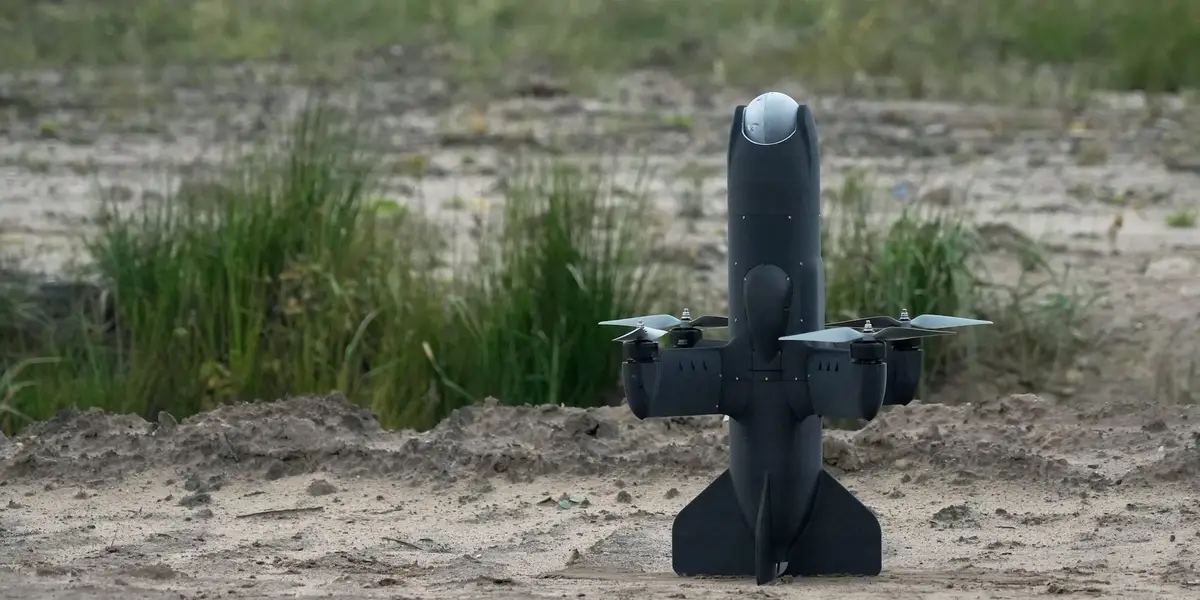
A drone maker that’s been arming Ukraine and designing systems to protect NATO says it’s learned what the alliance, especially allies sharing a border with Russia, will need to fight — and win — a war.
Drone maker Origin Robotics, which is based in Latvia, one of NATO’s smaller eastern edge allies bordering Russia and Belarus, is among those considered most at risk of a potential Russian attack. Facing a growing threat, countries along that frontier have played an outsized role in shaping NATO’s urgency toward Moscow.
CEO Agris Kipurs recently told Business Insider that these smaller front-line states need to invest in autonomy and lower-cost ways to take down enemy mass.
These are the kind of solutions that the technology company is working on. It has supplied some systems to Ukraine and has R&D contracts with Latvia’s defense ministry. And Belgium recently agreed to buy Origin’s interceptors.
Origin Robotics produces autonomous aerial and airborne systems, including an AI-enabled drone interceptor called BLAZE and a drone-launched precision-guided weapon known called BEAK. The latter is in use in Ukraine.
Janis Laizans/REUTERS
Kipurs said the company is using Ukrainian feedback to shape how it’s building its new systems with NATO in mind. “We take the learnings of Ukraine, but we adapt those weapons systems specifically to be used in a NATO country,” the market they are building for, he said.
Western militaries see real-world experience from Ukraine as key for industry. Luke Pollard, the UK’s armed forces minister, said earlier this year that any Western drone companies that don’t have their gear in Ukraine “might as well give up.”
A need for autonomy
Russia has one of the world’s largest armed forces. In Ukraine, Russia has shown a willingness to send waves of soldiers forward to relentless stress and overwhelm defenses — tactics often described as “meat waves.” It has roots in Soviet doctrine, though it’s not a 1:1 comparison to the fatal forward charges of the Second World War.
Smaller militaries with fewer troops can counter that mass with autonomy, Kipurs said. That kind of tech allows armies to be bigger than their numbers. Autonomy can give life to drone swarms, converting a single operator into an army of their own.
“For a NATO country, you need a scalable solution,” he said. Compared to Russia and Ukraine, “our armies, in terms of head count, are a lot smaller.” The alliance as a whole commands substantial forces, but force multipliers like autonomy can make alliance military might much greater.
“We have to build systems which can be deployed within a smaller army where one operator has to accomplish way more than an operator in Ukraine is accomplishing,” he said. “And pretty much the only answer to that is autonomy.”
Autonomy allows militaries to scale, Kipurs explained. “We don’t have the numbers in terms of infantry, in terms of any army operator. So they have to be able to accomplish more.”
Ukraine, one of Europe’s largest countries, is still struggling against Russia’s superior manpower and is increasingly turning to autonomy to offset that disadvantage. It also wants technology that protects operators by keeping them farther from the front lines, a crucial need as drone pilots have become top Russian targets.
Low-cost counters
Kipurs said finding cost-effective ways to stop large-scale attacks is also critical for nations with limited budgets, not just smaller militaries.
Kostya Liberov/ Libkos via Getty Images
A key Russian tactic has been launching massive drone and missile barrages across Ukraine. This is something the West is increasingly worried about, with many officials acknowledging a gap in its defenses. There are not enough air defense systems, particularly affordable ones. It’s not sustainable to fire a $4 million Patriot missile at a Russian drone worth only thousands.
Kipurs said that “when you look at the current offering for precision strike technology or weapon systems that can deliver precision strikes at the lowest end, you are talking hundreds of thousands per one successful strike.” Some missile systems are worth millions, which is what higher-end interceptors are made for.
In Ukraine, both sides have recognized that exquisite precision strike capabilities are simply not sustainable in the long run, so they’ve been augmenting barrages with cheaper drones and loitering munitions.
It’s cheap mass, not the expensive weapons that top armies have prioritized for decades. Addressing this problem, Kipurs said, is an “opportunity” for European entrepreneurs.
Front-line perspectives
Latvia and its neighbors, countries at risk that have grappled with Russian hybrid attacks and airspace violations, warned early on that Russia posed a threat and are now among Ukraine’s strongest backers.
They’re also some of NATO’s most vocal members, warning that Moscow could strike elsewhere in Europe. These nations rank among the alliance’s top defense spenders relative to GDP and have built new border defenses to blunt any potential attack.
They’re protected by NATO’s mutual-defense clause — it essentially states an attack on one is an attack on all — meaning that despite their small size, they have the backing of major militaries like the US, UK, and Germany.
But officials in these countries remain concerned about how quickly NATO could respond, insisting that Russia must not be allowed to seize even an inch of territory. That urgency is driving them to build stronger deterrents and homegrown defenses, a focus shared by companies like Origin Robotics.
The uncertain state of the US commitment to NATO and European security has only heightened those concerns across the region.