
What's Hot

    Top dividend development shares underneath $10 embrace Diversified Healthcare, Industrial Logistics & extra | Invesloan.com

    November 26, 2026

    Navigating Thanksgiving on GLP-1 medication with out insulting your vacation host | Invesloan.com

    November 26, 2026

    Visiting My College Town After Graduating Felt Different Than Expected | Invesloan.com

    November 26, 2026
    Facebook Twitter Instagram
    Finance Pro
    Facebook Twitter Instagram
    invesloan.cominvesloan.com
    Subscribe for Alerts
    • Home
    • News
    • Politics
    • Money
    • Personal Finance
    • Business
    • Economy
    • Investing
    • Markets
      • Stocks
      • Futures & Commodities
      • Crypto
      • Forex
    • Technology
    invesloan.cominvesloan.com
    Home » Naval Drones Alongside Warships Isn’t Always the Solution, Report Says | Invesloan.com
    Money

    Naval Drones Alongside Warships Isn’t Always the Solution, Report Says | Invesloan.com

    November 26, 2026
    Share
    Facebook Twitter LinkedIn Pinterest Email

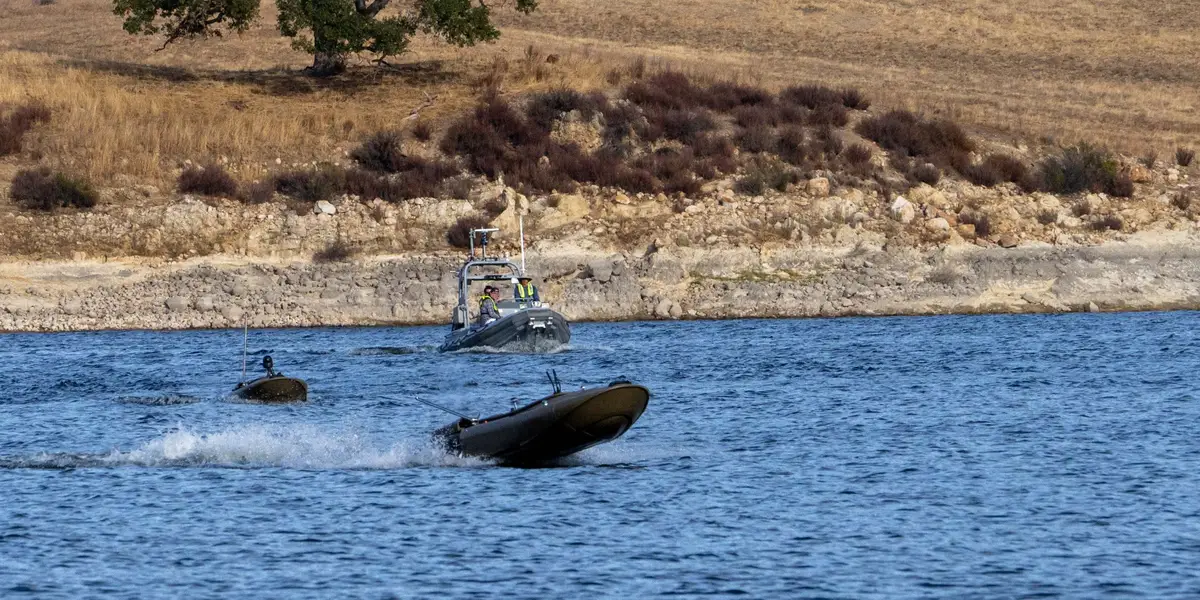
    The US Navy wants naval drones to help its crewed warships do more, but a new report argues that making them work together might not always be the best approach.

    Sometimes, drones might prove more useful on their own, defense analysts wrote.

    The US military has experimented with crewed-uncrewed teaming for years, focusing on how uncrewed systems can complement crewed naval elements by extending reach, sensing, and firepower. But forced manned-unmanned teaming can limit their biggest advantages, specifically their flexibility and the ability to take risks that humans can’t.

    In a new report from the Hudson Institute think tank, authors Bryan Clark, David Byrd, and Dan Patt analyze the Navy’s plan to grow the fleet, proposing a more affordable design and structure that adapts to new threats and embraces emerging technologies.

    Discussing a new theory of victory for the Navy, the authors argue that pairing crewed and uncrewed platforms “tend to suboptimize both the manned and unmanned components of the team and fail to exploit the advantages of each.”

    For example, uncrewed ships could carry additional munitions for crewed vessels, but limitations in speed, range, and protection could demand more frequent refueling and the use of defensive escorts, potentially defeating the purpose of using a naval drone in the first place.

    Furthermore, drones that aren’t equally low-observable could compromise nearby stealthier platforms, while fixing that could get expensive, sacrificing their affordability.

    Meanwhile, deploying drones alongside crewed warships could undermine the ability to quickly modify and adapt the uncrewed systems.

    “Manned platforms cannot change sensors, EW [electronic warfare] systems, C2 [command and control] software, or weapons quickly because engineers need to assess the impact on safety and other systems,” the report says.

    Want more Business Insider in your news feed?

    Add BI in Google so our reporting is easier to find when you’re searching for what matters.

    Autonomous systems can be modified much faster but could be subject to the same limitations if operating nearby.

    Clark, Byrd, and Patt provided several real-world examples that demonstrate how uncrewed technologies can operate as independent units. Over the past year, for instance, Ukrainian troops have expanded their use of uncrewed ground vehicles (UGVs) for logistics and medical evacuations, as well as engineering and fire support.


    A Ukrainian soldier stands near a ground drone that is carrying multiple small aerial drones.

    Ukraine has increased its employment of ground robots throughout this year, especially for logistics operations and medical evacuations. 

    Dmytro Smolienko/Ukrinform/NurPhoto via Getty Images


    “These operations deliberately use unmanned systems for operations or in places where the Ukrainian commanders do not want to risk human troops, increasingly producing a human-free front line,” the authors write.

    In less-contested environments, soldiers and ground robots can work together, but communications problems, difficult terrain, and the need to refuel and repair robots can complicate operations, potentially putting accompanying troops at risk.

    The authors argue that the more hands-off approach to uncrewed systems could help the US military counter a Chinese invasion of Taiwan.

    According to the Hudson report, recent Navy Integrated Battle Problems examining a potential Chinese invasion have experimented with using autonomous systems in ways that draw on lessons from Ukrainian, Iranian, and Houthi operations.

    “By attacking troop transports and their escorts with drone boats, undersea vehicles, and loitering munitions, a force of mostly RAS [robotics and autonomous systems] could slow or disrupt the invasion. This would give US and allied forces targeting information and time to destroy PLA [People’s Liberation Army] ships with long-range missiles and torpedo fires,” the authors write.

    US military officials have also explored using large numbers of drones to disrupt Chinese invasion forces in the Taiwan Strait. Adm. Samuel Paparo, the head of US Pacific Command, has referred to it as an “unmanned hellscape” that would effectively act as a first line of defense and buy US, allied, and partner forces time to respond.

    Clark, Byrd, and Patt’s observations come as the US military figures out the roles of uncrewed systems and autonomy and when it’s better to use them together with crewed assets or independently. The Navy has looked at drone boats for port security and also used them for rescue and attack missions in the Middle East.

    The Hudson report’s argument isn’t that drones should never work alongside crewed ships, but the Navy could get more out of them by giving them missions that take advantage of what they can do on their own.


    Share. Facebook Twitter Pinterest LinkedIn Tumblr Email

    Keep Reading

    Visiting My College Town After Graduating Felt Different Than Expected | Invesloan.com

    Macy’s Thanksgiving Parade Replaced on NBC With Rerun of Last Year’s | Invesloan.com

    Bird-Watching in ‘GTA 6’ Has the Seal of Approval From Top Birders | Invesloan.com

    Gen Z Entrepreneur on Why He Didn’t Follow Traditional Career Advice | Invesloan.com

    AWS VP Shares the two AI Mistakes He Sees in Job Interviews | Invesloan.com

    Bad Weather Has Wreaked Havoc on Macy’s Thanksgiving Day Parade within the Past | Invesloan.com

    A Massive Storm Is Barreling Toward the East Coast on Thanksgiving Day | Invesloan.com

    Dario Amodei Calls Out Rival AI CEOs Over Their AI Messaging | Invesloan.com

    Jensen Huang’s Message to Nvidia – We Don’t Need a Plan B | Invesloan.com

    LATEST NEWS

    Top dividend development shares underneath $10 embrace Diversified Healthcare, Industrial Logistics & extra | Invesloan.com

    November 26, 2026

    Navigating Thanksgiving on GLP-1 medication with out insulting your vacation host | Invesloan.com

    November 26, 2026

    Visiting My College Town After Graduating Felt Different Than Expected | Invesloan.com

    November 26, 2026

    Vitalik Buterin Is Designing Chips: Could Ethereum Become a Hardware Company and Overtake Nvidia? | Invesloan.com

    November 26, 2026
    POPULAR

    China’s first passenger jet completes maiden commercial flight

    May 28, 2023

    Numbers taking US accountancy exams drop to lowest level in 17 years

    May 29, 2023

    Toyota chair faces removal vote over governance issues

    May 29, 2023
    Advertisement
    Load WordPress Sites in as fast as 37ms!
    Facebook Twitter Pinterest WhatsApp Instagram
    © 2007-2023 Invesloan.com All Rights Reserved.
    • Privacy
    • Terms
    • Press Release
    • Advertise
    • Contact

    Type above and press Enter to search. Press Esc to cancel.

    invesloan.com
    Manage Cookie Consent
    To provide the best experiences, we use technologies like cookies to store and/or access device information. Consenting to these technologies will allow us to process data such as browsing behavior or unique IDs on this site. Not consenting or withdrawing consent, may adversely affect certain features and functions.
    Functional Always active
    The technical storage or access is strictly necessary for the legitimate purpose of enabling the use of a specific service explicitly requested by the subscriber or user, or for the sole purpose of carrying out the transmission of a communication over an electronic communications network.
    Preferences
    The technical storage or access is necessary for the legitimate purpose of storing preferences that are not requested by the subscriber or user.
    Statistics
    The technical storage or access that is used exclusively for statistical purposes. The technical storage or access that is used exclusively for anonymous statistical purposes. Without a subpoena, voluntary compliance on the part of your Internet Service Provider, or additional records from a third party, information stored or retrieved for this purpose alone cannot usually be used to identify you.
    Marketing
    The technical storage or access is required to create user profiles to send advertising, or to track the user on a website or across several websites for similar marketing purposes.
    • Manage options
    • Manage services
    • Manage {vendor_count} vendors
    • Read more about these purposes
    View preferences
    • {title}
    • {title}
    • {title}