
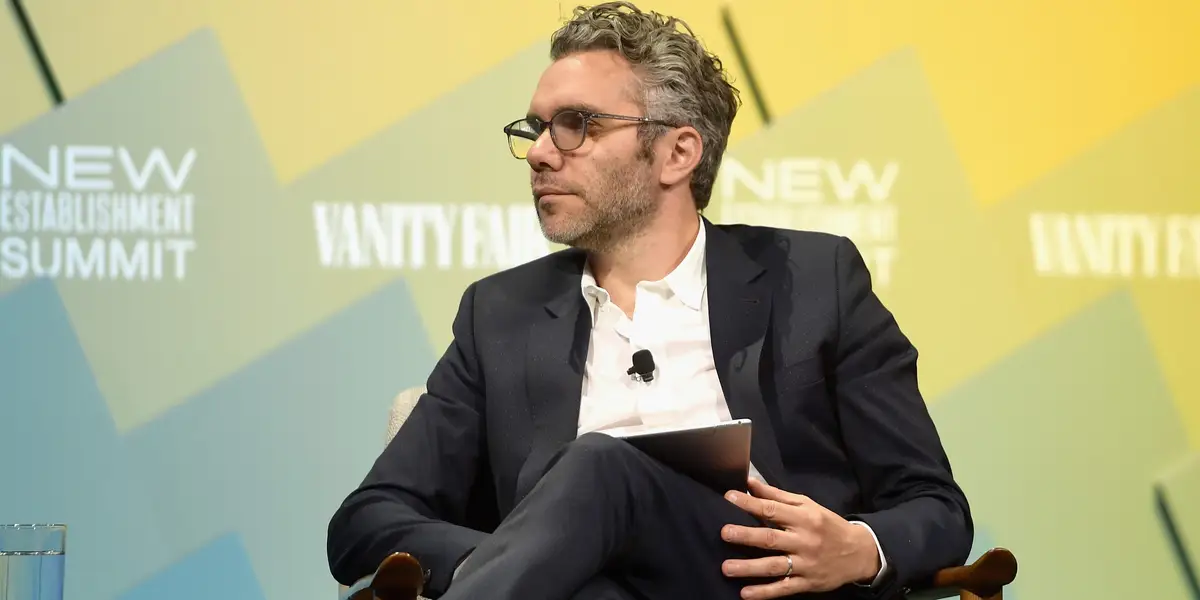
“60 Minutes” has a new top producer.
Nick Bilton, a former New York Times and Vanity Fair columnist, author, and documentary producer, is taking the helm of the news show, CBS News announced on Thursday.
Bilton is replacing “60 Minutes” veteran, Tanya Simon, who took on the role of interim executive producer a little over a year ago.
In a memo sent to staff, which Bilton shared online, he signaled plans to shake up how the storied news-magazine show is run.
“I’m here to lead this show, not preserve it under glass,” Bilton wrote. “I have a notebook full of ideas. Some are about the show itself. Some are about the next generation of correspondents. Some are about the strange fact that we produce one extraordinary hour for one night a week in a world that consumes content around the clock.”
In a press release, CBS News’ owner Paramount said Bilton was the show’s fifth executive producer and its first with experience outside traditional television.
“We have huge ambition for ’60 Minutes’ to reach new heights through deep, revelatory journalism,” CBS News’ chief editor Bari Weiss said in a statement about the appointment. “Nick shares this mission and will bring his deep investigative experience and understanding of the technological moment we’re in to ’60 Minutes’ so that its important journalism comes to life for all audiences.”
Bilton arrives at “60 Minutes” at a moment of tension for the program, which has consistently ranked at the top of Nielsen’s ratings for news shows.
On Wednesday, “60 Minutes” correspondent Sharyn Alfonsi told colleagues she was leaving following “an intense editorial dispute” related to a December story about the Trump administration’s deportation of migrants to El Salvador’s CECOT prison. Alfonsi’s exit was timed with the end of her contract.
Read the full memo that Bilton sent to staff, below:
Hi everyone,
I’m Nick. Some of you I’ve met. Most of you I haven’t.
Walking into this building and putting my name on this job is the honor of my career. Though I don’t need to tell you, 60 Minutes is, without exaggeration, the most important television journalism brand this country has ever produced. The fact that it has held that position for almost six decades is not an accident. It’s the result of generations of producers, correspondents, editors, researchers, and crews who decided that the work mattered more than the noise.
You are those people. I’m grateful to be working alongside you.
I am here because the world outside this building has changed a lot since this show was conceived—and we have to talk honestly about what that means.
Think back to September 1968, when the first episode of 60 aired. A gallon of gas was thirty two cents. The first pocket calculator wouldn’t go on sale for another two-and-a-half years. If you needed money, you went to the bank, stood in line, and asked a human being for it. Long distance calls were billed by the minute and you thought twice before making one. There were three networks. Most people watched the first episode of 60 Minutes in black and white. If you missed it, you missed it.
Every part of how we lived back then has been transformed since then. The cars, the phones, the music, the movies, the medicine, the money, the way news gets made and the way news gets consumed. The phone you are reading this on is more powerful than every computer that existed on the planet in 1968 combined.
The audience that watched that first episode is not the same audience watching us now. They have unlimited channels to choose from, not three. They are stalked by algorithms that they wake up to and go to sleep to. Algorithms that have figured out that anger is the only way to make sure they come back day after day after day. They have lost faith in almost every institution that used to hold the country together.
And yet here we still are. Same stopwatch. Same tick. Same Sunday night. Same form. The trusted correspondents are our guides through all of it.
There is something genuinely incredible about that. The fact that this show has remained a fixed point in a culture is part of why this show still matters as much as it does. I don’t want to lose that.
But the world we are reporting on, and the world we are reporting to, where people consume their news, has moved. And if we don’t move with it, in the ways that matter, we won’t be here for the next sixty years. I want to do everything humanly possible to ensure that we are.
How? I’ve spent most of my career writing about exactly this kind of moment. I started as a technology reporter at The New York Times, then an investigative journalist at Vanity Fair, covering industry after industry that got obliterated by these technological changes. I was a regular voice on CNBC, ABC, and CNN trying to make sense of it as it happened. I wrote books about it. I made documentaries about it for Netflix and HBO. And I watched (as we all did) newspapers and magazines and taxi companies and travel agencies and video stores and entire industries go under. Only a few survived. The ones that did all had one thing in common: They saw it coming, and they adapted before it was too late.
Over my time covering these disruptions, nothing compares to this one. Between AI rewriting how information is made and everyone with a phone calling themselves a media company, this is the most precarious moment for journalism (and society) I have ever seen. There was a time I would have written the story about what happens to television news next. Instead, I am here to make sure that story doesn’t get written about us. That is why Bari hired me. Evolving or dying isn’t a threat. It’s simple math.
My responsibility is not just technological transformation. It is also our trust with the public.
On the very first episode of 60 Minutes Mike Wallace said: “If this broadcast does what we hope it will do it will report reality.” I can’t think of a better north star for 60 Minutes than that. Above all, that means a commitment to fairness—in story selection, in the edit room, and in the broadcast.
Now, what happens next? I’m here to lead this show, not preserve it under glass. That means honoring what works and being honest about what doesn’t. I have a notebook full of ideas. Some are about the show itself. Some are about the next generation of correspondents. Some are about the strange fact that we produce one extraordinary hour for one night a week in a world that consumes content around the clock. I’m excited to share them, and I’m confident you’ll be excited by them, too.
But not yet. The first thing I want to do is meet you. Hear what you’re working on. Hear what isn’t working. Hear what you’ve been waiting to do and haven’t been able to. In about thirty days I’ll come back to all of you with where we go from here. It will be a conversation that we have together.
This is the best job in journalism. I can’t wait to introduce myself and meet each of you.
See you tomorrow.
Nick