The 15-year agreement restraining the US and Russia’s nuclear arsenals is no more, opening the door for distrust that could raise the risk of miscalculation, arms control experts say.
The expiration of the New START treaty this week, which capped the amount of nuclear warheads that the two sides could deploy on bombers, submarines, and missiles, will reduce the degree of transparency between Washington and Moscow at a moment of high tension in Europe. Without the verification processes and formal exchanges, like site visits, defense planners will find themselves in the dark.
“That is very likely going to cause both the US and Russia to revert back to worst-case scenario assumptions about each other’s actions,” Mackenzie Knight-Boyle, a senior research associate with the Nuclear Information Project at the Federation of American Scientists, told Business Insider.
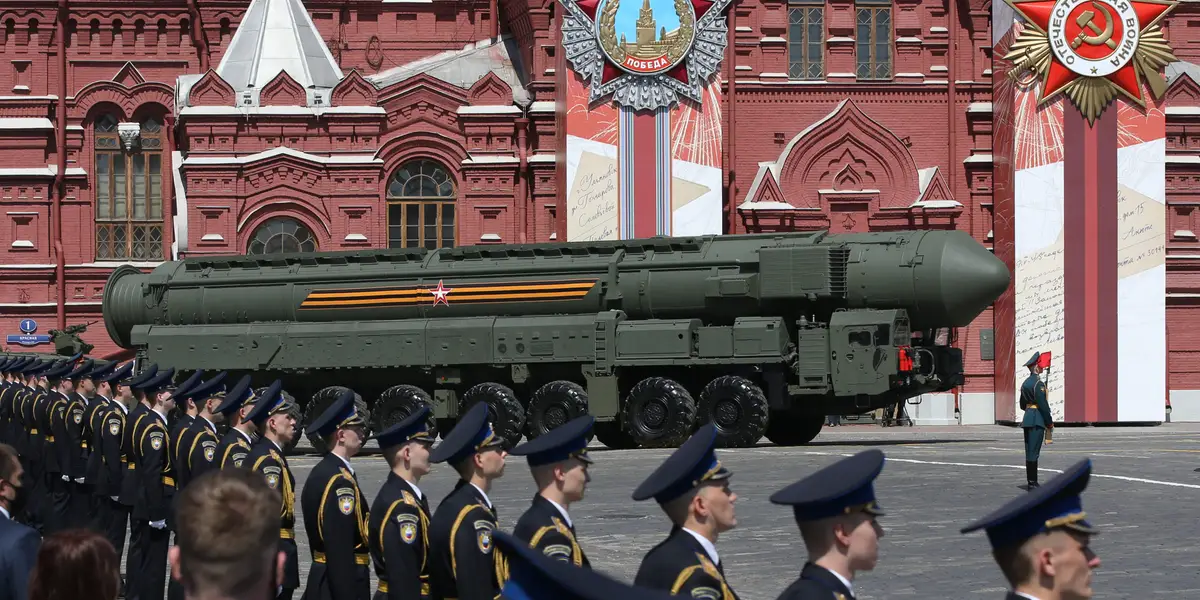
New START, signed in 2010 and officially enacted in 2011, was the latest in a series of nuclear arms deals between the US and Russia. It’s the first time in decades that neither countries has abided by an agreement to limit the number of operational nuclear warheads. In the New START era, Washington and Moscow could deploy up to 1,550 warheads and 700 launchers.
The agreement also imposed a system for both sides to verify each other’s actions. The US and Russia would notify one another when they moved a nuclear weapon, and sent inspectors to nuclear sites like missile, bomber, and submarine bases. Experts called the New START process robust and informative, building confidence that the two nuclear powers were following their agreement.

Every time Chris publishes a story, you’ll get an alert straight to your inbox!
Stay connected to Chris and get more of their work as it publishes.
US Navy photo by Mass Communication Specialist 1st Class Ryan Riley
Without it, there’s a “sense of less predictability and transparency between the two nations,” Eliana Johns, a senior research associate with the Nuclear Information Project at FAS, told Business Insider. The verification process provided detailed information about nuclear activities, including exercises and storage sites, down to specifics like how many B-52 Stratofortress bombers were equipped to carry nuclear weapons, she added.
The US and Russia are far and away the countries with the largest nuclear arsenals, even decades after the Cold War. China’s rapid build-up of its nuclear arsenal has worried American leaders, despite its pledge not to use nukes first in a war.
Now, the predictability brought by New START is gone. Without limitations, nuclear forces like intercontinental ballistic missiles and submarines could be increased in ways that risk a Cold War-like arms race. Right now, all of the US’ deployed ICBMs only carry one, but around half have Mk21A reentry vehicles that could carry three. Planning and posturing will be filled with more unknowns, and defense officials on both sides will be making assumptions in assessing risks.
According to Knight-Boyle, Johns, and FAS Nuclear Information Project associate director Matt Korda and director Hans Kristensen, it’s possible the US ICBM force could double from 400 warheads to 800 with uploaded reserve warheads. Increasing the warhead count for submarines could be faster and could add upwards of 800 to 900 warheads. The quickest ramp-up involves configuring B-2 Spirit bombers and B-52s to carry more bombs, and there are estimates of up to 800 nuclear weapons available to these aircraft.
This doesn’t mean the US and Russia will immediately begin to take these actions, though. Uploading warheads would require significant resources, logistics planning, and time, could enflame tensions, and would raise vulnerability concerns. But both countries have “significant warhead upload capacity that would allow them to increase their deployed nuclear forces relatively quickly,” the arms control experts wrote this week.
New START was only intended to be in place for a decade with the option of a five-year extension, which the US and Russia agreed to in 2021. The following year, Russia invaded Ukraine, and in 2023, Russia suspended its participation but said it would still follow numerical limits. This meant the exchange of data, notifications, and information was halted. The US followed suit.
VCG/VCG via Getty Images
Russia has offered to observe those caps for another year. And on the day the agreement expired, Axios reported that there were negotiations for both countries to follow New START’s limitations, but whether that deal would include verification processes is unknown. When asked whether there was a temporary agreement after the treaty’s expiration, White House Press Secretary Karoline Leavitt told reporters, “not to my knowledge.”
In the absence of New START, experts are concerned mistrust and assumptions could lead nuclear powers to increase their arsenal. “And that creates a domino effect where if the US uploads warheads for fear of Russia’s actions, Russia does it reciprocally,” Knight-Boyle said. Other nuclear states, like China, must also be considered in that possibility.
China’s nuclear arsenal has been the focus of officials in Washington in light of New START’s expiration. President Donald Trump and other administration officials have said future nuclear arms deals must incorporate China due to its rapidly growing nuclear force. Per Pentagon estimates, Beijing’s arsenal is expected to top 1,000 warheads by 2030.
“The president’s been clear in the past that in order to have true arms control in the 21st century, it’s impossible to do something without China,” Secretary of State Marco Rubio said this week. Washington also accused Beijing of conducting nuclear explosive tests, including one in 2020, which violates an international ban.
In response to a question about China’s role in a potential future nuclear arms deal, Lin Jian, a spokesperson for the Chinese foreign ministry, said, “China’s nuclear strength is by no means at the same level with that of the US or Russia. Thus, China will not take part in nuclear disarmament negotiations for the time-being.”