
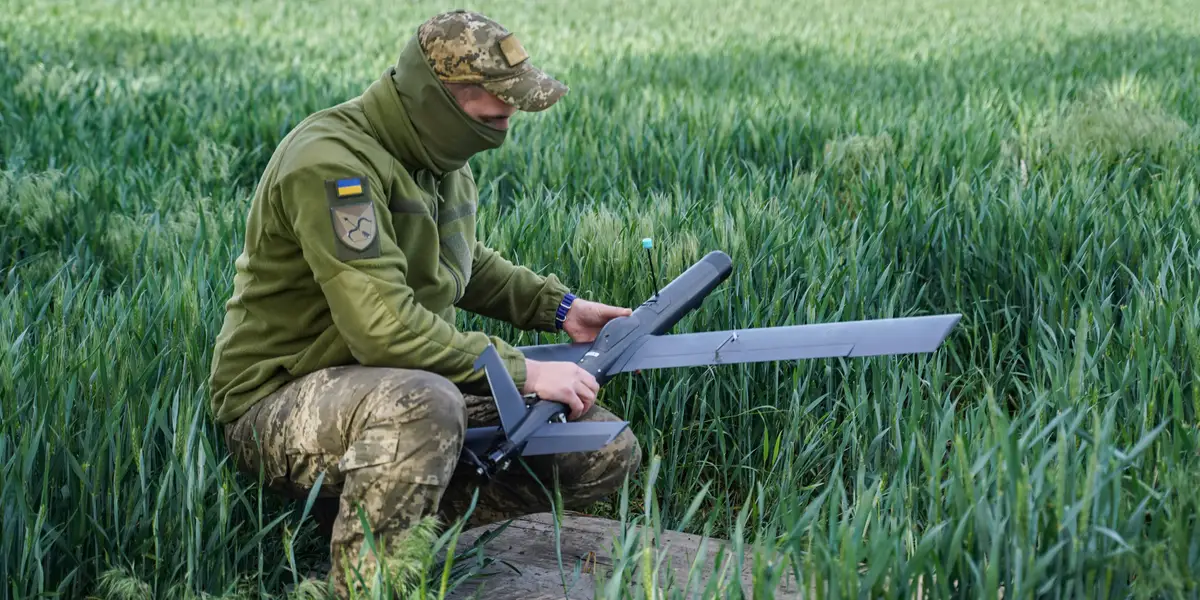
The Russian weapon looks kind of like a cheap cruise missile. It has a thin fuselage, outstretched wings, and a mini turbojet engine that propels it across the sky.
But Russia’s Geran-5 isn’t a missile. It’s the newest and fastest weapon in a family of jet-powered drones that Moscow is using in rising numbers against Ukraine. The unrelenting attacks have intensified since the start of the summer, further straining Kyiv’s already stretched air defenses.
Ukrainian interceptor drones, initially designed to counter Russia’s slower, propeller-powered drones, are being rapidly upgraded to combat newer, faster models and have already downed several Geran-5s. The race is no longer just to build interceptor weapons. It’s to build ones with the speed to catch Russia’s latest weapons.
American and European defense companies are rushing to develop similar capabilities to counter new Russian threats. Business Insider spoke with Western and Ukrainian military officers, officials, and defense companies about the push to develop next-generation interceptors.
“The percentage of jet-powered threats is rising,” said Lt. Col. Matt Keogh, who is tasked with procuring drone technology for the British Army. “And there is a commensurate level of interest being presented on the interceptors to defeat them.”
A worsening threat
Wild Hornets/Screengrab via X
Interceptor drones emerged in 2025 as one of Ukraine’s top defense priorities. They quickly proved highly effective against nightly bombardments by armed Geran-2 drones, piston-powered aircraft with a maximum speed of about 115 mph.
Russia responded by developing faster variants equipped with small turbojet engines. The Geran-3 exceeds 200 mph, while the Geran-4 can reach 310 mph.
The Geran-5, the newest variant, can fly at speeds up to 375 mph. Unlike its delta-wing predecessors, it more closely resembles a cruise missile. These drones, which are faster, deadlier, and harder to stop, are playing a growing role in Russian strike tactics.
Ukraine’s air force said Russia launched 2,800 jet-powered drones in August, compared to 350 in June. Ukrainian President Volodymyr Zelenskyy said on September 26 that Kyiv shot down just 55% of the jet-powered drones that month, a significant drop from its interception rate for propeller-powered drones, which officials regularly said was above 90%.
Russia is investing heavily in jet-powered drones. It has expanded the infrastructure at air bases to support their launch, and Zelenskyy said last month that Moscow plans to spend $12 billion on producing these drones and other strike weapons in 2027.
The consequences have been deadly. Nine people were killed, and dozens more were injured, in a recent Russian attack involving nearly 100 jet-powered drones, Ukrainian authorities said.
Frédéric Pétry/Hans Lucas via Reuters Connect
The rise in jet-powered drones has forced Ukrainian companies to adapt. Defense firms that built the first generation of interceptors are now developing faster models. Some, like Wild Hornets’ Sting S or SkyFall’s P1-SUN JetKiller, have already recorded combat kills.
“In war, every new capability quickly generates a countermeasure,” said Valerii Zarubin, the CEO of BlueBird Tech, a Ukrainian company developing a jet-powered interceptor. If we are talking specifically about jet propulsion and the higher speeds of these drones, interception systems have to evolve accordingly.”
Interceptors are getting faster
The realization that interceptor drones must be faster has extended beyond Ukraine’s borders.
Western defense companies have, throughout the war, developed new weapons based on the tactics and innovations observed in Ukraine. Now, many see faster interceptors as the next major leap, driven both by lessons from Ukraine and a growing appetite for cheaper ways to defeat drones.
Ukrainian Col. Volodymyr Gordiienko, the program design branch head at the NATO-Ukraine Joint Analysis Training and Education Centre, said that when jet-powered drones first began appearing in limited numbers last year, JATEC was working with French startup Alta Ares on defenses against older, slower threats.
Kay Nietfeld/dpa via Reuters Connect
Recognizing the emerging risk, JATEC advised monitoring the new drones, noting that they could become a capability gap. Alta Ares acted and developed an interceptor capable of taking down jet-powered drones. Gordiienko said that early identification and quick reaction gave NATO “a promising solution under development.”
“Western defense innovation should be about anticipating future challenges,” he said, “rather than spending several months developing solutions in reaction to an existing capability gap.”
Across Europe, defense tech companies are reaching the same conclusion and moving swiftly to adapt. Lithuania’s Granta Autonomy is considering developing a jet-powered successor to its current interceptor, which has a top speed of roughly 200 mph. Czech firm LPP Holding is working to increase the speed of its existing system, which can top 185 mph. And Germany’s Tytan Technologies is developing a new jet-powered interceptor designed to engage targets at “greater distance and with greater speed.”
These efforts reflect a growing recognition that today’s interceptor speeds won’t be enough for tomorrow’s threats.
Jason Cornelius, the CEO of Perseus Defense, said it’s not enough for an interceptor to fly as fast as its target — there must be a speed overmatch. The American firm developed a small, ground-launched missile that’s powered by a solid-rocket motor and flies at high-subsonic speeds.
After testing its current interceptor with the US military, Perseus is now designing a larger, more powerful model specifically for jet-powered drones. Cornelius said the goal is to test the new model as a prototype by the end of the year.
US military photo
NATO militaries have, for decades, fielded air defenses designed to engage threats like drones, cruise missiles, and helicopters. But many now view interceptor drones as a crucial addition to their arsenal after watching them reshape the air war in Ukraine.
Luke Pollard, the UK’s minister for defense readiness and industry, said Britain must have faster interceptors to keep pace with the threat, characterizing them as a priority acquisition in the coming years.
Keogh, the officer procuring drones for the British Army through its Project Rapstone rapid acquisition initiative, said there is a requirement to buy interceptors as part of the program and that he is considering jet-powered models. He said Rapstone is sourcing solutions from the UK industry and hopes to make a procurement decision by the end of the year.
Interceptor drones are just one product to emerge from what Ukrainian officials describe as a cat-and-mouse game of battlefield innovation, and the US and Europe are paying attention
Lt. Col. Adam Scher, a spokesperson for the Joint Interagency Task Force 401, a US Defense Department organization responsible for coordinating counter-drone efforts for the military and federal agencies, said counter-drone development and procurement must focus on the “first principles and physics of flight, rather than a drone’s specific modality of control,” to ensure that the capabilities remain relevant as technology evolves.
For Ukraine and its partners, that’s becoming an increasingly urgent lesson. Russia has accelerated the pace of drone innovation, and the West is racing to ensure its interceptors don’t fall a generation behind.
“If a country cannot rapidly develop effective countermeasures against missiles and jet-powered UAVs, its ability to withstand a modern war becomes severely limited,” said Zarubin, the BlueBird CEO.