
Alarms blare over the factory floors, and work at Patria’s Hämeenlinna facility grinds to a halt.
The soft thrum of an explosion echoes through the campus. Moments later, roughly 700 workers continue making their armored vehicles bound for Japan, Sweden, Slovakia, and other countries. The blast is not a test-firing of its new combat vehicle, but part of the construction for its expanding manufacturing facility.
Patria, Finland’s largest defense company, is planning to nearly double production at its main hub just north of Helsinki, clearing rocks with explosives on-site to make way for several new assembly lines.
Matthew Loh for Business Insider
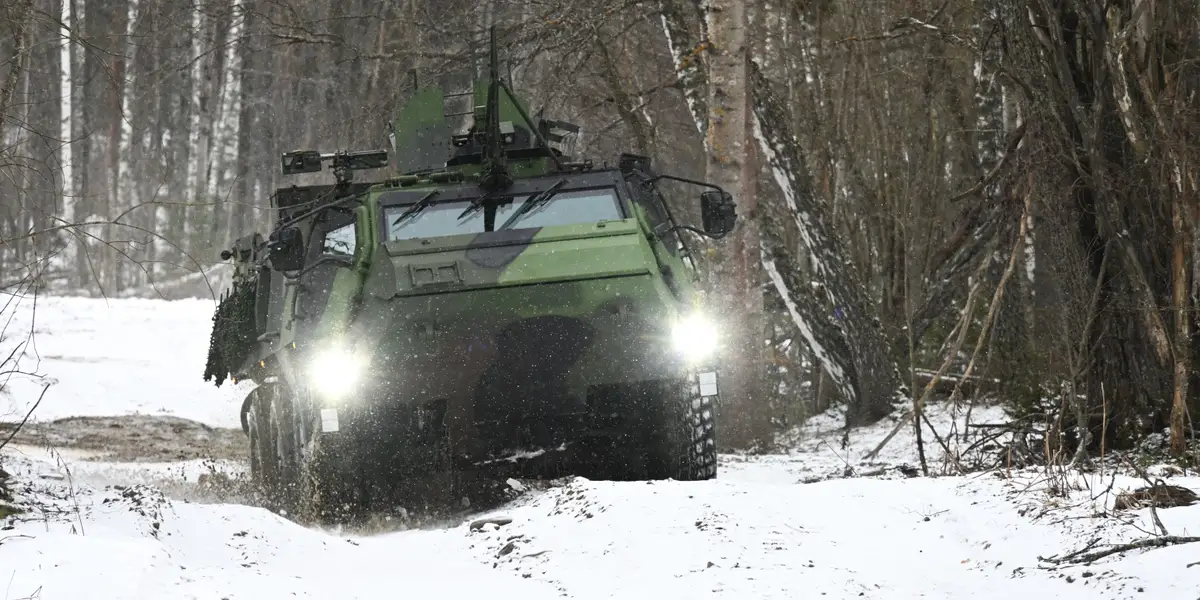
The Hämeenlinna factory manufactures Patria’s 8×8 armored personnel carrier and a relatively new, up-and-coming vehicle: a wheeled 6×6 troop transport that’s receiving surging demand from northern and western Europe.
Work on the 25-foot-long, 17-ton vehicle began in 2020 under a joint program between Finland and Latvia called the Common Armored Vehicles System. Both countries sought a cost-effective, mass-produced armored vehicle that could be used by their militaries for interoperability.
Latvia has since sent at least 42 of these vehicles to Ukraine, armed with heavy machine guns and rolled out in batches over the last year. The vehicle can cross tundra and even rivers while shielding up to 10 troops it carries from land mines and artillery fire to get them to forward positions.
Alexander Welscher/picture alliance via Getty Images
When Business Insider visited Patria’s factory, representatives for the company — which is majority-owned by the state of Finland — said the firm wasn’t authorized to share details about the 6×6’s performance in Ukraine.
But the CAVS 6×6 program has been quickly drawing attention from the rest of Europe: What began as a partnership between two countries has expanded into a consortium of seven member states.
Sweden joined the Common Armored Vehicles System program in 2022, followed by Germany, Denmark, the UK, and Norway in subsequent years.
Finland and Latvia have placed orders for just under 500 of these vehicles, while Sweden has requested 415 of the 6×6s to be delivered over the next five years. Stockholm’s latest order for 94 vehicles, announced in early December, priced each one at about $1.75 million.
Germany has become the program’s largest buyer, signing contracts in mid-December to acquire 876 of the 6×6 vehicles, valued at $2.3 billion. These vehicles will be split into four variants, including one that features a mortar turret.
Meanwhile, Denmark, which joined the program this year, has already placed an order for 129 6×6 vehicles.
The UK and Norway are still negotiating 6×6 orders with Patria.
Inside the CAVS 6×6
The CAVS 6×6 can accommodate roughly 10 troops, along with a typical crew of two or three, and features up to NATO standard level 4 armor designed to withstand direct hits from large-caliber machine gun fire, mine explosions, and nearby artillery blasts.
The CAVS 6×6 competes with other wheeled troop transports, such as Rheinmetall’s Boxer and General Dynamics Land Systems’ Stryker, the latter of which is extensively fielded by the US Army.
The Finnish company said it can tweak the vehicle for each customer’s needs, but a typical model features climate control that enables the vehicle to operate in temperatures as low as -40°F.
“Inside, it will be comfortable enough to easily survive. We are talking about temperatures of the plus centigrades,” Mikko Rantanen, Patria’s director for 6×6 vehicle programs, told Business Insider from inside the rear compartment of one of the vehicles.
Matthew Loh for Business Insider
The 6×6’s rear interior is spartan: Cloth-covered metal-frame seats and headrests for five people on either side, with space behind each seat for equipment and small arms.
There’s just enough room for a soldier to sit with their knees touching the opposite passenger’s. A few fire extinguishers inside are connected to an automatic suppression system that can detect a blaze in the rear cabin.
Matthew Loh for Business Insider
Screens allow troops to see outside the vehicle through exterior cameras, while a rear hatch provides the option of fitting a machine gun or crewed weapon module on top of the 6×6.
On the right-hand side of the vehicle, a small passageway also lets troops pass between the rear compartment and the driver’s cabin, which resembles that of a truck and features an automatic gearbox.
Matthew Loh for Business Insider
Optional propellers on the 6×6’s underside enable it to transition seamlessly from traversing land to crossing small bodies of water, such as rivers or lakes.
“We can enter the water without needing preparation in this configuration,” said Rantanen.
Matthew Loh for Business Insider
However, the 6×6’s speed in the water is just under 5 mph, and Rantanen added that it’s not meant to be a landing craft or amphibious assault vehicle.
On land, it’s designed to drive at speeds of over 60 mph, easily cross trenches that are four feet wide, and surmount obstacles about two feet high.
Matthew Loh for Business Insider
Moving fast in the Arctic
Building weapons and vehicles specifically for arctic terrain is a specialty for contractors in Finland, a country renowned for holding off the Soviet Union for over 100 days in deep snow and dense forest during World War II.
Patria said that while the 6×6 can be outfitted for various terrain types, including the desert, the arctic domain is its forte.
Patria
Snow isn’t the only challenge in arctic warfare. Few roads are available on Finland’s border with Russia — the priority threat for NATO — and its vast hinterland is peppered with thousands of small lakes and marshland that can bog down armored transport.
“In the wintertime, it’s snow,” said Petri Hepola, Patria’s executive vice president for sales and marketing and its chief program officer for the F-35. “In the summer, lots of wet soil and swampy areas. One of the most important features is how fast you can move your troops and tools through these areas.”
Patria
Finland and Norway are the only two members of Patria’s 6×6 program that share Arctic borders with Russia.
However, as northern Europe, especially the Baltic and Nordic states, grows increasingly concerned about conflict with Moscow, the Kremlin has been bolstering its military presence in the high north, repopulating key bases and transforming its Arctic fleet into a separate strategic theater.
Since Finland joined NATO in 2023, alliance forces have been rushing to train on the country’s terrain and frigid temperatures, making it one of the most active spots for joint exercises in recent years.
“Our products have been surviving very well in that environment,” Hepola said.
Gearing up for 2027
With an order backlog of nearly 2,000 6×6 vehicles, Patria hopes its new facility in Hämeenlinna will be ready for production by 2027. The factory campus serves only the tail end of the entire manufacturing cycle, which can take weeks in most cases, or several months for more complicated variants.
Inside, hundreds of workers conduct welding, surface treatment, assembly, tests, and other final processes that can each take weeks to complete. Dozens of vehicles line the factory floors, and dozens more sit in parking lots, each marked with a flag to designate the country for which it has been modified.
GINTS IVUSKANS/AFP via Getty Images
Before delivery, each one is supposed to be driven at least 200 km, or 124 miles.
Rantanen, director of the 6×6 program, said Patria has been integrating counter-drone systems, such as jammers, on the vehicle.
Armored vehicles in Ukraine have especially struggled against pervasive minefields and small drones with explosive payloads, some of which are controlled via a fiber optic cable connection that can’t be jammed. In response, soldiers there have relied more on firearms such as shotguns and machine guns to counter such attacks.
Rantanen said Patria hasn’t yet officially added any kinetic weapons that can take down drones.
“The drone threat is currently evolving at such a speed that it’s hard to keep track of it closely,” he said. “But we are hard at work for the countermeasures against drones as well.”