
On a recent sunny spring day, Father Eric Salobir led a delegation through St. Peter’s Square, past the crowds and toward Pope Leo XIV.
With him were representatives of Meta, Google, and Amazon, part of a small group gathered in Rome to discuss child protection in the age of artificial intelligence. The encounter with the pope was brief. The meeting that followed, in the French embassy to the Holy See in central Rome, lasted for hours.
There, Paolo Ruffini, the Vatican’s top communications official, sat across from the tech representatives to wrestle with a question now at the center of Leo’s young papacy: How should one of the world’s oldest moral authorities judge the cutting-edge technology Silicon Valley is racing to build?
The April 29 gathering was the latest in a series of meetings that, taken together, amount to a quiet lobbying push by the tech industry ahead of Leo’s first encyclical, according to interviews with seven people for this article. An official papal document due Monday will set out the Catholic Church’s position on artificial intelligence.
Silicon Valley has spent years trying to convince governments and the public that AI can be developed responsibly. Now, the industry has been making that case inside the Vatican.
In recent months, representatives from the tech sector have traveled to Rome to meet Church officials involved in the debate, presenting themselves as partners in the ethical development of AI. Their message has reached the Vatican through embassy events, small-group meetings, and Catholic intermediaries with deep ties to the technology world.
The effort reflects the unusual stakes of Leo’s first encyclical. The document is expected to be presented by the pope in person on Monday, but its preparation has drawn contributions from cardinals, experts, and businesses — all waiting to see how the Church will weigh in on a technology shaping the global economy, the workplace, and ever larger spheres of daily life.
Sarah El Haïry, the French government’s high commissioner for children, who participated in the April event, said the document could reverberate well beyond the Vatican. She compared it to Leo XIII’s 1891 encyclical on the rights of workers, which helped define Catholic social teaching during the Industrial Revolution.
“The pope’s encyclical could have a rather enormous impact, in the same way that Leo XIII’s encyclical helped to establish a comprehensive vision for how to orchestrate the industrial revolution,” she told POLITICO. “Several countries have, in their own way, drawn inspiration from this doctrine.”
The AI pope
Leo XIV has signaled from the start that technology — and artificial intelligence in particular — will be central to his papacy.
In his first address to the college of cardinals, he acknowledged his choice of papal name was a deliberate reference to Leo XIII, who is known in the church for his defense of human dignity, and in particular that of workers, and he indicated he would dedicate his teaching “in response to another industrial revolution and the developments of artificial intelligence.”
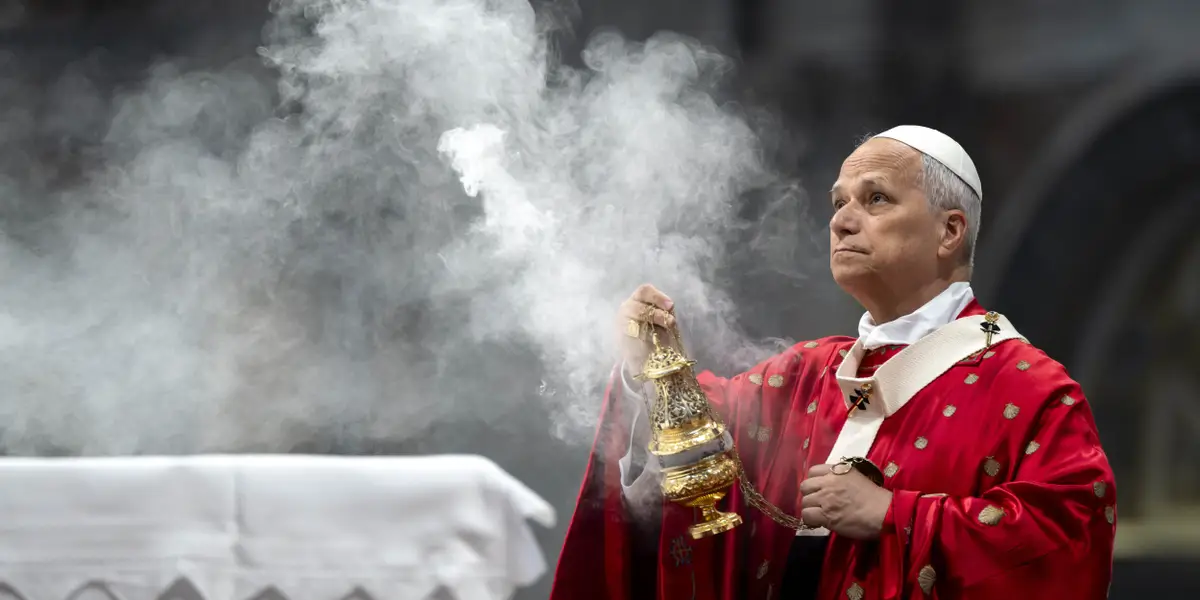
Even Leo’s public image has offered flashes of modernity. As he raised his arms to celebrate his first Mass after his election, the sleeve of his cassock slipped to reveal an Apple Watch on his wrist.
When Leo unveils the encyclical on Monday, he is expected to be joined by Christopher Olah, a cofounder of Anthropic, the American AI company that has made safety central to its public identity. Anthropic has clashed with the US Defense Department over its refusal to allow its technology to be used to surveil American citizens or empower autonomous weapons, and has cultivated ties with the Vatican on AI ethics.
The relationship predates Monday’s launch. In January, Anthropic released a “constitution” laying out the values that will guide the development of its flagship AI model, Claude. Credited among the outside contributors were two advisors to the Holy See, Bishop Paul Tighe, secretary of the Vatican’s Dicastery for Culture and Education, and Father Brendan McGuire, a Silicon Valley priest and former engineer who advises the Vatican on technology issues.
The Rome network
Tighe and McGuire are not the only figures linking the Vatican to the tech world. Another important conduit has been Éric Salobir, a French Dominican priest who began his career as an investment banker before joining the Church.
Now an expert with the Holy See, Salobir chairs the executive committee of the Human Technology Foundation, an organization that promotes ethical reflection on technology and counts Google, Palantir, and Qualcomm among its members.
Working with the French Embassy to the Holy See, Salobir helped launch a “French AI Observatory in Rome” in 2024, creating a forum for closed-door exchanges between the technology sector and Vatican officials. Since Pope Francis, they have become more frequent.
The April 29 meeting was one of those. In addition to Salobir and the French government official El Haïry, those attending the meeting included Benoit Tabaka, director of institutional relations and public policy for Google in southern Europe; Claire Scharwatt, head of public policy at Amazon France; Claudia Trivilino, public policy manager for Italy and Greece at Meta; and Adrien Abecassis, director of policy initiatives at the Paris Peace Forum and a former advisor to French President Emmanuel Macron. The focus of the gathering was child protection in the age of AI, but the discussion quickly widened to “the profound impacts of artificial intelligence on human sociability,” said one participant, who was granted anonymity to speak freely. “We had lengthy discussions on the foundations of human development, and on the risks that emerge with a tool that is always available for seamless communication, like artificial intelligence.”
The tone, the participant said, was “more humanist than theological.” Some technology executives appeared personally invested in the discussion, while others stayed closer to their talking points. “In any case, the meeting shows that a part of the Vatican does not reject technology as such, but wants to put it at the service of humanity,” the participant added.
Afterward, participants drafted a summary note that was sent to Clara Chappaz, France’s minister delegate for artificial intelligence and digital affairs, to inform France’s digital policy discussions at the G7.
Washington weighs in
The tech industry isn’t the only constituency trying to shape the Vatican’s thinking.
The encyclical has also drawn attention from Washington, even as the Trump administration’s relationship with Leo has grown openly strained. In April, Trump criticized “a pope who criticizes the president of the United States,” adding that he was “not a big fan.”
But behind the diplomatic friction, US officials have also been working to keep a channel open on AI. In early May, the US Embassy to the Holy See hosted a series of events on artificial intelligence and work, backed by the embassies of Australia, the UK, Japan, and Taiwan.
Among those present was George Osborne, the former British chancellor of the exchequer, who now leads country relations for the American tech giant OpenAI. Osborne’s discussion with Tighe on “the worker of the future and the power of AI” included the risk that the technology could deepen inequality.
Noam Yuchtman, a London School of Economics researcher who spoke at a US embassy event, said the outreach was at least in part aimed at demonstrating to the Vatican that there are “individuals and companies with an ethical approach to AI.”
But if the Vatican offers companies a moral forum, it does not guarantee that political leaders will accept Leo’s conclusions uncritically.
JD Vance, the American vice president and a convert to Catholicism, has warned that he will not necessarily take the pope’s encyclical as gospel truth.
“When the Pope issues an encyclical on artificial intelligence, it’s going to have some influence,” Vance said during a White House press conference last week. “I’m sure it will contain a lot of insights, some of which I’ll probably agree with, some of which I may not. But I think it’s going to be a very, very important document.”
That mix of anticipation and caution now surrounds the final text.
After months of embassy events, private meetings, and outside submissions, the people who tried to shape the Vatican’s thinking are now waiting to see which arguments Leo will adopt.
“Encyclicals are, in any case, texts meant to last,” said a contributor close to the Vatican, who was granted anonymity. “The Church’s principle is that it never recants what it has written.”
Océane Herrero is a tech reporter at POLITICO in Paris.
This story originally ran in POLITICO and appears on Business Insider through the Axel Springer Global Reporters Network. The network publishes major stories from the Axel Springer network of publications, a worldwide group of news outlets that includes Business Insider.