
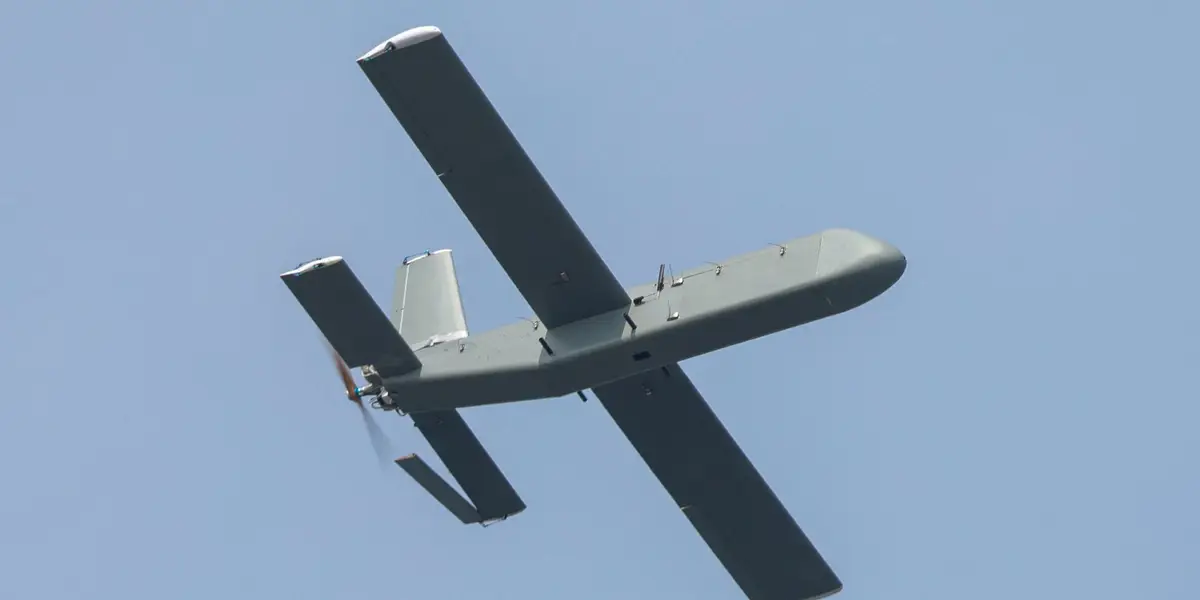
ZUOYING, TAIWAN — Taiwan’s navy deployed two medium-class strike drones on Saturday for the island’s biggest annual military exercise, and their designs resemble those of the loitering munitions giving Ukraine fresh wins against Russia this year.
The pair of fixed-wing, propeller-driven drones appeared during a littoral combat drill simulating an attack on Zuoying, Taiwan’s southwest coast.
It was the first time these drones were shown at the Han Kuang exercise, Taiwan’s annual rehearsals against a Chinese invasion.
As the drones loitered for about 30 minutes above the beach, Taiwanese military officials described them to reporters as “medium-size suicide drones,” adding they were locally built. The island’s National Chung-Shan Institute of Science and Technology designs and manufactures the vast majority of Taiwan’s homegrown weapons.
“The drone used was provided by the Armament Bureau to the navy for testing purpose,” a spokesperson for Taiwan’s navy told Business Insider.
They declined to comment on the drone’s specifications or whether its design was influenced in any way by the recent wars in Ukraine or the Middle East.
The one-way drones were not shown attempting to launch an attack, and it’s unclear whether they represent Taiwan’s final designs for the aircraft.
Ukraine has been using similar fixed-wing drones to attack Russian forces roughly 30 to 300 km behind the front lines this year, mainly disrupting supply routes that the Kremlin has relied on to funnel resources to the war.
Zuoying, where Taiwan hosts its largest naval base, is about 295 km, or 183 miles, from mainland China.
“The desire to employ more medium-range drones fits into things that Taiwan has learned from Ukraine,” said Bryce Barros, a visiting fellow at the Institute for National Defense and Security Research, a Taipei think-tank backed by the Taiwanese government.
Mid-range drones would fill a gap in Taiwan’s littoral defense with a cheaper way to strike Chinese forces or weapons from “over-the-horizon” as they approach the island, Barros said.
Unlike Ukraine’s plains and forests, Taiwan’s littoral defense covers a strait notorious for bad winds and volatile sea states, suggesting that Taipei may want its own drone built to withstand poor weather.
Instead of air defense systems or supply trucks like in Ukraine or Crimea, Taiwan’s mid-range drones would likely target slow-moving vessels transporting troops or weapons, Barros added.
“A range of 40 kilometers to 60 kilometers would be very useful for a whole host of different platforms, anything to make it more difficult for the PLA to start getting into Taiwan’s territorial waters,” he said, referring to the People’s Liberation Army.
Taiwan’s government has said that it plans to produce 100,000 drones a month by 2030. In June, its national defense ministry proposed a $6.6 billion budget to procure over 210,000 domestically produced attack, reconnaissance, and sea drones.
It’s all part of the island’s emerging “hellscape” strategy, which aims to hamper Chinese forces attempting to cross the Taiwan Strait by flooding it with thousands of aerial, surface, and underwater drones.
The littoral drills on Saturday, attended by Taiwanese president Lai Ching-te, also featured naval special forces deploying in the island’s homegrown M109 Skyship rigid-hull inflatable boats.
Taiwan’s navy and coast guard launched rapid sorties with four of its older, 170-ton Kuang Hua-6 missile boats and at least one Anping-class patrol vessel — a newer, 600-ton catamaran that can be fitted with anti-ship missiles during wartime.
The Han Kuang exercise, which lasts 10 days and 9 nights this year, features island-wide drills to simulate how Taiwanese forces and civilian institutions would respond to Chinese gray-zone tactics and an invasion.