


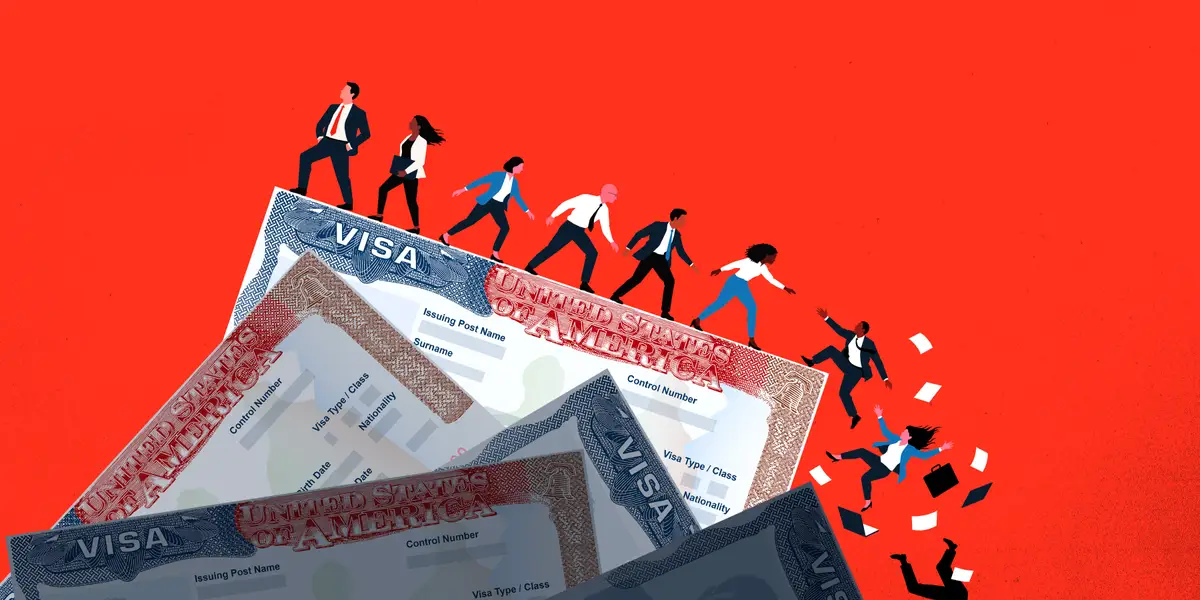
The new H-1B reality is beginning to produce clear winners and losers.
The Trump administration has introduced proposals that target various legal immigration pathways, from the H-1B visa for highly skilled foreign workers to the OPT student work authorization for foreign students who have graduated from a US university.
On Thursday, Vice President JD Vance announced a crackdown on the pathway to green cards for workers at some tech firms, including Microsoft and Adobe.
Business Insider has been covering how skilled foreign workers navigate the changing immigration policies through our ongoing H-1B fallout series, launched one year after Trump first introduced the $100,000 fee on some H-1B applicants. We have examined where foreign talent is heading and the hidden sacrifices of those who opt into the H-1B system. We’ve also spotlighted stories from individuals at different stages of the visa pipeline.
To understand who is better and worse off in the new H-1B system, Business Insider spoke to immigration lawyers and academics and analyzed H-1B application data from the first three quarters of the last three fiscal years.
Ted Chiappari, head of immigration law at law firm Duane Morris, told Business Insider there is nothing in any of the changes in H-1B rules or policies that “would favor one company over another.”
Instead, what’s emerging is that employers with cash and employees with in-demand skills are seeing a relative advantage from the increasingly uncertain H-1B regime.
The US issues 85,000 H-1B visas a year. Demand still outweighs supply, even as applications in the March 2026 H-1B lottery dropped more than 38% from the year before, the United States Citizenship and Immigration Services said.
Trump’s proposed $100,000 H-1B fee for new applicants is held up in the courts. It is “probably the main reason” those applications fell, Chiappari said.
The administration has previously said its changes are intended to curb misuse of the H-1B program and protect American workers, a sentiment echoed by USCIS. Spokesperson Zach Kahler said the goal is to have employment-based visas “supplement, not supplant American workers.”
The White House and the Department of Labor did not respond to requests for comment.
Winner: High salary, high specialization workers
A regulatory change that favors one group of workers over another is the wage-weighted H-1B cap selection. It replaced the randomized lottery earlier this year and gives applicants in higher wage bands a greater chance of being selected.
They get another boost by simple arithmetic. If you’re going to potentially pay $100,000 more than someone’s salary in order to hire them, you likely would only do it for someone who is making quite a bit above $100,000.
It’s evident in some of the largest hiring increases in the data, which are directly tied to generative AI trends. Data scientists saw the number of certified H-1B applications go up by nearly a quarter year-over-year in 2026, the largest of any other job category with more than 5,000 applications. The smaller category of computer and information research scientists saw their applications go up nearly 40%. These are high-paying occupations: As of May 2025, data scientists earned a median annual salary of $120,230, and computer and information research scientists made $140,300, both well above the overall median annual wage of $50,980.
Certified applications are not the same as visas issued and may include updates to information on existing employees, but the data can provide insight into the state of the H-1B system. Data that shows the full scope of the fiscal year’s H-1B hires is expected to be released later this year.
Want more Business Insider in your news feed?
Add BI in Google so our reporting is easier to find when you’re searching for what matters.
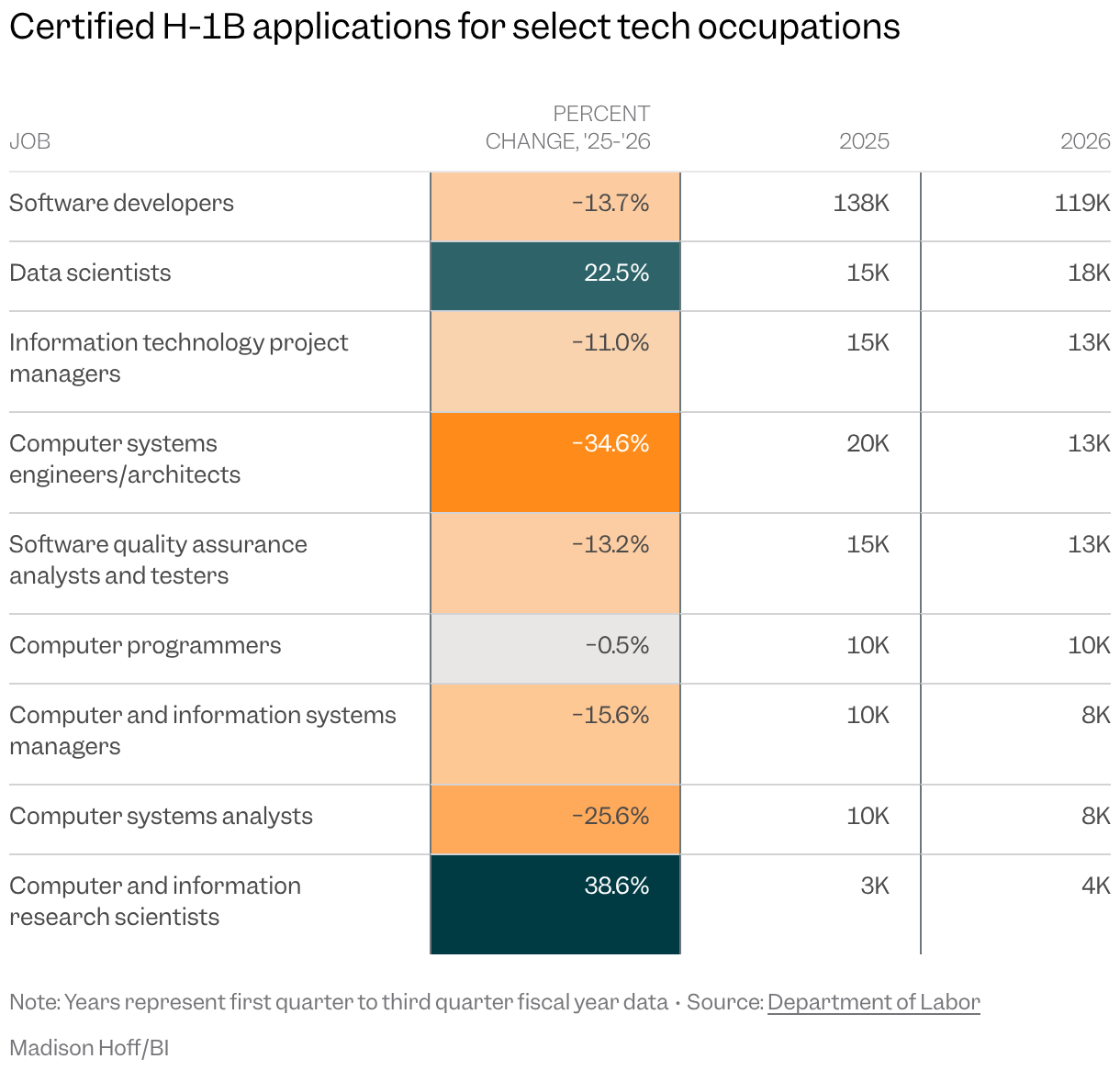

Catherine Macris, a partner at the immigration law firm Fragomen, said that employees in highly specialized, high-demand fields — like tech — might be better positioned because recent changes have placed increased emphasis on “specialization, compensation levels, and employer compliance readiness.”
Specialized roles don’t just command higher salaries; they also “align more readily with evolving H-1B eligibility and wage considerations,” Macris said. It’s easier to show that they’re actual specialists who need to be hired internationally rather than domestically.
Winner: Tech employers
Tech employers rapidly building out generative AI have been one of the biggest pillars of the economy in the last couple of years. The story is no different with H-1B visas.
Tech companies are among the top employers that recruit highly skilled talent and maintain robust immigration policies and compliance programs, potentially making them better positioned to navigate the current environment, Fragomen’s Macris said.
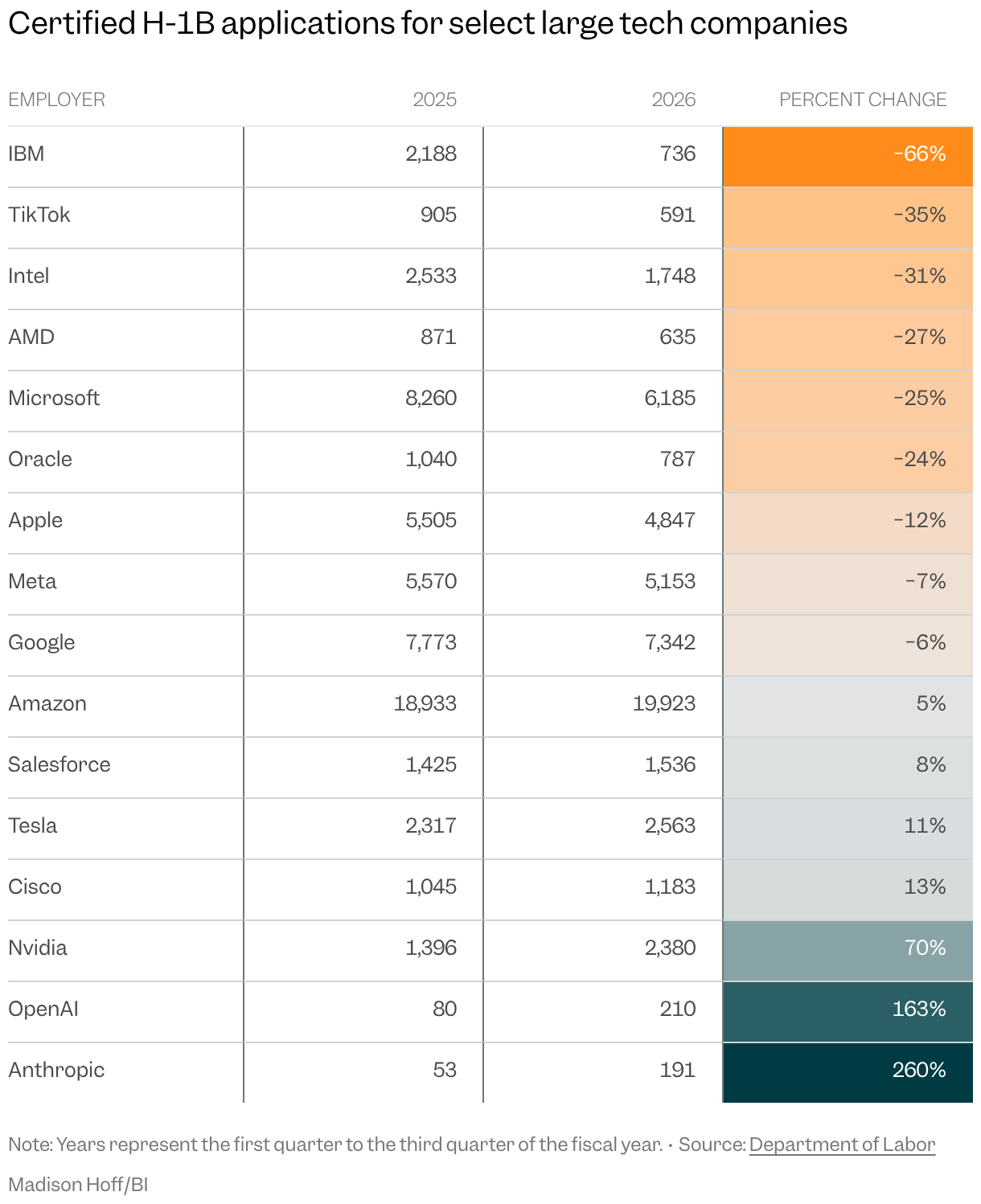
Among a select group of Big Tech employers, certified applications were only down about 6.5%, compared to 10% for all total applications. At rapidly growing AI giants like Nvidia, Anthropic, and OpenAI, applications are shooting up especially quickly, highlighting how closely tied hiring changes are to broader economic trends.

Loser: Small startups that can’t afford the $100K fee
Smaller startups, without the money or legal departments to try their hands with the H-1B lottery, are another likely loser, said Gaurav Khanna, a UC San Diego associate economics professor.
“Big companies like Nvidia and Salesforce are not deterred by such fees, but smaller startups are,” he said. This could have a stifling effect on innovation from the startup sector, he said.
Loser: Companies that transfer foreign workers from overseas
Companies with large international presences that transfer employees from overseas to the US are “most susceptible to the restrictive policies,” said Lynden Melmed, a partner at the immigration law firm BAL.
Professional services companies that can already outsource work overseas will have an increasingly hard time making the case for bringing workers stateside.
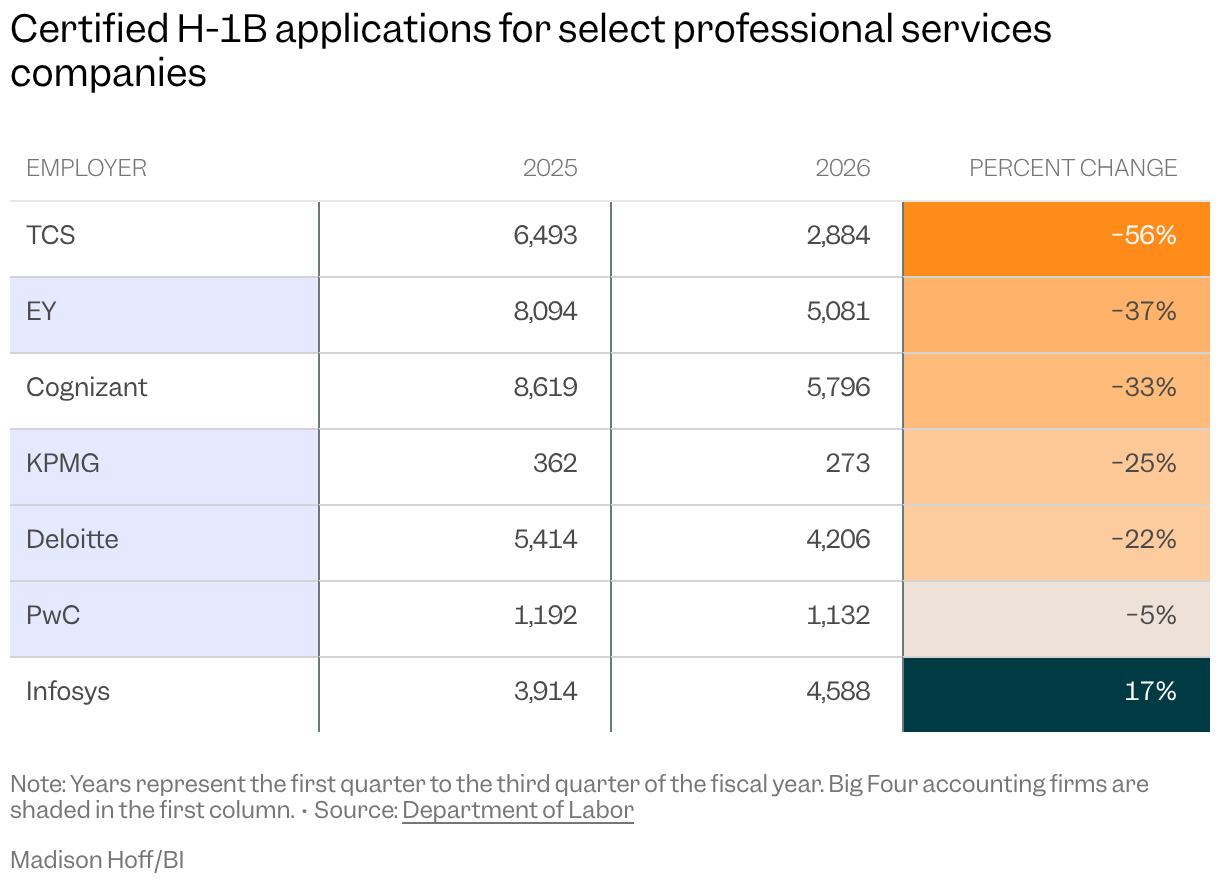
Khanna said he would guess that the overall impact has been hardest on outsourcers like Infosys, TCS, and Cognizant, as well as those that rely on these outsourcers for tech talent. Those three employers saw their certified applications fall in aggregate by 30% year-over-year.
Vice President JD Vance’s comments on October 8 underscored the administration’s stance on the outsourcing firms that help third-party corporations bring overseas workers to the US.
“These firms are as complicit, or maybe more so complicit, in the visa fraud than any American corporation,” Vance said.
Accounting firms, or at least their employees overseas, face a similar problem. Accountant and audit professional certified applications were down 25% year over year.
Certified filings for the Big Four accounting firms are also down around 30% year-over-year.

Loser: Universities, recent grads, and entry-level employees
Recent graduates and early-career professionals might naturally lose out due to their lower earning potential. Fragomen’s Macris said employers who rely heavily on early-career talent, such as accounting and consulting firms with large campus recruiting programs, “may also experience greater pressure” because of this framework.
Their challenges stand in contrast to the relative success of highly paid, highly trained employees.
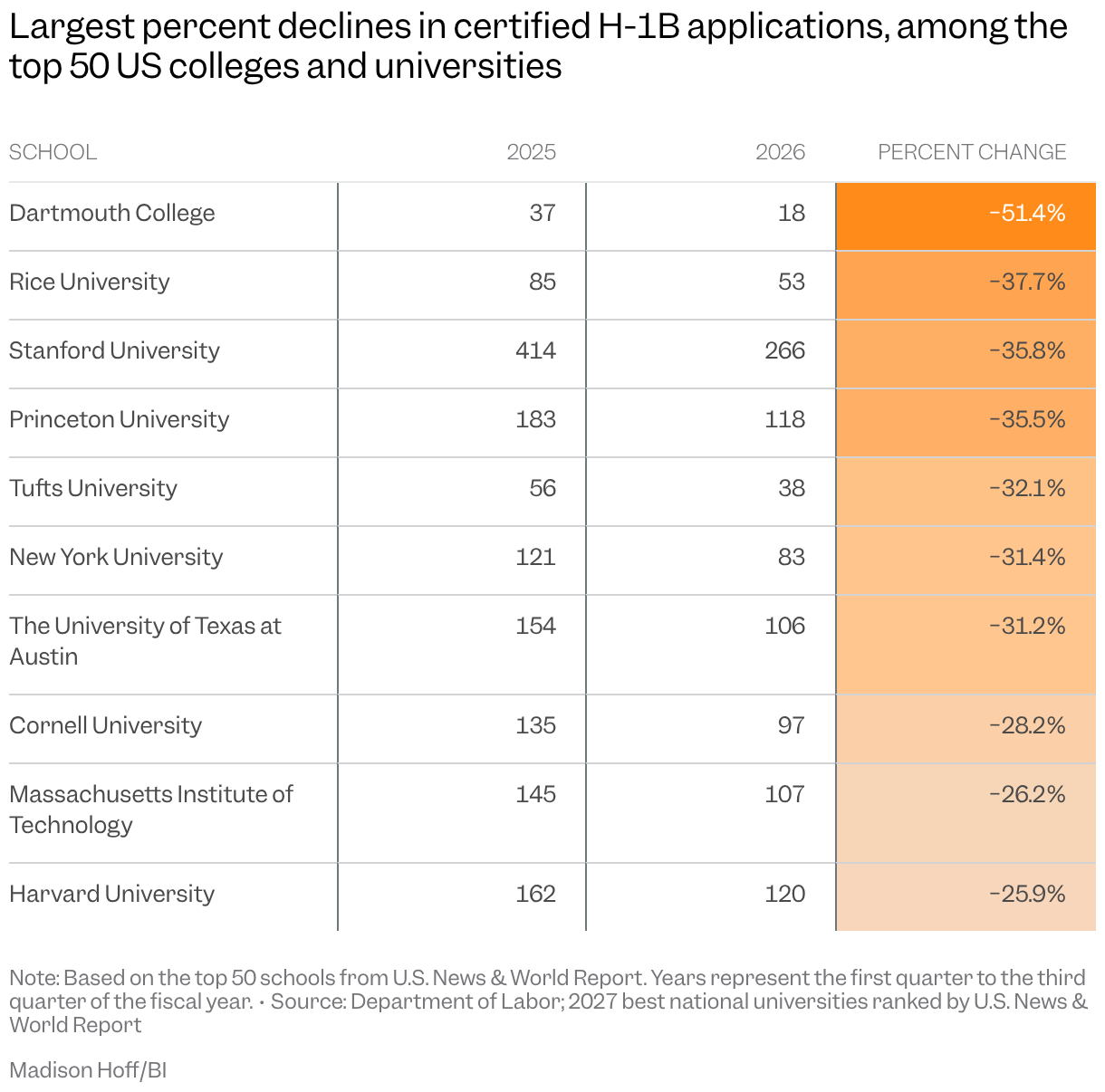
As for the institutions training these workers, they’re also facing an uphill battle, said Chiappari, as they don’t have the same deep pockets as other employers to stomach the costs and uncertainty of the current H-1B regime.
The top 50 schools on the 2027 U.S. News & World Report ranking saw their certified applications fall by 14% from 2025 to 2026.

Credits
ReportingCharissa Cheong, Alex Nicoll, Aditi BharadeDataAlex Nicoll, Madison HoffEditingLina Batarags, Andy Kiersz, Steve RussolilloArt DirectionRebecca Zisser, Bryan EricksonIllustrationRob Dobi