
Copy link
X
Bluesky
Threads
Impact Link
Save
Saved
Read in app
subscribers. Become an Insider
and start reading now.
Have an account? .
- Automakers have been reorganizing their EV lineups since September 2025.
- Legacy car brands — like Ford, Nissan, and Acura — announced discontinuations last year.
- Business Insider compiled a list of EVs that have been killed or indefinitely delayed in 2026.
American EV sales are slumping.
Since September 2025, when the federal $7,500 tax credit for US-made EVs ended, fewer shoppers have chosen a battery-powered car for their next set of wheels.
In January 2026, EV sales fell 53.5%, per CarGurus’ data shared with Business Insider. The figures exclude direct-to-consumer brands like Tesla, Rivian, and Lucid.
Carmakers have responded to the sales collapse with several product cancellations. Last year, Ford ended production of the F-150 Lightning, Nissan axed the Ariya, Acura stopped building the ZDX, and Volkswagen paused the ID. Buzz.
The cancellations aren’t a wholesale retreat from EVs. Each of those brands has next-generation EV models in the pipeline — they’re cheaper, longer-range, and faster charging.
But the shake-up hasn’t stopped. It’s continued into this year.
Business Insider has compiled a running list of electric vehicles discontinued or indefinitely delayed since January 1, 2026 — a tally that we will keep updating as automakers continue tinkering with their EV road map.
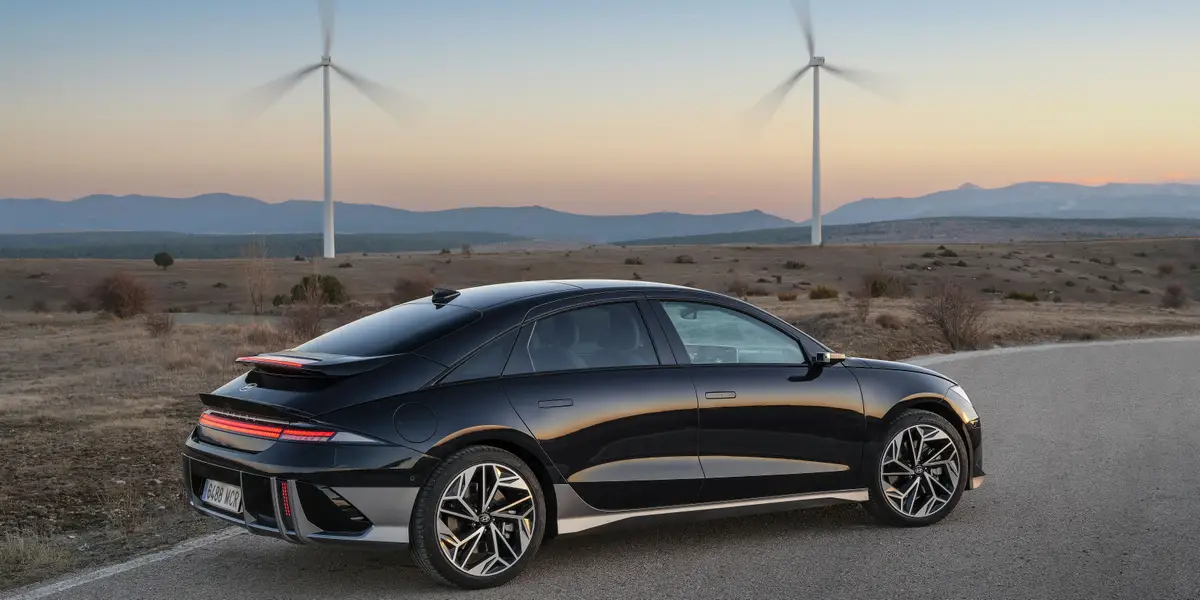
Hyundai Ioniq 6 Standard
Sjoerd van der Wal/Getty Images
Hyundai confirmed to Business Insider that it will stop selling the Korean-built, standard-range Ioniq 6 in the US.
The retro-styled sedan never matched the success of its crossover sibling, the Ioniq 5 (which the company said saw a surprising 33% sales increase in February).
Hyundai said it sold just 229 Ioniq 6 units last month.
“Sedan sales have declined a lot over the past decade, and the Ioniq 6 is no exception,” Sam Abuelsamid, the vice president of market research at Telemetry, told Business Insider. “Without enough sales to justify US production, the numbers just don’t add up for Hyundai.”
Hyundai said it plans to import a limited number of high-performance Ioniq 6 N models to the US — a pricier variant with more oomph in the electric motor and track-focused upgrades.
“In the meantime, 2025 Ioniq 6 sedans continue to be available at dealers alongside our award-winning, US-assembled Ioniq 5 and Ioniq 9 SUVs,” the automaker said.
The Ioniq 6 will still ship to Canadian dealerships.
2026 Hyundai Kona Electric
Hyundai
In 2019, Hyundai electrified its popular Kona crossover, swapping the gas engine for a battery-powered drivetrain.
It became one of the automaker’s first mass-market EVs.
That run is now on pause. Hyundai said in February that it would not ship the 2026 Kona Electric from its Korean plants to US dealerships. Like the Ioniq 6, the Kona Electric remains available in limited numbers as a 2025 model.
The model could return for the 2027 model year.
With a starting price around $33,000, it was one of the cheapest EVs on the US market in 2025.
Tesla Model S
VCG/VCG via Getty Images
The Model S was critical to Tesla’s historic ascent.
When the sedan debuted in 2012, it was the company’s first ground-up vehicle — and a sharp break from the slow, quirky EVs that came before it.
With hypercar-like acceleration, sleek body lines, and a tech-forward cabin, the sedan made going electric feel aspirational rather than a legacy automaker’s compliance exercise.
That shift helped propel Tesla into America’s dominant EV automaker.
Now, despite its historic role, CEO Elon Musk says the $94,990 sedan is headed for an “honorable discharge” after years of sliding sales.
Tesla Model X
Tesla
The Model X is also going the way of the dodo.
Tesla’s second built-from-scratch vehicle will end production in the second quarter of 2026 amid soft demand. The SUV starts at $99,990.
Launched in 2015, the Model X was ambitious. And complicated.
Its signature second-row falcon-wing doors — which opened by pivoting upward via electronically connected hinges mounted to the roof — became a production headache.
Musk once called the car a “Fabergé egg.“
The production lines that made the two vehicles will now build the company’s Optimus robots.
“We’re really moving into a future that is based on autonomy,” Musk said while announcing their final days, adding that the decision was “slightly sad.”
Kia EV6 GT, EV9 GT
David Benito/Getty Images

Kia is also tweaking its EV plans — but more narrowly.
The Korean automaker is delaying the GT trims of two models, the EV6 and EV9. Those versions are the highest-performance variants in each lineup.
Kia confirmed to Business Insider that the GT trims are delayed “until further notice” due to “changing market conditions.”
Other trims — which are made at Kia’s plant in West Point, Georgia — remain on sale in the US.
“This delay does not impact the availability of other trims in the EV6 and EV9 lineups,” the company said.