
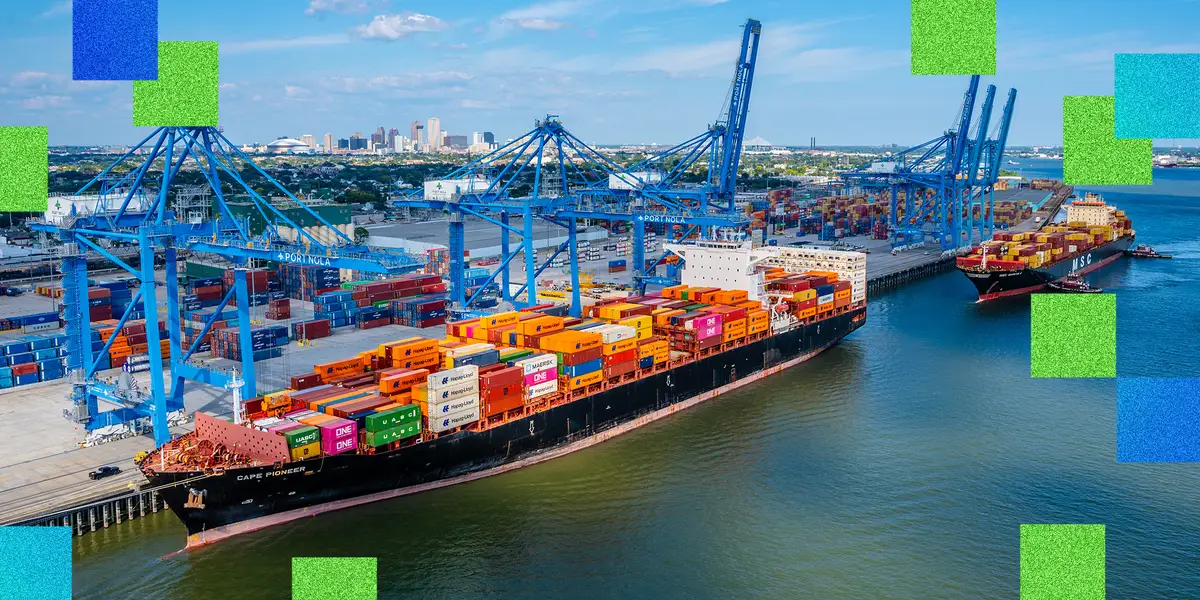
At the Port of New Orleans, a cargo ship docks. On board are power transformers, wind turbine components, and industrial generators used to construct data centers in the US.
Moving these unwieldy pieces of equipment inland from the port is a massive logistical undertaking: The cargo is often too heavy to travel by road, and dimensions must be considered to ensure the parts will fit through rail structures.
With these complex logistics in mind, the port kicked off a partnership in late May with the New Orleans Public Belt Railroad and a new logistics company, UTC Transoceanic, to deploy AI to help plan oversize moves.
Instead of workers pulling from static drawings and entering data manually in spreadsheets, the AI — which is in its deployment and implementation phase — will use digital twins and predictive modeling to determine whether cargo can safely travel its route. It will also pull in real-time data, because railroad tracks can shift slightly with temperature changes, according to the Federal Railroad Administration.
“The primary benefit is speed and certainty,” Kimberly Curth, Port NOLA’s press secretary, told Business Insider.
Once the application goes live, an importer will be able to enter their cargo’s dimensions and weight. The AI will compare those specs against the digital model of the rail network to determine if the cargo can move safely. If it spots any issues such as bridge clearance heights, maximum weights, or other physical restrictions, the AI can recommend an alternative route, Curth explained.
Beyond the Port of New Orleans, other seaports are also dabbling in AI. The Port of Corpus Christi in Texas deployed AI and digital twins to track vessels, while the Port of Los Angeles amped up its truck appointment system with AI. The Georgia Ports Authority, which oversees ports in Savannah and Brunswick, is rolling out opt-in AI-based facial recognition for truck drivers arriving at terminal gates. PortCity, a logistics provider up the road from Savannah, recently deployed EAIGLE’s technology to automate truck gate check-ins and check-outs.
Still, it’s early days for AI at ports, and real-world examples in the US are limited. Ports are “quietly testing” AI, but the technology hasn’t “been rolled out to the level of everybody within the port community adopting it,” said Lauren Beagen, the founder and CEO of The Maritime Professor and a former project manager at the Massachusetts Port Authority who also worked as an attorney with the Federal Maritime Commission.
Quiet testing in a risk-averse industry
One reason for slow AI adoption is that ports and terminals “have never been risk takers,” said Rene Alvarenga, vice president of products, AI, and execution visibility at Kaleris, which provides terminal operating systems to 80% of the world’s terminals.
Cybersecurity is a significant concern, and most terminals have on-premise networks to keep sensitive data local. But that also makes it slower to integrate cloud‑based or third‑party AI, Alvarenga said.
In addition, maritime transportation is a critical infrastructure sector, and if terminals go offline for software overhauls, goods moving through the supply chain may not reach their destinations. As a result, terminals tend to lag other industries on AI adoption by about five years, he added.
Many operators use systems from the late teens, long before generative AI existed. “If you go to any marine terminal today, you won’t find any AI in the terminal operating system,” Alvarenga said.
The handoff points between port stakeholders are also consistent sources of friction, said Amir Hoss, the founder and CEO of software company EAIGLE, which provides gate and yard AI automation for warehouses and marine terminals.
Different entities own and operate the cargo ships, marine terminals, railroads, trucking companies, and the chassis that secure containers onto trucks or railroads — each with its own tech systems and data practices, Hoss said.
“It’s arguably a bigger barrier than the technology itself,” Hoss said.
Still, there are many potential AI use cases at ports. Traditionally, coordinating a large industrial shipment like the ones arriving at the Port of New Orleans would require weeks or months of engineering studies, communication with multiple railroads, and the collection of fragmented data, said Curth. With AI that assesses cargo dimensions and a digital twin of the rail network, the Port of New Orleans can give customers an answer almost immediately and more accurately determine whether a route is feasible for a specific piece of freight, Curth said.
Some port and terminal employees are also using AI models like ChatGPT or Claude for day-to-day administrative work, such as sending emails, invoicing, or billing, Beagen said. Terminals have added chatbots to their websites for customer support, so a cargo owner can ask the status of their container and receive an AI-generated answer, Alvarenga said.
“The internal productivity boost from generative AI is real in marine terminals, just like in any other industry,” Alvarenga said.
A future AI copilot?
When Alvarenga speaks to terminal operators, he said he often fields questions about how AI could act as a copilot to workers.
Someone working in a terminal’s control room could ask problem-solving questions to an AI in natural language, like, “There’s a long line at the gate. How do I reduce it?” Or if they’re unsure how to do something technical, they can ask AI rather than flipping through hundreds of pages of manuals. The AI would respond in natural language with step-by-step solutions, Alvarenga said.
This application isn’t yet in place at US terminals, but operators are expressing interest in AI as a copilot, said Alvarenga. He added that he predicts real use cases will materialize in about three years as ports begin to implement the technology.
The Port of New Orleans also views its AI project as a way to aid humans. Curth said the technology will quickly provide information, but railroad personnel, terminal operators, and logistics professionals will still use their judgment to plan how an oversize piece of cargo moves through the supply chain.
“The strongest applications combine advanced technology with human expertise,” Curth said.