


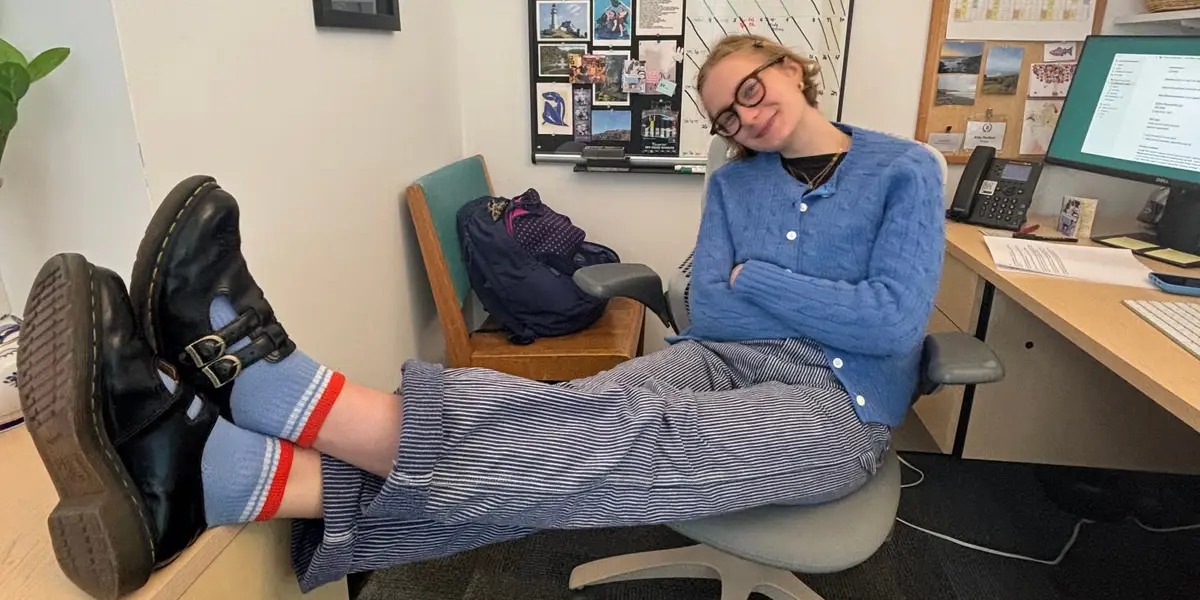
When I was in college in New York City, I loved the theater department so much that it became a punchline: my friends and I joked that after graduation, I would take a job there and stay forever. Little did we know that would actually become my reality.
After earning my degree in May 2022, I faced an uncertain job market in an industry still struggling to recover from the COVID-19 pandemic, which had forced my hands-on theater program to transition to remote learning.
Even though I was beginning to build a freelance career in theater, I wanted a day job to offer some stability in an unpredictable field. So, when a job as the administrator of my college theater department opened up, I applied, and a yearslong joke came true.
On paper, it was the perfect position: stable, better-paying than a comparable administrative role at a commercial theater, with ample time off and the flexibility to freelance as a director and writer. Above all, it was something I loved doing — managing the operations of a place I knew inside and out, surrounded by colleagues who had been my teachers, mentors, and friends for years.
In reality, the job was so much more than that: It allowed me to retrace the footsteps of my college self in a way I never would’ve imagined.
The theater department became my lifeline, but after a while, it made me feel stuck in the past

Celia Krefter
At the start of the pandemic, I was a sophomore in college. Like universities everywhere, we had to adjust to online learning, with campus operations not “returning to normal” until the spring of 2021.
So, two years later, by the end of my senior year, as I started preparing to say goodbye to a place that had become a lifeline, I balked.
I thought it was unfair that half my undergraduate career had been in a virtual or hybrid format, and this sense of betrayal froze me in my tracks. So, because I felt I hadn’t had a full college experience and that I was unprepared to make the high-stakes choices required of graduates, I decided to stay.
There’s a touching scene in Greta Gerwig and Noah Baumbach’s film “Frances Ha,” in which the titular character returns to her alma mater as a resident assistant for a summer program. Frances, expecting to fall back into the comfort of her old routine, shows up for a dance class only to be told it’s just for students. It’s a bittersweet moment in which she is forced to realize that, even if she doesn’t feel like it, she has grown up.
Want more Business Insider in your news feed?
Add BI in Google so our reporting is easier to find when you’re searching for what matters.
I felt some version of this embarrassing alienation almost every day at work. Not only did I miss being a student in the department more than I was willing to admit, but I yearned for the experiences I never got to have. I couldn’t help but feel jealous as new generations of students enjoyed field trips to theater productions around New York City, studied abroad, and took classes I would never get to take.
I watched each class of graduates displace me further from my own school days with a mixture of pride, melancholy, and envy that they were ready to inhabit the world beyond these halls.
Why couldn’t I bring myself to do the same?
It took 4 more years, but I finally felt ready to leave
Kate Purdum
Despite these complicated feelings, I thrived in my job. The more I did, the more confident I became, until one day I looked around and realized that both my skill set and my confidence had grown beyond my circumstances.
I produced dozens of plays, elevated the visibility of our productions within the university and beyond, built lasting professional relationships with individuals I admire, and most importantly, helped students find their artistic voices.
In the end, forces outside my control dictated my exit, and after four years in the role, my job was eliminated as part of restructuring. I was heartbroken — and almost immediately relieved.
Having this choice made for me was easier than making it for myself: I could leave the party while I was still having fun.
I had stayed for an additional four years, an entire college life-cycle, and in that time, the school and I had both changed.
I realized I had finally maximized what I could learn at the place that taught me most of what I know. This, I thought, is how people are supposed to feel at the end of college. It was time to use what I had learned without losing the fondness for the place I had loved as a student.
Leaving felt like a second graduation, except this time, I actually feel prepared to leave the world of higher education behind and pursue a career as a freelance writer and director.
Without the sometimes messy, painful, wonderful experience I had in that job, I might never have felt prepared to make that leap.