
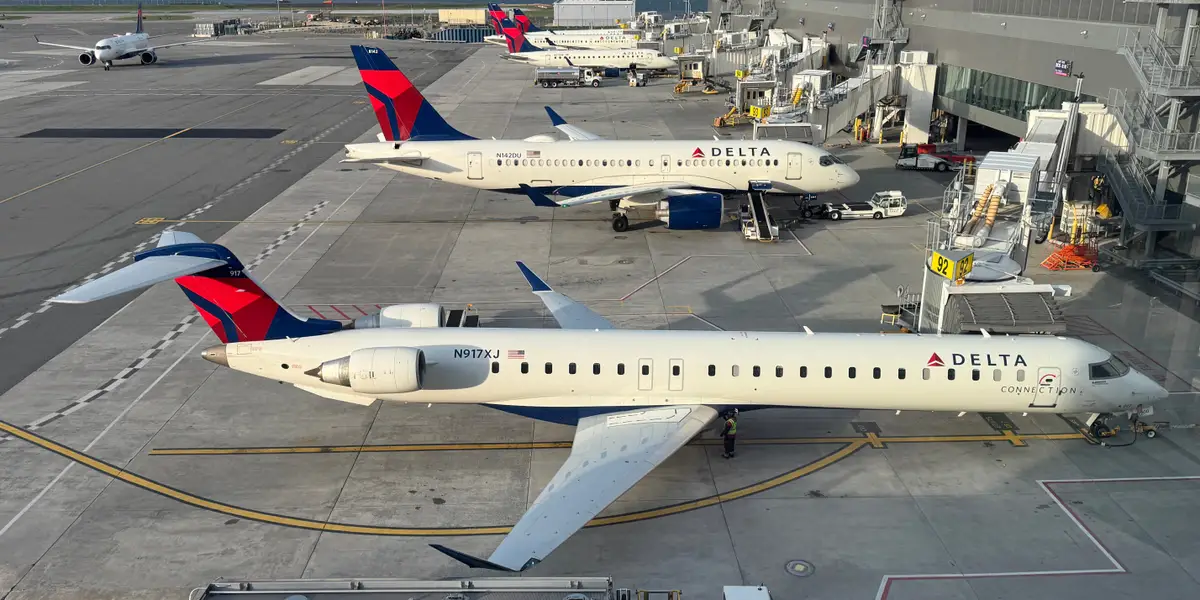
President Donald Trump’s threat to “decertify” Canadian-made aircraft — the backbone of many US carriers’ regional jet fleet — is a threat to aviation safety, industry watchers said Friday.
The president also doesn’t have the authority to unilaterally declare planes unworthy to fly in the US, Henry Harteveldt, an aviation industry authority and president of Atmosphere Research Group, told Business Insider. That authority belongs to the FAA.
The trade spat — another in a continuing back-and-forth between Trump and Canada — comes after Canada hasn’t fully certified newer US-made Gulfstream jets to fly in its skies. (It has certified older models.) Gulfstream planes are used almost exclusively by private aviation companies, governments, and the ultrawealthy.
Trump said on Thursday night, in a Truth Social post, that he would “decertify” Canada-made Bombardier jets until Canada approved the Gulfstream models. He also threatened a 50% tariff on “any and all” Canadian aircraft sold in the US until the situation was corrected.
Bombardier said in a statement that it’s in contact with the Canadian government. The FAA referred Business Insider to the White House. A White House official said decertification would not immediately affect aircraft already in operation; it would apply only to new deliveries.
That would be a relief for US airlines like American, Delta, and United, whose regional affiliates operate Bombardier CRJ aircraft to cities across the country.
Fabrizio Gandolfo/SOPA Images/LightRocket via Getty Images
Still, any move to decertify these more than 2,000 passenger airliners and private jets — part of almost 5,550 Canadian-made aircraft and helicopters certified in the US, according to Cirium — could trigger thousands of flight cancellations a day. A 50% tariff would likely raise airline ticket prices.
Aviation analysts said Trump’s threat posed a safety risk in itself.
“Anything that intrudes on the turf of safety regulators coming from politics, trade issues, or personal grievances is a very, very bad idea,” Richard Aboulafia, managing director of the aviation consultancy AeroDynamic Advisory, told Business Insider.
Aboulafia said aircraft certification is intentionally non-political for a reason: Regulators are meant to evaluate risk, not respond to trade threats. Once certification becomes a political weapon, trust in the system erodes for manufacturers, operators, and the flying public, he contended.
Why is the Gulfstream certification delayed in Canada?
In Canada’s case, the delay in certification is likely not obstructionism but the result of independent regulatory decisions.
For the Gulfstream G700 and G800, Canada hasn’t completed its own certification, while the FAA has granted Gulfstream a temporary exemption from certain fuel‑icing rules designed to ensure aircraft engines and systems operate safely in extreme cold.
The FAA waiver means Gulfstream has until the end of this year to meet those requirements — meaning the aircraft is operating under essentially conditional certification in the US, despite being allowed to be delivered.
These waivers are not unusual and are typically granted to allow new aircraft to enter service while completing certain technical tests and paperwork, rather than because the planes are unsafe.
Still, history shows what can sometimes go wrong when thorough certification and safety protocols are deprioritized. The most consequential example was the Boeing 737 Max, which suffered two fatal crashes in 2018 and 2019 due to systemic design issues, killing 346 people.
More recently, in early 2024, a door plug separated on another 737 Max due to quality-control issues at Boeing’s Washington factory, further exacerbating scrutiny of production and certification. No one died in that incident.
Part of the reason the 737 Max issues slipped past regulators is that, for decades, global authorities often relied on reciprocal approvals, effectively rubber-stamping each other’s certifications to speed aircraft to market.
The Max disasters exposed the risks of that approach. Today, regulators — including those in Canada — are expected to conduct their own full assessments rather than automatically rely on approvals from foreign authorities.
The FAA itself is taking extra precautions before certifying the Boeing 737 Max 7 and 10, as both aircraft have technical problems that could lead to engine overheating. Boeing initially asked for a waiver but rescinded it amid the scrutiny.