



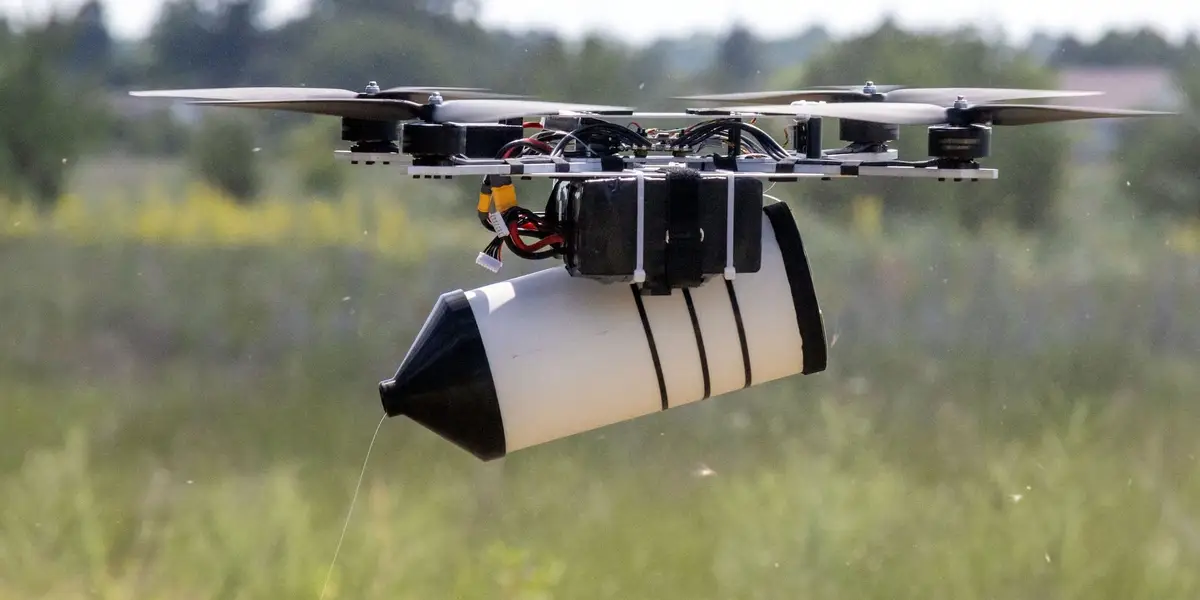
A major drone maker said Ukrainian soldiers surprised it by packing one of its drones with more explosives than the company ever thought it could carry.
When loading up an attack drone with explosives, combat units are limited by how much weight it can carry and still fly. Batteries, cameras, and other essential equipment also take up some of that capacity. That doesn’t stop soldiers from pushing the equipment to its limit.
“One of the most surprising videos I’ve seen recently is that one of the units has managed to put the huge explosive part on our drone,” Oleg, an executive at TechEx, told Business Insider.
The drone was carrying “something like five or seven kilos, and they managed to fly into the building and put it completely to the ground with one single FPV.”
“I was like, ‘How do you literally put this amount of explosives on one single FPV?’ But it managed to carry this on and did the mission,” the TechEx exec said, speaking on the condition that he be identified only by his first name for security reasons.
TechEx lists a maximum payload of two kilograms for three of its NATO-codified fiber-optic drones: the Stalker XO-10 China-Free, Stalker XO-15 MAX PRO, and Stalker XO-13.
Weight is a major constraint for Ukraine’s drone makers, who are constantly trying to accommodate more firepower and bigger batteries, as well as heavier weapons and cameras. It’s a constant trade-off, with every gram mattering.
Soldiers fighting for survival often push beyond advertised limits. Last year, a sergeant major in a heavy bomber company told Army Inform, Ukraine’s defense ministry media, that while a Bat drone can fly up 8 kilometers and carry up to 12 kilograms, his unit pushed it to fly a little farther and carry a little more.
Weight is an important consideration for TechEx drone development. The company advertises its “ultralight fiber optic reel” as one of its product advantages. Last year, Ukraine’s Ministry of Defense characterized TechEx’s Stalker series as having a “record-low spool weight among Ukrainian fiber-optic drones.”
Want more Business Insider in your news feed?
Add BI in Google so our reporting is easier to find when you’re searching for what matters.

Jose Colon/Anadolu via Getty Images
The struggle with weight is particularly acute for fiber-optic drones because, in addition to gear like batteries, they have to carry the spool containing the fiber-optic cable that trails behind them, maintaining a connection with the drone operator. The cable makes them resistant to enemy jamming, but the added weight limits how many explosives they can carry. The cable spool can weigh several kilograms on some drones.
Olha, a TechEx representative, told Business Insider that the company developed its own technology to reduce spool weight, making “tiny tweaks and changes” to how the spool is assembled and the fiber is wound into it. Those adjustments allow the company to keep the spool lightweight while maintaining a stable connection and minimizing the risk of the cable breaking during flight.
The company needs the “perfect balance” to make sure it stays reliable and durable, as not all drone pilots have a wealth of flying experience, Oleg said.
The company faces trade-off decisions. Extending the range of its fiber-optic drones, for instance, would require larger cable spools, potentially leaving less room for explosives, Olha said. But not every drone needs a heavy payload. For some, speed and agility matter more.
Ukraine’s soldiers often surprise the manufacturers of their weapons with how they use and adapt their gear, with troops sometimes repairing and modifying equipment near the front lines and experimenting with new tactics.
Kuldar Väärsi, the founder and CEO of Estonian ground robot maker Milrem Robotics, previously told Business Insider that Ukrainian soldiers used the company’s technology in ways it was not expecting, including adding and attaching things to the robots. “Ukrainian troops are really creative, and they really find very simple ways how to get even more out of the equipment,” he said.
2CR
How gear is used in the field often informs how Ukraine’s defense companies update and modify their products. Soldiers give feedback to firms like TechEx every day, and companies send their own employees close to the fight to gather feedback and make changes.
Oleg said that TechEx receives direct feedback from soldiers constantly, resulting in weekly changes to its products. Without changes, a product in Ukraine “within three months, it will be outdated, and nobody will use it, because the industry is moving extremely fast,” he said.
TechEx encourages soldier experimentation, including by making its drones with parts that are interchangeable. Soldiers can swap components to repair damaged drones or combine parts to create configurations the company never designed.
“Part of what I think TechEx is really great at is the ability to customize,” Olha said.