
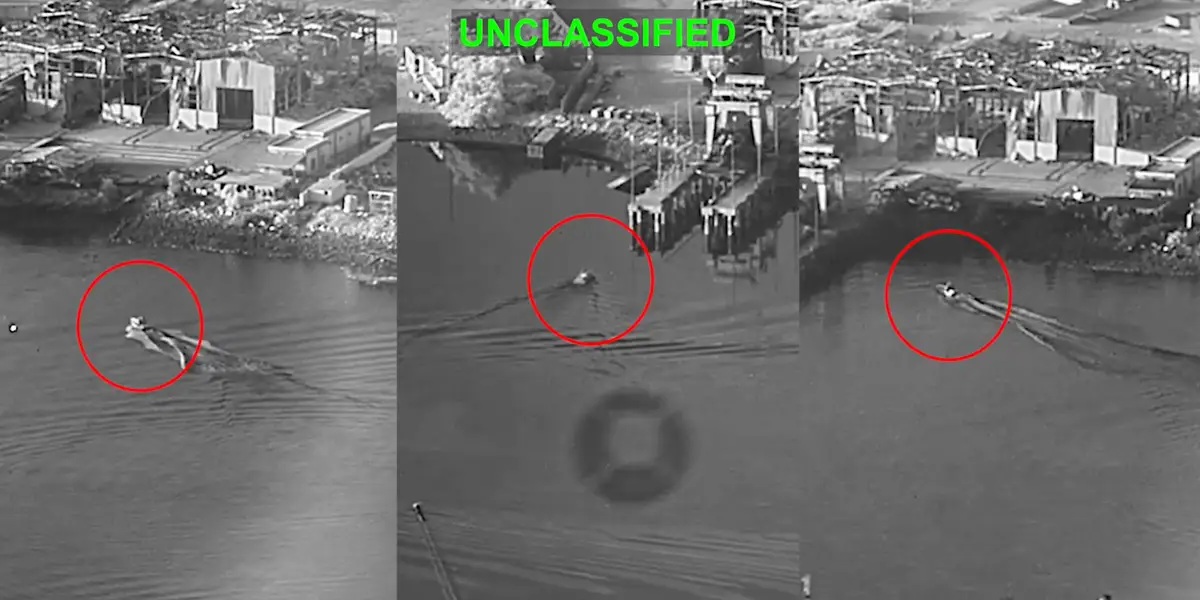
The US Navy’s new Saronic Corsair sea drones are getting a workout in the Middle East, pulling off operational firsts for the American military in both rescue and combat.
US Central Command revealed Monday that attacks over the weekend that targeted an Iranian submarine and ship maintenance facility involved three Corsair sea drones made by Saronic, an autonomous naval drone company. The company’s Corsair drones are 24 feet long, boast a range of over 1,000 nautical miles, and have a payload capacity of 1,000 pounds.
Video footage shared by the command online showed the drone boats maneuvering into the port area before hitting their targets, triggering a massive explosion.
Per Saronic, Corsair drones can support a variety of kinetic and non-kinetic missions, including intelligence, surveillance, and reconnaissance, and can be adapted to carry different payloads. CENTCOM said that the drones hit a port at Iran’s Bandar Abbas Naval Base, “marking the first time American forces have employed sea drones in combat operations.”
Last month, a Corsair drone rescued the crew of a downed US Army AH-64 Apache helicopter. The US accused Iran of shooting the aircraft down and responded with force.
The Corsair uncrewed surface vessel involved in the rescue mission belonged to Task Force 59, a Middle East-based unit focused on integrating new technologies into maritime operations.
At the time, Navy Capt. Tim Hawkins, a CENTCOM spokesperson, said the drone boat recovered the service members and carried them to another point in the water, where a helicopter picked them up. Hawkins said Task Force 59 had begun fielding Corsairs in the CENTCOM region in late March. The rescue also appeared to mark the first operational use of a US naval drone for such a mission.
US Central Command
These developments reflect US Navy efforts to integrate uncrewed capabilities into operations, as well as how these systems are reshaping US capabilities. During both combat and the persistent tensions between the US and Iran throughout a shaky ceasefire and negotiations, drones have played important roles.
The Navy, for instance, has also used uncrewed underwater vessels to help clear Iranian mines from the Strait of Hormuz. In April, CENTCOM announced that two Navy guided-missile destroyers, the USS Frank E. Peterson and USS Michael Murphy, were involved in efforts to clear the strait of mines, adding that additional forces, including underwater drones, would join clearance missions.
CENCOM has not identified which specific drones were used for clearing mines or how many mines have been disabled or destroyed. US officials have said Iranian small boats dropped mines that endangered US military vessels and commercial ships attempting to transit the region.
Among recent US military drone firsts was the use of Low-Cost Unmanned Combat Attack Systems (LUCAS) one-way attack drones during Operation Epic Fury to strike Iran. Announced in February, the use of LUCAS drones in combat for the first time came after CENTCOM stood up a new task force for the military’s first one-way attack drone squadron, Task Force Scorpion Strike, in December 2025.
LUCAS drones are developed by American engineering firm SpektreWorks; they’re low-cost systems modeled after Iran’s Shahed drones. LUCAS drones can be launched from catapults, vehicles, and mobile ground stations. The systems have rocket-assisted takeoff capabilities and “extensive” range, according to the Navy.