
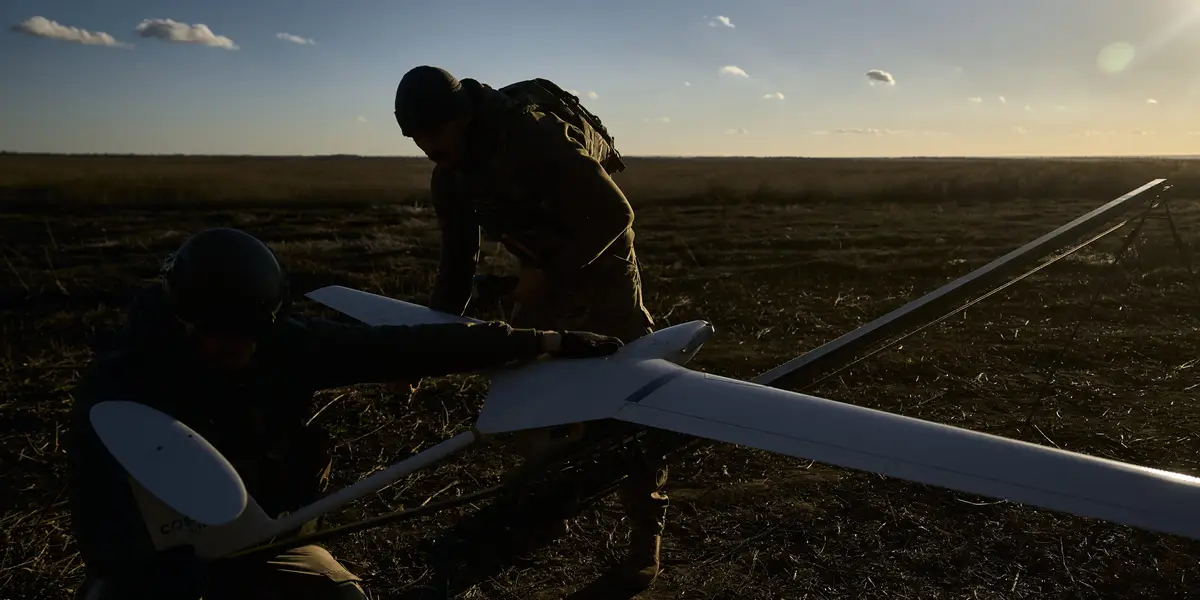
The US isn’t ready to detect and defend against hostile drone attacks, a detection company warned, echoing concerns raised by others about a growing threat.
Drones have become a defining weapon in Ukraine and a growing threat in the Middle East, underscoring how cheap, accessible systems can create serious security challenges abroad and at home.
Companies working on counter-drone technology warn that the US isn’t ready to meet the threat.
“I’m very concerned,” Kristian Brost, the general manager of the US division of Robin Radar, a company that makes drone-detection radars used by Ukraine and US allies and has contracts with the US, told Business Insider.
When he first entered the counter-drone space in 2024, Brost assumed that the US had figured out solutions to this problem.
“What I’m finding in the US, that is not the case,” he said.
“I’d say frankly, we’re probably behind Europe” when it comes to implementing counter-drone technology, he added. And the problem with the US is that “only the very top elite kind of law enforcement organizations protecting very critical infrastructure have any kind of drone detection technology.”
‘Marginally capable to defend’
Brost isn’t alone in his assessment of the situation. “Don’t listen to me,” he said. “Listen to our top military commanders who have openly said this.”
Earlier this year, Brig. Gen. Matt Ross, the commander for the Department of Defense’s Joint Interagency Task Force 401, a counter-drone unit, described drones as the “defining threat of our time” and emphasized the challenge of defeating them, warning that there’s “no silver bullet.” If there was, he said, the US would have it.
Last year, Rear Adm. Paul Spedero Jr., vice director for operations on the Joint Chiefs of Staff, said that should an “adversary choose to employ drones for surveillance or even attack, we would not be prepared to adequately defend our homeland and only marginally capable to defend our military installations.”
The situation has improved for bases and other military installations, Gen. Gregory Guillot, the head of US Northern Command and North American Aerospace Defense Command, said in March, but there are still extensive gaps in the defenses.
“We have more detection capability now than we did in the past, and then our ability to defeat them has improved,” he said in March. “Whereas a year ago, almost every one that was detected was not defeated. Now about a quarter of the ones that we detect we’re able to defeat.”
The Department of Defense issued updated guidance for countering uncrewed aircraft systems in the homeland last December after determining that the previous guidance was “inadequate to address the current, complex” drone threat environment, and then in January, the Department of Homeland Security created a new office dedicated to countering the drone technologies “increasingly exploited by malicious actors.” The UAS threat is constantly evolving, though.
‘What really concerns me’
Warnings about the drone threat come amid a spate of incursions across the US and Europe, and Ukraine shows what the threat can look like in wartime.
Diego Fedele/Getty Images
Relentless attacks on both military sites and civilian centers have forced Kyiv to build layered defenses that combine sensors, mobile fire teams, electronic warfare, interceptors, and traditional air defenses — infrastructure Western countries are now scrambling to build out before they face the threat at scale.
Many Ukrainian officials and soldiers have warned that the West is not ready, including the commander of Ukraine’s Unmanned Systems Forces, who said last year that “from what I see and hear, not a single NATO army is ready to resist the cascade of drones.”
On the civilian side, the picture isn’t much better.
Drone tech is inexpensive and readily available, lowering the barrier to entry on surveillance and precision strike, as the war in Ukraine and conflicts in the Middle East have repeatedly shown. Homeland defense, however, is often significantly more expensive and complicated by factors such as potential impacts to civilian activities, from communications to air traffic control.
Robin Radar is a Dutch company that has had its systems deployed in Ukraine since 2023. Its products are now increasingly used by US allies in the Middle East, with updates made from lessons learned on Ukrainian battlefields.
It is working with the US, including partnering with the Department of Homeland Security to provide counter-drone protection for the World Cup. Its involvement comes as President Donald Trump takes steps to strengthen counter-drone security around major events.
Brost said drones are worrying because they are relatively easy to operate, do not require much sophistication, and can threaten everything from “high school football games to nuclear facilities.”
“My 16-year-old daughter could research how to make her own drone and to arm it somehow,” given how much information is available online,” he added.
“I hope to God there’s not some sort of horrific event,” Brost said, but a lack of readiness has left the US at risk of receiving an unwanted wake-up call. It wouldn’t even “need to be a sophisticated state actor,” he said. And “that’s what really concerns me.”
DroneShield, an Australian counter-drone company with US operations and gear in Ukraine, has issued similar warnings.
The company makes counter-drone tech that detects, tracks, and disrupts drones by jamming their radio links. Matt McCrann, the CEO of its US arm, told Business Insider that awareness of gaps in US drone defenses is “snowballing.”
In the US, “there’s a lot of area to cover,” he said. Drones are threats to airports, critical infrastructure, energy installations, data centers, and sporting events as much as they are to military sites.
“We definitely have to expand our thinking as far as the potential threats and how we guard against them,” McCrann said.
European officials have also issued warnings about the continent’s readiness for drone incursions and warfare. EU defense commissioner Andrius Kubilius last year said that “we are not ready to detect Russian drones and to destroy them with cost-effective means.”
A series of drone incursions on the continent in recent months has disrupted major airports and seen NATO scramble fighter jets.
Air defense has been identified as a priority for NATO as its allies pledge a huge increase in defense spending, but the process still faces issues, as the defense industry faces capacity challenges and backlogs.