
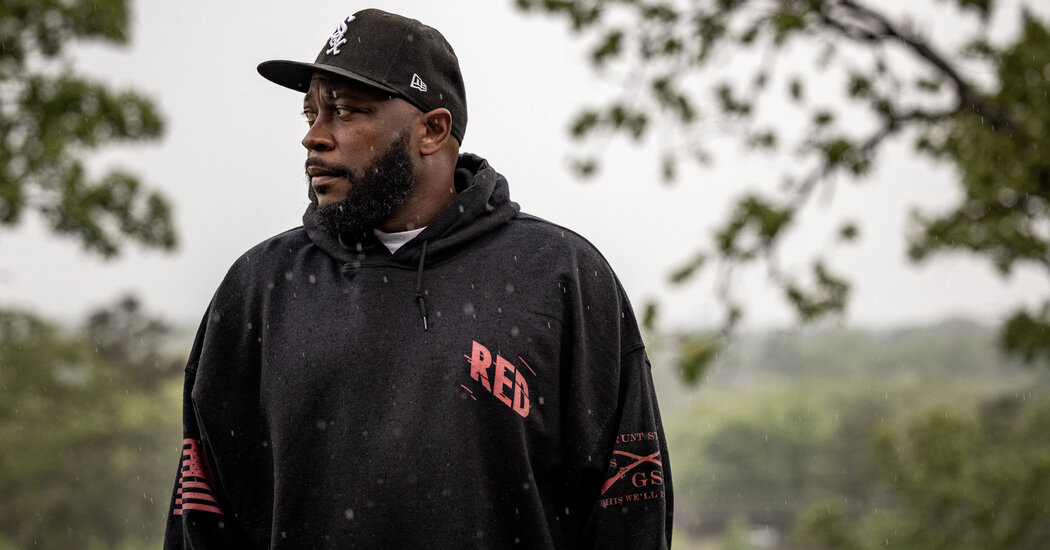
Early one morning in September 2020, Michael J. Hill called the police after hearing banging on the doors and windows of his home in Okmulgee, Okla. — part of a swath of the state that the Supreme Court had recently ruled to be tribal land.
He eventually realized it was a group of his friends, Mr. Hill later recalled in an interview, but the police had arrived and proceeded to arrest one of them, Aaron R. Wilson, for an outstanding warrant. Mr. Hill, 40, then got into an altercation with the police and was himself arrested after a struggle.
Mr. Hill and Mr. Wilson are both Black and citizens of Native American tribes in Oklahoma. They both moved to have their cases dismissed, arguing that as tribal members in tribal territory, they were outside the state’s criminal jurisdiction. Mr. Wilson’s case was dismissed, but Mr. Hill’s request was denied.
The key difference in the fate of the two men was race — specifically, a small degree of what is known in the courts as “Indian blood.” Mr. Wilson is one sixty-fourth Creek Indian. Mr. Hill is a citizen of the Cherokee Nation through ancestors called Freedmen — Black people who were enslaved by Native tribes. Because Mr. Hill’s ancestors did not have Indian blood, he was found in court not to be Indian.
“He’s a member of the Cherokee Nation,” Phillip Peak, Mr. Hill’s lawyer, said in court arguments. “Yet when he steps in this courtroom, all of a sudden he’s not.”
Mr. Hill is one of several Freedmen, as they are known for their ancestry, who have been caught in the middle of a feud between the State of Oklahoma and tribal nations after the Supreme Court ruled in 2020 that much of eastern Oklahoma falls within an Indian reservation. Their dilemma stems from federal court rulings that define what it means to be considered Indian in the eyes of the criminal justice system.
After the Supreme Court’s decision in the case, McGirt v. Oklahoma, hundreds of people successfully had their criminal cases in state courts dismissed, as the ruling prevents state authorities from prosecuting offenses committed by Native Americans on tribal land. Instead, those offenses can now be prosecuted only by tribal and federal authorities.
But state prosecutors have fought to continue pursuing some criminal cases involving Freedmen in tribal territory. In several cases reviewed by The New York Times, judges rejected arguments by Freedmen that they were outside the state’s criminal jurisdiction, ruling that the defendants did not meet the legal definition to be considered Indian.
Oklahoma’s highest criminal court sided with the state in one of those cases, paving the way for state prosecutors to continue bringing cases against Freedmen who are tribal citizens but have no Indian blood.
The state’s continued prosecution of Freedmen amounts to a new chapter in their long struggle to receive all the rights of tribal citizenship. Some Freedmen are not even allowed to become tribal citizens, because a handful of tribes exclude them from membership.
“They’re being treated differently than other members of the tribe based solely on their race,” Matthew J. Ballard, a district attorney in northeast Oklahoma and the chair of the state’s District Attorneys Council, said of the prosecution of Freedmen in state court. Freedmen who want to be considered Indian in court have “a nearly impossible burden” to meet, he said.
Tribal nations have said that state officials have at times refused to cooperate with their courts and police officers, and that working relationships with state agencies have soured after the McGirt ruling.
Tribal nations in Oklahoma have criminal justice systems that are generally less punitive than the state’s. Federal law limits sentencing in tribal courts for any criminal charge to three years and a $15,000 fine, and major crimes that occur in tribal territory are prosecuted in federal court. Many tribal courts also promote sentencing that emphasizes treatment programs for drug and alcohol use and mental illness.
“People ask, ‘Well, what’s the difference between you prosecuting this and the state?’” said Kara Bacon, the lead tribal prosecutor in the Choctaw Nation. “From a cultural perspective and from a member perspective, we understand that rehabilitation is important.”
Caught up in the dispute are the Freedmen, the descendants of Black people who were enslaved by Native tribes. Many tribes allied themselves with the Confederacy and fought to preserve the institution of slavery. After the Civil War, treaties between the federal government and the tribes abolished slavery and granted the Freedmen “all the rights” of citizens in the tribal nations.
But courts have typically used a two-part test to determine who is legally considered to be Indian: whether the person is recognized as an Indian by a tribe or the federal government, and whether the individual has Indian blood. Most Freedmen, even if they are enrolled in a tribe, do not satisfy the blood requirement, meaning they are not recognized as legally Indian in court.
“Sometimes the state courts will say: ‘Well, even though you might meet Part A, you can’t meet Part B of this test. Therefore, we are not going to dismiss your case from the state courts,’” said Sara Hill, the attorney general for the Cherokee Nation.
It is unclear how many Freedmen who are tribal citizens have been prosecuted in state court since the McGirt decision, because state officials have not specifically tracked those cases.
Mr. Ballard, the district attorney, said prosecutors in Oklahoma had been frustrated by having to navigate sensitive issues about race and identity.
“We’re having to inquire as to the racial identity of people that we’re prosecuting,” Mr. Ballard said, adding, “That is new territory for us.”
“Frankly, it’s a little offensive,” he said. “And we don’t like having to do that. But that’s what the case law is.”
Long before the legal wrangling over criminal prosecutions, rules surrounding Indian blood had been used by tribes to segregate and even expel the descendants of Freedmen. The Muscogee (Creek), Choctaw and Chickasaw Nations still exclude Freedmen from membership, making it harder for them to seek tribal jurisdiction.
Marilyn Vann, a Cherokee Nation citizen and the president of the Descendants of Freedmen of the Five Civilized Tribes Association, said the discriminatory practices of the tribes were now being wielded by the State of Oklahoma in criminal cases.
“Overturning this policy would take an act of Congress or another ruling from the high courts,” Ms. Vann said of the state’s prosecution of Freedmen, adding, “If no one is able to take this higher up the ladder, I doubt it’s going to change.”
Mr. Wilson’s path through the legal system — he succeeded in winning the dismissal of his case in state court, unlike Mr. Hill, on account of his Creek Indian blood — illustrates the tensions between state and tribal authorities.
Mr. Wilson, 44, had been arrested on an outstanding warrant for violating his probation after pleading guilty to driving under the influence of alcohol.
After his case was dismissed in state court in 2021, he was not immediately charged by the Muscogee (Creek) Nation. But Muscogee tribal officials said that the district attorney’s office for Okmulgee County, which had handled the case in state court, never notified them of the dismissal and that they found out about it only when contacted by The Times.
“The fact that we did not learn of this case until we received notice from a third party speaks to the absence of a cooperative, functional relationship with the Okmulgee County D.A. following the McGirt ruling,” said Jason Salsman, a spokesman for the Muscogee Nation.
An arrest warrant was issued for Mr. Wilson days later and remains active, according to the Muscogee Nation. The district attorney’s office for Okmulgee County did not respond to requests for comment, and efforts to reach Mr. Wilson were unsuccessful.
Mr. Hill, the Cherokee Freedman who got in the altercation with the police, faces several charges from the incident, including assaulting a police officer, and his case has not yet gone to trial. A disabled Army veteran who served in Afghanistan, Mr. Hill said that he had struggled to continue paying for his legal defense and that the episode had aggravated trauma from his military service.
“It just makes things 10 times worse,” Mr. Hill said. “I’m more isolated. I don’t want to do anything. I stay at home. If I’m out somewhere and see the police, I get extremely nervous.”
Mr. Peak, the lawyer for Mr. Hill, said that seeking tribal jurisdiction in the case was a matter of principle for his client.
“He enjoys every other benefit, every other responsibility, every other right of being a Cherokee citizen,” Mr. Peak said. “It’s backwards. I don’t understand it.”