
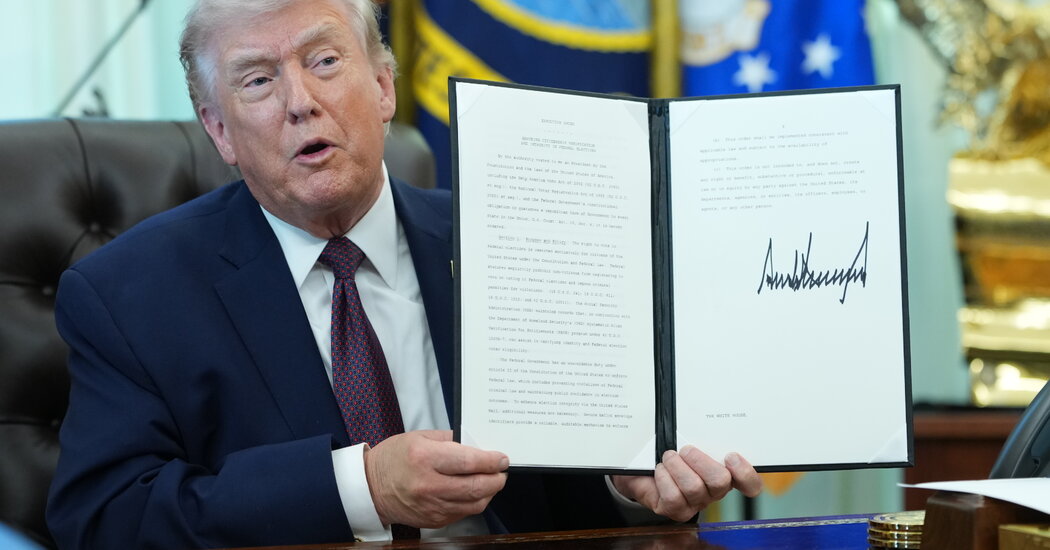
President Trump is seeking to create state-by-state citizenship lists, saying they are necessary to block noncitizens from voting, a virtually nonexistent issue that the president has described as widespread despite his own administration’s inability to substantiate the claim.
“I think this will help a lot with elections,” Mr. Trump said in March before signing an executive order directing the Department of Homeland Security to create a list of citizens in each state that could be used to help determine voter eligibility.
Mr. Trump has been pursuing similar policies since his first term. In 2019, he called on the government to compile citizenship data after a failed attempt to include a citizenship question in the 2020 census.
More recently, the president has championed a strict voter identification bill, now stalled in the Senate, which called on states to use federal databases to identify noncitizens.
Democratic-led states and voting rights groups have sued to block the executive order on a number of grounds, including that the Constitution does not grant the executive branch explicit authority over elections.
During a recent hearing in Federal District Court in Washington in a lawsuit challenging the order, the Justice Department acknowledged the lists would likely be unreliable for determining voter eligibility.
Here are some practical, legal and historic implications of Mr. Trump’s proposal.
A citizenship list is bound to be incomplete.
Unlike in other countries with national identification cards, there is no single document that denotes U.S. citizenship.
Only about 54 percent of Americans have passports. Social Security cards, which are generally issued to Americans at birth, can also be possessed by noncitizens. Naturalized citizens do not have U.S. birth certificates, which prove citizenship by birthright. And no central index exists for naturalization records, according to the National Archives.
According to Mr. Trump’s order, his lists would be based on citizenship and naturalization records, Social Security records and other federal databases.
His directive instructs the Department of Homeland Security to send the lists it compiles from that data to each state. It then invites states to send the U.S. Postal Service their own lists of voters eligible to cast ballots by mail at least 60 days before a federal election. And then it instructs the service to send states another set of lists of individuals “enrolled with the U.S.P.S.” to participate in mail voting.
At the court hearing, lawyers challenging the order argued that any lists the government created would be immediately out of date.
An administration lawyer acknowledged that “no list is ever going to be perfect.”
Creating citizenship lists using federal data could violate privacy laws.
According to the Privacy Act of 1974, “no agency shall disclose any record” to another agency without written consent from the person whose records would be shared.
Certain exceptions to the rule are allowed, and one such exception says that information can be shared in “civil or criminal law enforcement activity” as long as the enforcement activity is legal.
There are also strict regulations the government must follow if it would like to conduct a “matching program” using a computer program to compare different records databases.
Lawyers challenging Mr. Trump’s order argued that it would be impossible for the government to create a list that does not violate the Privacy Act in some way. Judge Carl J. Nichols indicated that it was too early to know if the government would violate privacy laws.
Justice Department lawyers said that the government had not yet decided how to carry out the executive order. They did not explain how the citizenship lists would adhere to the Privacy Act.
The federal government has not maintained citizenship lists.
The United States has used various methods to certify citizenship since the 18th century, but the country has never had a central citizenship registry.
In the hearing, lawyers for the Trump administration said that the proposed citizenship lists could have a variety of lawful uses, including helping to verify eligible voters and law enforcement operations.
David J. Bier, the immigration studies director at the Cato Institute, a libertarian-leaning think tank, said that the rights of both citizens and noncitizens could be violated if a flawed database was used for either aim.
“Absolutely it’s an abuse when it comes to our rights,” Mr. Bier said. “If it’s contingent on the accuracy of a database, then automatically you end up with problems.”
Mr. Trump’s effort to create a citizenship list comes on the heels of other challenges to the very nature of U.S. citizenship. On his first day back in office, Mr. Trump attempted to revise the longstanding understanding of birthright citizenship, an order that is now pending before the Supreme Court. His administration is also in the process of trying to strip U.S. citizenship from hundreds of naturalized Americans.