
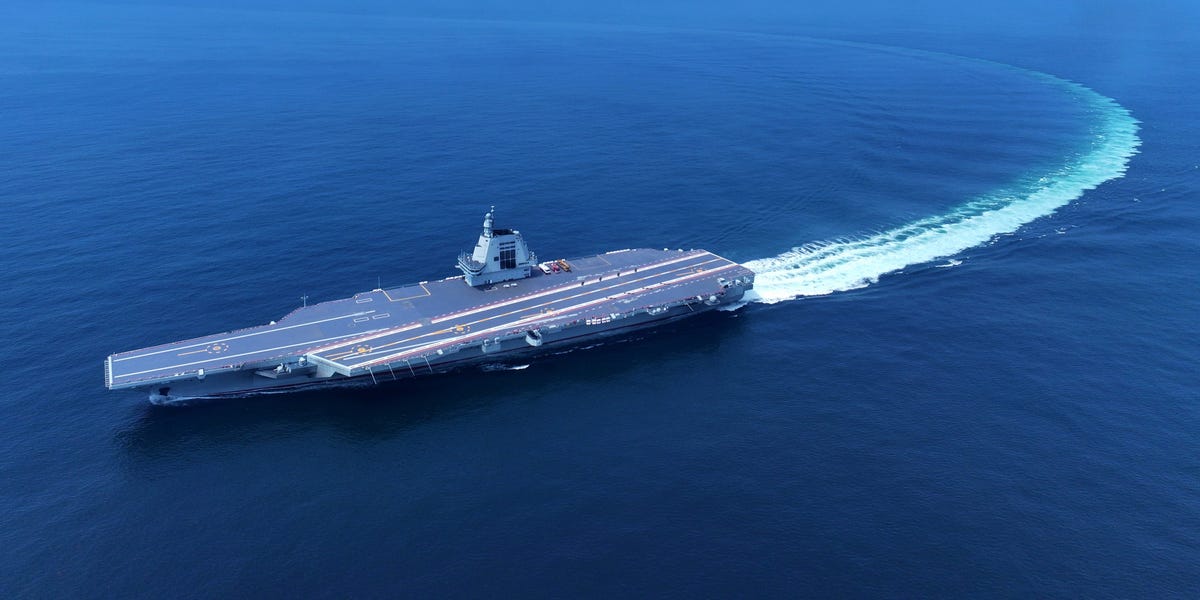
China is making leaps and bounds with carrier technology. It recently showed off its newest aircraft carrier launching jets with electromagnetic catapults, a capability once unique to the US Navy’s cutting-edge Ford-class flattops. And it did it with stealth jets, something the US has yet to do.
But while Beijing’s carriers may be nearing America’s in technological capabilities, experts say they’re still a long way from fighting like them. The real challenge isn’t building ships. It’s building the experience, crews, and doctrine to use them.
“You can engineer and build something much quicker than you can build up a group of people to operate it,” Bryan Clark, a retired US Navy submarine officer and defense expert at the Hudson Institute, told Business Insider.
China has three aircraft carriers. The first two, the Liaoning and Shandong, are operational, but the newest one, Fujian, is completing sea trials. The former two are Soviet designs with ski jumps for launching aircraft. Fujian is a major improvement with its electromagnetic catapults.
The US Navy, on the other hand, has 11 nuclear-powered aircraft carriers. All of China’s vessels are conventionally powered, although there’s evidence that it’s pursuing a nuclear-powered design. Furthermore, while only one of China’s carriers has a catapult, all of the US carriers have catapults. Nimitz-class ships are equipped with steam-driven catapults, while the new first-in-class USS Gerald R. Ford has electromagnetic ones.
China’s active carriers feature a fleet of fourth-gen fighters. The US ships carry a mix of fourth- and fifth-gen jets. But the main difference in the fleets is in the depth of experience. While China has been building a carrier fleet for over a decade now, the US Navy has been operating carriers since the early 20th century.
China is quickly catching up on the technological side
Sun Xiang/Xinhua via Getty Images
Last month, China released video footage of the Fujian launching a J-35 stealth fighter, J-15T carrier-based fighter, and KJ-600 early warning and control aircraft via its electromagnetic catapult systems. The clips were distributed by state media and show carrier crews readying the aircraft for takeoff, launching them off the top deck, and recovering them using arresting cables and tailhooks.
Expert observers noted how quickly China’s navy moved from no aircraft carriers to Soviet designs to a modern one with electromagnetic catapults. Not only is China catching up to the latest technology, but it skipped the steam-driven catapults completely.
The electromagnetic catapults on the Fujian let China launch a more diversified air wing of not just fighters but also airborne early warning and control assets. Combat aircraft can take off fully fueled and also fully armed for improved combat effectiveness.
Whether that capability is fully mature remains to be seen.
Related stories

Business Insider tells the innovative stories you want to know
Business Insider tells the innovative stories you want to know
The recent launch footage was a test run filmed while the Fujian is still completing sea trials under managed conditions. It’s a state-sponsored video that doesn’t shed light on challenges. The videos alone are not enough to assess whether the Fujian’s systems are ready to operate reliably in all weather, day and night, under the stress of combat.
“The Chinese have reached this milestone,” Clark said. “But they probably lacked the capacity on board the ship to do it at scale and over a sustained period.”
Looking at the air wings
Official US Navy photo
In the recent footage, China showed sailors launching the Shenyang J-35, a fifth-generation stealth fighter widely viewed as Beijing’s answer to the F-35 Lightning II stealth fighter. The launch made China the first nation to launch a stealth aircraft with electromagnetic catapults. The Gerald R. Ford has yet to be certified fully for launches of the F-35C, the stealth fighter’s carrier-based variant.
However, US Navy carriers, specifically Nimitz-class carriers, have not only launched and recovered but also deployed with the F-35C, a combat-proven platform. F-35Bs have also been deployed on amphibious warships and foreign carriers. Like the jets, American carriers have been tested in combat. China’s J-35 is a relative black box.
China’s primary carrier-based fighter is the Shenyang J-15, an exceptionally heavy derivative of a Soviet design. The ski jumps limit the effectiveness of the jet by putting takeoff weight constraints on it, while the new catapults allow China to maximize the jet’s combat power while employing upgraded variants.
The US Navy, on the other hand, still predominantly relies on the F/A-18 Super Hornet and electronic warfare EA-18 Growlers. The Navy can notably employ its aircraft in greater numbers than China; US carriers can support a larger air wing, usually 60-70 aircraft.
China’s aircraft carriers can also support rotary-wing aircraft like the US Navy, and now with the Fujian, China’s People’s Liberation Army Navy can also field airborne control and early warning plans like the KJ-600. Serving in a role like the US E-2D Hawkeye, these planes allow a Chinese carrier group to see much farther than helicopters or ship radars, allowing for better coordination and more complex operations.
Operational experience and expertise take time
US Navy photo by Mass Communication Specialist 2nd Class Tajh Payne
The US Navy has decades of experience with carrier operations with highly skilled technicians and operators. The Navy has run continuous global carrier deployments for decades, from peacetime patrols to major wars, from WWII to Vietnam to the Gulf War to more recent wars and fighting in the Middle East.
China is still new to aircraft carrier operations and is likely relying on a smaller group of people who’ve gained experience over the past decade or so, meaning that the workforce isn’t comparable yet. China’s carriers have only recently begun sailing beyond coastal waters, mostly in the Western Pacific, with very limited long-duration missions, so the fleet has not yet been stress-tested in the same way.
“They just don’t have the kind of core you would need to do this on a multi-shift basis across an entire carrier fleet,” Clark said, highlighting that while the US has officers managing catapult operations and recovering aircraft, those jobs on Chinese aircraft carriers are filled with much higher-ranking personnel, hinting that experience is limited to a smaller cadre of senior figures.
The US has multi-generational institutional knowledge built into its Navy schools, training commands, and simulation centers. China is starting from scratch — its “first generation” of carrier sailors are only now moving into senior leadership roles. Likewise, China is still experimenting with its doctrine, while the US Navy has had the opportunity for extensive iterative innovation.
China has been focused on training enlisted personnel for technician and operational carrier roles, “but it takes time because you have to build up an entire generation of people,” Clark said. It can be expedited by having personnel doing more tours and increasing their experience, but it can’t be skipped in the way that some technological and engineering hurdles can.
To run these carrier operations, especially in a conflict scenario, China will need to build that out.
There’s also readiness at sea to consider for a carrier fleet. The US has spent decades learning how to keep complex vessels sailing and sophisticated warplanes flying in harsh environments.
Warships are supported by a global web of supply ships, repair hubs, and carefully managed maintenance cycles. China may have a massive manufacturing workforce and can bring in personnel with technical backgrounds, but it’s still learning how to handle the wear and tear on carrier-based aircraft and how to sustain large flattops with regular overhauls and at-sea resupply. These are essential skills that only come with time and experience.
What’s next?
VCG/VCG via Getty Images
As the US Navy continues to build Ford-class carriers, ships currently behind schedule, China is continuing to run its new aircraft carrier through sea trials. Once it’s certified for operational status, the Fujian will join the Liaoning and Shandong and help expand Beijing’s maritime presence in the Indo-Pacific region.
There are expectations that China will expand its carrier fleet further, and its massive shipbuilding juggernaut has the momentum to build that. But there’s a technological hurdle it may seek to overcome beforehand to facilitate its blue-water ambitions.
China’s carriers are all conventionally powered, meaning that without refueling support abroad, they have limited reach. Beijing appears to be working on nuclear-powered propulsion tech for a future carrier though. China already operates nuclear-powered submarines, but all surface ships are conventional.
China is suspected to have begun work on a fourth carrier, but it’s unclear if it will feature nuclear power. If it is, it’ll be another significant example of the leaps China is making in aircraft carrier technology. But like everything else, new technology also comes with a host of new challenges and learning curves. China will need to continue to build personnel with experience and skillsets to clear those obstacles to effective operational use.