
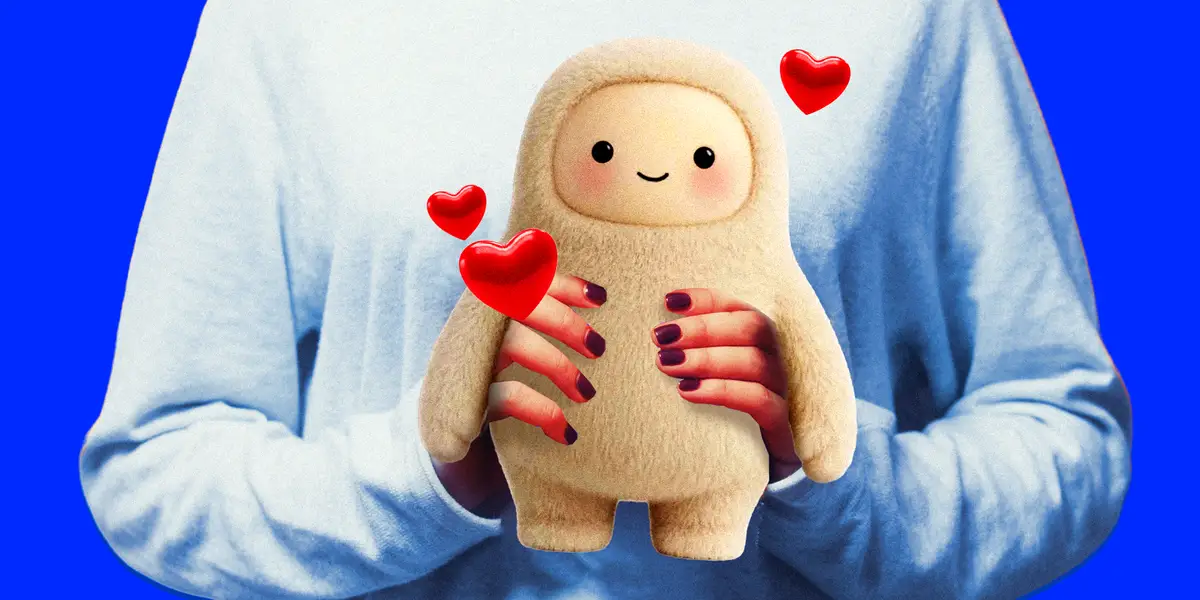
Jolly wants to help make your life easier — and be cute while doing it. The mascot for Meta’s Muse AI is a slightly rotund, plush creature with rosy cheeks, big eyes, and a toothless grin. It can wear clothes or little headphones when he’s “working” on tasks for you.
As someone who once went through some (embarrassingly) elaborate hoops to acquire a Labubu, I must admit that I was immediately enamored by the creature’s debut. I’m not alone — much ink has been spilled on how cute the little avatar is. Jon Stewart even devoted a whole segment to debating the cuddly guy’s true intentions.
Jolly joins a growing group of creatures vying for the hearts and minds of potential AI users. There are the round, mouthless dots of OpenAI, the fluffy Genspark lobster, and Grok users have adopted a little teal alien named “Groklet.” All adorable, all plushy, and all debuting as the general populace was starting to worry that AI would maybe kill us all.
The idea behind Jolly and the rest of the mascots is simple: make us forget about all that AI doom-and-gloom and learn to love it. They play on our most human, primal instincts, distancing us from the fact that they represent something distinctly non-human. This round, fun little creature is your friend! He’s going to work on your behalf! The fuzzy little charms also tap into our sense of nostalgia. Everyone I spoke to for this piece immediately had a connection to the Muse avatar: Some said it reminded them of a Tamagotchi, or MySpace avatars, or Baymax, the lovable robot from Big Hero 6.
“Seeing something cute stimulates the pleasure centers in your brain before you’ve even had a chance to think about it,” Joshua Paul Dale, the founder of the niche academic field “Cute Studies,” and a professor at Chuo University in Tokyo, tells me. “You’re predisposed to act socially towards something that you find cute.”
It’s not the first time that cuteness has arisen in response to a collective sense of unease. In the past, the trait has been wielded as a comforting salve, a PR pivot, or to put a smiling face on something more complex. Cute has proven to be a powerful tool, and AI companies hope they can ride that wave into America’s hearts — and computers.
The most visible — and successful — use of cute culture was in Japan following post-World War II. Fluffy mascots, manga, and stationery were used to shift the narrative about the country away from its aggressive, imperial history toward one of an approachable cultural destination. This shift is best personified by Hello Kitty, the now-ubiquitous cat-like mascot created in 1974 as an emblem of kawaii, the Japanese term for cute. Designed to appeal to Japanese women with newfound spending power — and their children — the cat avatar has since become a literal cultural emissary, bringing comfort to Japan’s citizens and promoting the country’s image elsewhere.
KAZUHIRO NOGI/AFP via Getty Images
Beyond Japan, the deployment of cute as a culture-shaping force seems to repeat across the years. Gen Zers embraced Y2K nostalgia during the pandemic — a marked contrast to their Zoom-first era. Another 2020 hit was the video game “Animal Crossing: New Horizons,” as gamers stuck at home clamored for the coziness of tending to animated life. Cultural theorist Sianne Ngai calls cuteness “an aestheticization of powerlessness” — for a consumer to feel something is cute, they need to feel they can wield power over it, giving them a sense of calm control. On the grim end, cuteness was used by Purdue Pharmaceuticals in its campaign for OxyContin: the company handed out plush toys to practitioners whom they wanted to convince to prescribe the drug. The Drug Enforcement Administration later said the tactic was “an indicator of Purdue’s aggressive and inappropriate marketing.”
AI companies clearly appreciate the persistent power of cuteness. It’s easier for you to ask a question to your little buddy than a gray box — and why not buy a few more tokens so Jolly can book your next vacation or sift through your finances. For University of Iowa business analytics professor Thiago Serra, the branding has echoes of Tesla. Rather than consumers feeling like they have to take their eco-conscious vitamins and pony up for an electric car, Tesla made cars that looked and felt good — the environmental thing was a nice added bonus. For agents, adding a mascot shifts your thinking from the scary AI that might kill you or take your job to a cute buddy that can be helpful in your personal life.
Rebecca Kowalewicz, a digital marketing VP and millennial-Gen-X-cusper in Philadelphia, dabbled with a few AI platforms, but none were as fun as Muse. Jolly played on her sense of bygone days, reminding her of choosing a MySpace avatar. And Kowalewicz went one step further: She fed the software a photo of her late dog, Doctor Watson — a rescued coonhound pointer mix — and it quickly generated an animated version of him to replace Jolly. Now, Doctor Watson smiles at her, types, and moves his head. She’s so endeared to the agent that she feels more inclined to stick with it.
“It’s almost like having a work bestie,” she says, except it won’t push back and “you don’t have to take it out to lunch.”
Courtesy of Rebecca Kowalewicz
In addition to personifying inanimate ideas or technologies, coziness and cuteness can also psychologically soothe us in uncertain times. Take Japan: already steeped in postwar cuteness, the country saw a renewed boom in coziness after its property bubble burst in 1990. People said it felt healing, Dale tells me, temporarily easing their woes amid financial and job-market upheaval. Similarly, agents can endear themselves to users by solving a task that causes dismay — with a little smile.
That’s been the case for edtech consultant Tonja Brunn, a Gen Xer who — like many white-collar Americans — is on the job hunt. That search is how she and “Monkey,” her Muse agent, first “connected.” Monkey has “revolutionized the job search” for Brunn, and she’s fallen in love with how cute her newest “employee” is. Seasonally appropriate, Monkey now wears a little shirt with a pumpkin and two cherubic ghosts.
Tonja Brunn via Muse
A friendly avatar helping you plug away at all of the worst parts of the job search is the latest attempt by AI companies to target a new segment of customers: Everyday folks who were turned off by the early, austere chatbots and spooked by the rush of AI doomer news.
When Cole Benefield, the 25-year-old founder of Servo, an agentic firm for service businesses, first saw the Labubu-esque creature, he thought it was silly. Then he saw the promotional materials for Jolly, happily typing away at a keyboard. The business owners he works with probably wouldn’t be too amused or charmed by the fuzzy guy. But the greater mass appeal of Jolly revealed something: While other AI firms signal their tech-industry bona fides with clever model names and sterile interfaces, Meta’s years of honed consumer prowess have allowed it to reach a wider swath of consumers. Benefield says Meta’s use of Jolly means non-technical users never have to think about what’s happening under the hood.
“Their goal is to make it to where they never even have to think about that,” he says.
Kaitlyn Murphy, a 26-year-old tech publicist in Massachusetts, questions how much AI agents could improve her day-to-day life — especially given the access they require. Despite the skepticism, when she first saw Jolly, she felt tempted to make her own version.
“I love the idea that I could watch it typing while I’m sending it on a task. I actually do think it’s really cute,” she said. The Jolly aesthetic could definitely appeal to cute-obsessed Gen Z, she said, but it would have to go hand in hand with a meaningful attempt to address the larger AI doom-and-gloom concerns many in her generation still hold.
The fact, though, that someone like Murphy is swayed shows the potency of personifying these agents. They also come at a time of tanking consumer sentiment and increasing worry about the economy, making the idea of a pinchable, smiling face even more enticing.
“I do have psychologist colleagues who are speculating that Japan might’ve hit peak cuteness, that people are being overstimulated by it, and that’s certainly possible,” Dale says. “But my answer to that is that outside Japan, it’s only getting started.”
Business Insider’s Discourse stories provide perspectives on the day’s most pressing issues, informed by analysis, reporting, and expertise.