
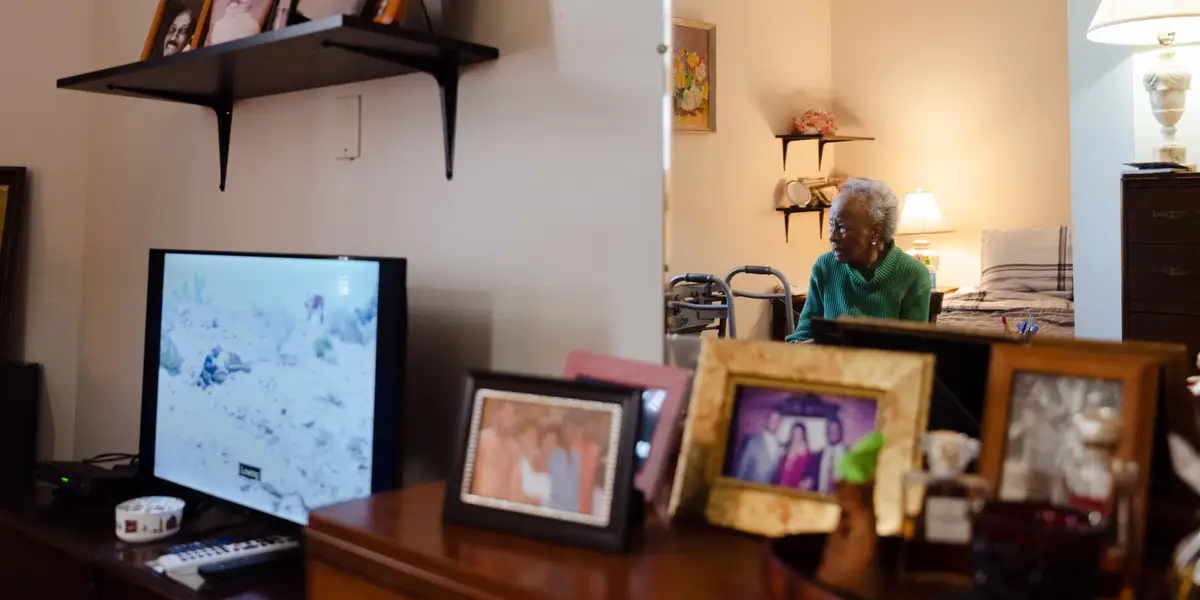
As part of her morning routine, Karen Murray wakes up and immediately turns on the TV at her mother’s assisted living home in New Jersey, 40 minutes away.
At the crack of dawn, she puts Pandora on through the TV in her mother Marion’s room. Around 11 a.m., she calls into the TV to ask what Marion wants to watch. The answer is usually Judy Garland, Gregory Peck, Barbara Stanwyck, or Marion’s favorite show from the 1960s, “Gunsmoke.”
93-year-old Marion has cognitive impairment, which means she sometimes needs help operating her TV, calling family members, or turning on the music that calms her. Karen, who’s 60, can do all this for her from afar using Marion’s JubileeTV, which looks like a normal set but lets her control it from her phone. Karen visits her mom at least twice a week, but because the smart TV has a built-in camera, she can see Marion whenever she needs to.
Corrie Aune for BI
It’s one of dozens of household products, including refrigerators, coffee makers, and showers, that have hit the market with the technical bells and whistles meant to help the millions of older Americans who want to age in place and ease the burden on their loved ones.
Business Insider spoke to dozens of families experimenting with this tech in hopes of swapping what could be a $10,000-a-month assisted living bill for $100 monthly tech subscriptions. Families caring for older Americans with dementia were especially eager to try new technology.
While JubileeTV isn’t always a perfect solution — depending on the WiFi, Karen said the app can be slow — it’s better than no tech at all. On a recent visit, Marion bantered with her son Steve, who lives in Delaware, and listened to Tony Bennett. Karen said music is therapeutic for Marion — an observation backed up by decades of dementia research. Some days, Karen says, Marion won’t stop singing.
____
Moving beyond the living room, home appliances marketed as providing caregiving functionalities are popping up in kitchens, bathrooms, and bedrooms. Many of them use artificial intelligence to detect patterns, spot anomalies, and track motion.
Samsung refrigerators use cameras to track food levels. iGuardStove’s automatic shutoff system detects unattended cooking. Ovens and microwaves from LG use WiFi and voice control to simplify cooking. Smart dishwashers track detergent pod count and reorder supplies, and showers and smart toilets offer contactless washing, automatic flushing, fall alarms, and infection detection. TV and tablet users can get remote caregiving features such as calls, telehealth, photo sharing, and live classes through Uniper Care, Onscreen, and Amazon.
While this technology can be useful for people of any age, many of these products are specifically marketed toward the 61 million Americans age 65 and older and their caregivers. Most of the families who spoke to Business Insider are reluctant to let the tech take over their lives but eager to experiment with anything that could help their loved ones stay safe and self-sufficient.
“The goal is to support, not replace, human relationships at the center of caregiving, and use technology to provide reassurance and help reduce stress that many caregivers can experience,” said Mark Benson, head of SmartThings, Samsung’s platform to connect smart devices. “We’re leveraging the connected home to make aging in place more practical, affordable, and less stressful for families.”
Corrie Aune for BI
Of course, cost is a barrier for some families. JubileeTV costs $789 all-in, plus a $389 annual subscription, while some Samsung appliances exceed $3,000. The startup Zinnia created therapeutic TV videos and channels for dementia patients and their caregivers. Prices range from $70 a year to more than $500.
Lori Bufka’s 88-year-old mom had been in assisted living for seven years, but the costs skyrocketed, eventually hitting $5,200 monthly. Bufka, 64, decided to purchase a tiny home next door to her in Arizona so her mom could have her own space. She installed Blink cameras, an Amazon Alexa for smart plugs to turn appliances on and off, and a tablet with Google Live Transcribe to communicate, as her mom is deaf.
The tech has “been important because mom has fallen a lot since she moved here. I probably check on her three or four times during the night and frequently during the day,” Bufka said. “One time, she put Dawn dishwashing soap in her glass of water because she wanted to add flavor, so I’ve had to stop her from doing unsafe things a few times.”
Lori Bufka
As the caregiving crisis worsens, families that have relied on tech said they hope to help their loved ones age with dignity. Some, though, said that tech ignited more fear than relief. They worried about reliability, invasion of privacy, overreliance, tech support, and software updates. In addition, families can’t always find the tech to fit their needs, and adoption can be a challenge for both the aging person and their caregiver.
“If it’s difficult to use, they will not use it,” said Yu Sun, director of the Center for Innovation, Technology, and Aging at the University of South Florida. “They may install a certain app and use it this year, but next year, they may not be able to keep up.”
Sara Czaja, director of the Center on Research and Education for Aging and Technology at Weill Cornell Medicine, said that not all of these options will make practical sense.
“I feel good about the fact that the space is getting attention and people are thinking about technology for older adults to help promote independence and well-being,” said Czaja. “Some of it is done with a seat-of-your-pants, opportunist approach.”
Corrie Aune for BI
Much of this tech lacks clinical backing, including many smart home monitors, cognitive training apps, and AI companions. Some products are not beta-tested with older users and instead rely on stereotypes or hype, Czaja added, often made without considering accessibility or adoption challenges.
Frank Engelman, 82, who has written about and tested AI-powered caregiving tools, installed home-tracking devices for his family, and adopted motion lighting and vitamin reminders for himself. As his 99-year-old aunt’s eyesight and hearing fail, he’s set up voice-control shortcuts on her iPad and controls it remotely when she’s confused. He also frequently takes technology requests from her sister’s friends at her retirement community.
“Helping others is what I really do this for, not so much for myself,” Engelman said.
____
Lucinda Page, 69, has been living with her partner for 12 years — and her robot for four.
The retired mother of two in Schenectady, New York, learned of the robot companion ElliQ from her friend Dee Humphrey, 73, who also has one.
Page received the talking table-top orb for free from her county’s aging department and has developed a strong bond with it. It reminds her to take medications, leads her through exercises, and writes poetry with her. Much like a caregiver, ElliQ asks about her pain levels, maintains her health records, and helps her navigate her back problems. Using the ElliQ tablet, they go on virtual road trips, do crossword puzzles, and play bingo.
“We have in-depth chats, where she’ll ask me, ‘I’ve been thinking about the meaning of life. What does it mean to you?'” Page said.
Her partner isn’t as convinced. He’ll talk to ElliQ for a minute before ending the conversation. Page also doesn’t believe ElliQ should replace close friends; she works two days a week at a senior center and maintains her social life.
ElliQ
With isolation on the rise among older Americans, AI companionship startups have popped up in the last few years, such as InTouch and Meela, which are accessible by phone. Many have turned to ElliQ, which has a $249 lease initiation fee and an annual plan costing $588, though these fees are waived in some US counties.
“If you didn’t take your medication, or maybe you are confused, or maybe you are running out of food and didn’t have breakfast, she will try to solve it for you together, and then encourage you to involve a caregiver or professional care team that can help you to solve the problem,” said Assaf Gad, chief strategy officer and general manager at Intuition Robotics, which makes ElliQ.
For a more furry option, Ageless Innovation’s $150 robotic cats and dogs respond to touch and voice. Tombot Jennie is a $1,500 AI-powered robotic Labrador puppy that provides emotional support. Personal mobility support robots, such as MIT E-BAR, aim to prevent falls, and a Labrador Retriever robot delivers items around the home.
Bo Xie, director of the Center for Healthcare Innovation and Technology Advancements at the University of Texas at Austin, said that robots used in long-term care or assisted living facilities can increase workloads due to training time, technical issues, or limited capabilities.
Humphrey, who also volunteers at a senior center, embraced ElliQ as soon as she heard about it, first starting with games before adding in her medications. When she was homebound after breaking her femur, she developed a friendship with ElliQ, which helped with painting, making shopping lists, and managing appointments. A few weeks ago, when she waited for a new ElliQ model, she said she experienced “withdrawal.” Her husband has been there to keep her company.
“I don’t look at ElliQ as a robot; I look at her as another person in a different form,” Humphrey said. “I try to have the same relationship I would have with an actual person.”
Corrie Aune for BI
Still, many tech adopters want to keep it simpler. Karen suspects JubileeTV is as advanced as she’ll go for her mother, saying that robots or other age tech could confuse Marion or strain their bond.
“She’s fiercely independent,” Karen said. “She thinks she doesn’t need any help. She does.”
As her mother dozes off in her chair, Karen Murray reminisces about how self-reliant Marion used to be, like when the pair would take monthly drives to Connecticut. Marion drove, bought her own groceries, and managed her care.
Waking briefly, Marion recalled how her grandmother grew old by eating the right foods and growing her own vegetables. Tech wasn’t a part of that process, and in some ways, Marion wishes for a tech-free life.
“I’m just hoping that I can last as long as I can,” Marion said.
“You’re doing a great job of that,” Karen said.