
Louis Fawcett’s wife doesn’t love the credit card points game like he does, though she does enjoy the perks — when she actually uses them. They make most of their purchases with two elite American Airlines cards to build up loyalty points and status. Whenever it comes time to do something points-related, Fawcett’s wife just hands him her phone. “She’s a more laid-back person,” Fawcett, 53, says.
She’ll join him in American’s Admirals Club, which she jokingly calls the “poor people’s lounge,” but she skips out on the “rich people’s” Centurion Lounge, which Fawcett can now access thanks to a recently acquired Amex Platinum card. (The reluctance is partly due to the $50 guest fee.) She doesn’t always take advantage of the American benefits, either — a few years ago, Fawcett upgraded to first class on a family trip from South Carolina to Hawaii. His wife opted to sit in the main cabin with the kids. “‘That’s your choice,’ I said, ‘but don’t tell me I’m snooty because I’m in first class when you have to walk past me to go back in the tiny seats,'” he says.
As rewards credit cards have become more lucrative — not to mention more expensive and complicated — these kinds of inter-relationship divides are increasingly common. Consumers have become amateur point strategists in an attempt to maximize bonuses, accumulate points, and jump on every opportunity to make their premium plastic worth it. Taking full advantage can require spreadsheets and deep dives into the fine print to identify exactly which purchase should go on which card and make sure no rewards-related stone is left unturned.
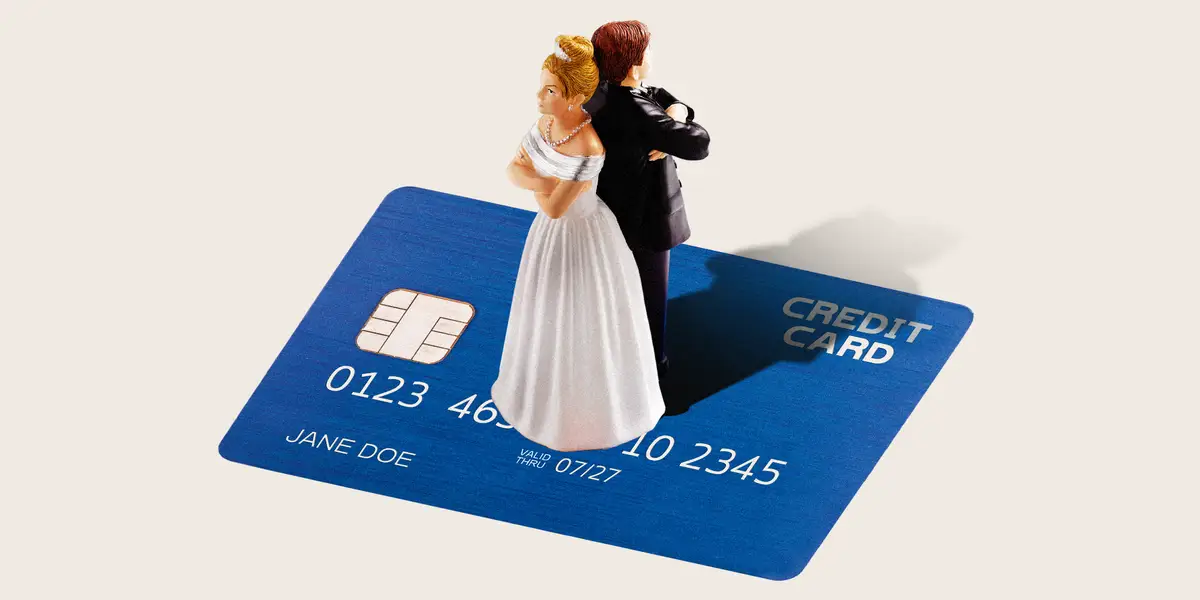
This has created a new financial dynamic in many households, where one partner effectively becomes the points point person while the other opts out (or opts for a different approach). This mismatch can reveal stark differences in how couples think about money and require some delicate negotiations over how to spend or save.
Fawcett’s wife has been the one to bend on his rewards obsession. On a recent trip to the Dominican Republic, she joined him in the lap of first-class luxury, while the kids were left to fight it out with the riffraff in coach.
People tend to seek out partners who are their financial opposites, explains Scott Rick, an associate professor of marketing at the University of Michigan and the author of “Tightwads and Spendthrifts: Navigating the Money Minefield in Real Relationships.” Big spenders are attracted to penny-pinchers, money maximizers who want to constantly comparison shop to satisficers who are generally fine with good enough.
“If you encounter someone with your problem, I think it can really be a turnoff, because it just really reminds you of your own stuff,” Rick says. “The mismatch, at first, can be really intoxicating and intriguing.”
If one partner really wants to maximize points, is it about the points or is it about feeling like you have enough for the future?
Couples wind up with what Rick and other researchers coined a “fatal (fiscal) attraction,” a reference to the 1987 film. Once people settle into relationships and real life begins, the exhilaration of a partner’s novel approach to money can wear off and the cracks start to show. It’s one thing when the free spirit in the equation is spending a bit too much on Amazon when a pair first starts dating, it’s another thing when finances are intertwined, and the cheapskate starts worrying that shopping habit could make it hard to keep up on the mortgage.
“The stakes can sort of ratchet up on you,” Rick says.
Misalignment on rewards cards isn’t nearly as grave as, say, one partner thinking another’s spending is a terrible influence on their kids, but it can point to underlying issues or bigger differences.
“A lot of times, these asymmetries or this tension between partners isn’t about the money, it’s more about what it represents,” says Jenny Olson, an assistant marketing professor at Indiana University’s Kelley School of Business. Perhaps for one person, money represents freedom and fun, and to another, it’s more about security and stability. These conflicting goals and values can raise deeper emotional questions. “If one partner really wants to maximize points, is it about the points or is it about feeling like you have enough for the future?” she says.
My Business Insider colleague, Jane Zhang, confesses she’s a points fanatic — she’s got a notes app cheat sheet on which cards she should use for which purchases. Her husband’s not so convinced these gymnastics are worth it. If it were up to him, they’d probably have one card. They’ve found common ground where they can. He doesn’t put up a fuss if she takes a beat to decide which card to use when they’re out. She recognizes that it’s OK for him not to be rewards-maximizing every little thing. “I just trust that it’s worth it, whereas he’s like, ‘I don’t trust that it’s worth every inconvenience,'” she says.
Even two points enthusiasts can find themselves at odds — especially when it comes to where loyalty lies. That’s the case for Matthew Williams and his husband in San Francisco. Williams, who’s originally from Arizona, and his family have long been dedicated to Southwest Airlines, and he’s had a card from them for years. His husband is a “big points guy,” but also a “United guy.” After the pair met in 2018, they were so attached to their respective airlines and rewards setups that they flew separately to the same destinations.
The scheme worked until it didn’t: In December 2022, Williams got ensnared in Southwest’s operational meltdown on a visit to his parents. He had to sprint across the airport to get their apartment keys to his husband after his Southwest flight was canceled. “After that, I was like, ‘This really is not a great system,'” he says. “We ended that after that fiasco.”
He still has the Southwest card, but he also got a Chase Sapphire card that’s less restrictive, so he can book whatever — including United, which his husband is still sticking with.
When couples find themselves in a bit of a rewards card standoff, they should interrogate the “why,” says Megan McCoy, a financial therapist and associate professor at Kansas State University. It might be a personality difference — one person is more detail-oriented, or maybe one side thinks the gamification aspect is fun.
“If someone’s anxious, then the partner can have empathy around that anxiety,” she says. “If it’s from a gamification, I love to win, I want to beat the credit card company, maybe there’s other outlets for it.”
Get to a point that you can win over someone’s heart in the game.
As with many things in a relationship, simply talking can go a long way. Many people assume that any money-related conversations will be negative, so they come into them angry and anxious or put them off until there’s a problem.
“Couples expect talking about money to be worse than it is,” Olson says.
People don’t need to know everything about their partners’ financial habits, Rick warns. They don’t need to be combing through financial statements to scrutinize each line item and make sure every point and card was used to perfection. It is good to have a sense of the broad strokes, though. “It’s more about maintaining this balance between the economics and a functioning relationship,” he says.
Chris Hutchins, the creator and host of the “All the Hacks” podcast, tells me he hears “all the time” about rewards card-related relationship conflicts, including in his own household. Like many savvy optimizers, he sometimes opens up credit cards in his wife’s name to take advantage of sign-up and referral bonuses. One time, he forgot to keep her in the loop (or she at least says he did), and she was surprised to find out about a new card in her name. “Now, I make sure there’s an actual conversation,” he says.
Hutchins also notes that disputes can arise not only when accumulating rewards points but also when using them. One person wants to stay at a certain hotel or fly a certain airline to use points, while the other would rather do the thing they want to do, regardless of what their memberships dictate.
“One of the things that points does that is frustrating is that it locks you into thinking that you can only travel in a certain way,” he says. The family really wants to go to Hawaii, but they’ve only got the points to go to Phoenix for free.
Credit card companies have done a very good job of convincing us that racking up points and gaming the system are worth it, and so rewards cards are yet another relationship battlefield. The best way to approach it is for people to communicate— and for the superfan to take responsibility for keeping everything straight. Hutchins also suggests a novel way to convince the skeptics: take them on a lavish, points-paid trip.
“Get to a point that you can win over someone’s heart in the game,” he says.
Emily Stewart is a senior correspondent at Business Insider, writing about business and the economy.
Business Insider’s Discourse stories provide perspectives on the day’s most pressing issues, informed by analysis, reporting, and expertise.

