
What's Hot

    More proof that broad-market index funds stay unbeatable, even within the period of AI stock-picking | Invesloan.com

    October 9, 2026

    Brian Anthony Williams arrested in San Diego after posing as chef | Invesloan.com

    October 9, 2026

    Aaron Sorkin Wanted to Make Mark Zuckerberg Uncool in ‘the Social Reckoning’ | Invesloan.com

    October 9, 2026
    Facebook Twitter Instagram
    Finance Pro
    Facebook Twitter Instagram
    invesloan.cominvesloan.com
    Subscribe for Alerts
    • Home
    • News
    • Politics
    • Money
    • Personal Finance
    • Business
    • Economy
    • Investing
    • Markets
      • Stocks
      • Futures & Commodities
      • Crypto
      • Forex
    • Technology
    invesloan.cominvesloan.com
    Home » Photos Show Life in Cuba Before and After the Castros Came to Power | Invesloan.com
    Money

    Photos Show Life in Cuba Before and After the Castros Came to Power | Invesloan.com

    October 9, 2026Updated:October 9, 2026
    Share
    Facebook Twitter LinkedIn Pinterest Email

    On New Year’s Day 1959, Cuba woke up to a new reality.

    By the 1950s, the island had established itself as a tourism hot spot and cosmopolitan travel destination, thanks to its entertainment, hospitality, and proximity to the US.

    Before dictator Fulgencio Batista fled Havana and revolutionaries led by Fidel Castro transformed the country into the first communist state in the Western Hemisphere, Cuba’s social and economic fabric had already begun fraying.

    The glamour of Havana hospitality and nightlife masked political repression, corruption, and sharp divides between the capital and vulnerable rural communities.

    Today, Cubans on the island struggle with shortages of food, water, fuel, and medicine, as well as recurring power outages. Yet some scenes look remarkably similar to those from the midcentury.

    Historic buildings dot the island, vintage cars preserve a distinctive streetscape, and tourists still come for its beaches, hospitality, and nightlife.

    Since 1962, the US has maintained a trade embargo with Cuba, restricting most US commerce aside from limited exceptions for food, medicine, and humanitarian exports.

    Decades of economic animosity and restricted access to US markets have deterred foreign trade and investment in the country, contributing to the island’s economic isolation.

    On January 29, 2026 — shortly after the US captured Venezuelan President Nicolás Maduro and blocked Venezuela’s oil shipments to Cuba — US President Donald Trump signed an executive order creating a process to impose additional tariffs on imports from countries that directly or indirectly provide oil to Cuba.

    Recent reforms have begun to open Cuba to more private businesses and imports, and the government has announced broader measures to attract investment. But the authoritarian state remains central to the island’s fragile economy, and daily life for most Cubans is far more difficult than the island’s nostalgic imagery can suggest.

    See how life on the island has changed since the 1950s, from flashy tourism centers to vulnerable rural communities.

    In the 1950s, Cuba was a cosmopolitan tourist destination for foreign travelers.


    A group of sailors stand outside a cafe at the end of a narrow street in Old Havana, Cuba, 1950s

    Old Havana in the 1950s.

    Hulton Archive/Getty Images

    Old Havana drew visitors in the 1950s with its historic architecture, hotels, restaurants, and nightlife.

    Today, there are visible reminders in Havana of that bygone era.


    Crumbling and damaged residential buildings line the streets of Havana, showing years of deterioration and lack of maintenance amid ongoing economic hardship in Havana, Cuba, on May 9, 2026. Cuba continues to face severe electricity shortages and fuel scarcity amid a deepening economic crisis.

    Deteriorated historic buildings in Cuba today.

    Magdalena Chodownik/Anadolu via Getty Images

    Deteriorated historic buildings and vintage American cars remain part of the daily landscape in Havana, though they reflect decades of repair, scarcity, and preservation efforts.

    Fulgencio Batista seized power in 1952 and ruled repressively.


    Motorists in Havana were surprised to see a 35 foot figure of Cuba's President Fulgencio Batista smiling down on them from a small park, and below the figure the words "This is the man." It's Batista's campaign slogan in the presidential campaign. At right in the background is the American Embassy. 1954

    Batista led a reportedly corrupt government.

    Bettmann/Getty Images

    Batista took control in a 1952 military coup and led a government widely associated with corruption, censorship, and violence against opponents.

    Even after his 2016 death, Fidel Castro’s legacy still shapes Cuba.


    Old cars ride past a billboard with the portrait of late Cuban leader Fidel Castro that reads in spanish 'Socialism or Death' in Havana on August 11, 2025.

    Cuba is led by President Miguel Díaz-Canel.

    Yamil LAGE / AFP via Getty Images

    Cuba remains a one-party state led by President Miguel Díaz-Canel, who is also the top official of the Communist Party.

    Fidel’s brother Raúl Castro stepped down as the party’s top official in 2021.

    The 1950s saw a rapid expansion of Cuba’s hospitality infrastructure.


    A magnificent view of the modern building recently erected in the Vedado facing Malecon Drive in Havana, Cuba.

    Cuba’s Malecón and nearby Vedado neighborhood.

    Pictorial Parade/Archive Photos/Getty Images

    The Malecón and nearby Vedado neighborhood became focal points for midcentury hotel, apartment, and entertainment development as the government pursued tourism revenue.

    Development has continued in Havana’s tourist districts, even as historic buildings deteriorate.


    Storm clouds hang over Havana during a nationwide power outage on July 10, 2026. Cuba suffered its second nationwide blackout in five days on July 10 as twin energy and economic crises, compounded by a six-month US fuel blockade, caused the electricity grid to collapse.

    Havana’s skyline today.

    Yamil LAGE / AFP via Getty Images

    The capital’s skyline now combines historic buildings with newer hotels and high-rises, underscoring the government’s continued focus on tourism amid a wider housing and infrastructure crisis.

    Luxurious hotels like the Riviera attracted tourists from all over the world.


    The Hotel Habana Riviera on the Malecon coastal road in Havana, Cuba, circa 1959.

    The Hotel Riviera in Havana, circa 1959.

    Archive Photos/Getty Images

    The Hotel Riviera opened on Havana’s Malecón in December 1957 and became one of the city’s best-known casino hotels.

    Today, the high-rises still stand, but tourism is largely state-run and strained.


    Buildings stand in darkness during a nationwide blackout in Havna, on July 14, 2026. Cuba's power grid failed for the third time in less than 10 days, sparking another nationwide blackout, the national electricity company said.

    Cuba’s power outages have disrupted hotels since 2024.

    ADALBERTO ROQUE / AFP via Getty Images

    Cuba nationalized foreign-owned hotels after the revolution, and state enterprises still control much of the industry.

    Recurring blackouts have disrupted businesses and hotels since 2024, as severe fuel shortages and frequent failures in the country’s aging, deteriorating power plants strain the energy grid.

    American tourists often flocked to Cuba in the 1950s.


    American comedienne, actress, singer and businesswoman, Edie Adams (1927-2008) (left), poses for a portrait with a friend at the Hotel Nacional de Cuba, Sun Club Cabana circa 1950 in Havana, Cuba.

    Americans flocked to Cuba.

    Edie Adams and Ernie Kovacs Estate/Getty Images

    American celebrities were among the many visitors Cuba welcomed in the midcentury, when the US was the island’s largest tourism market.

    Americans today cannot travel freely to Cuba.


    Tourists pose for photos with an American classic car in Havana on March 18, 2026.

    There are still international tourists today, though.

    YAMIL LAGE / AFP via Getty Images

    Tourists from other countries still support the industry. Countries like Canada and Russia are among the top sources of international visitors to Cuba today.

    The Hotel Nacional de Cuba became a symbol of the island’s international prominence.


    The Hotel Nacional de Cuba on the Malecon in Havana, Cuba, circa 1959.

    El Hotel Nacional de Cuba, circa 1959.

    Archive Photos/Getty Images

    The hotel, which opened in 1930, hosted celebrities, politicians, and organized crime figures in the ’50s.

    The Hotel Nacional remains open today as a luxury hotel.


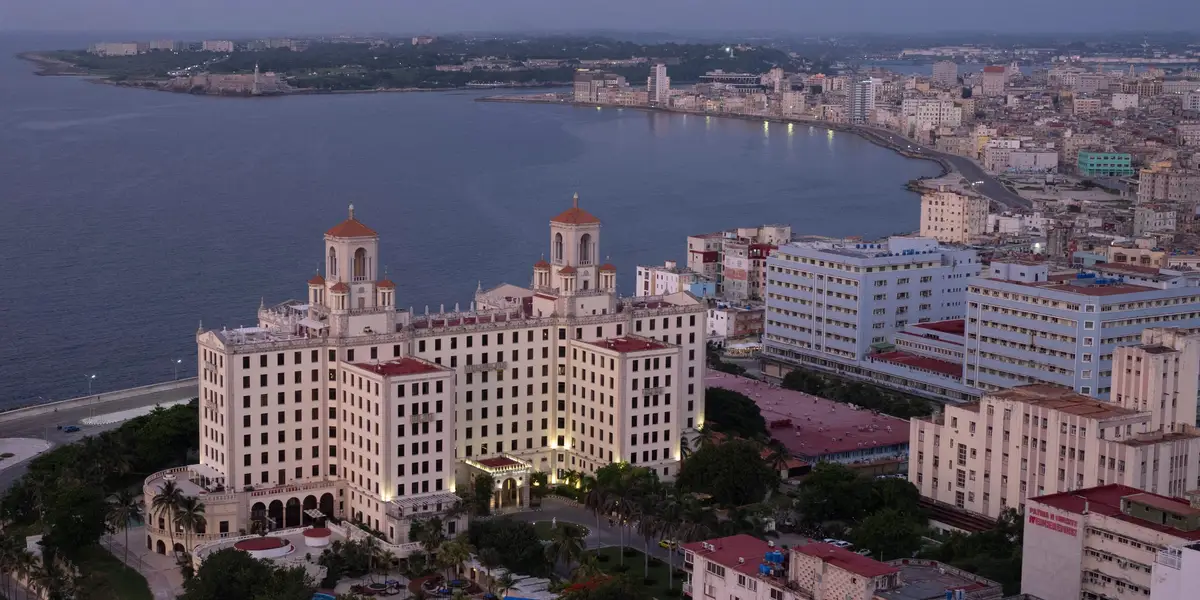
    General view of Havana, including the Hotel Nacional, on June 21, 2026.

    The Hotel Nacional today.

    Pablo PORCIUNCULA / AFP via Getty Images

    Today, the hotel survives alongside food shortages, blackouts, and deteriorating housing that shape daily life for Cubans.

    In the ’50s, golf courses catered largely to affluent foreign visitors and Cuban elites.


    HAVANA, CUBA - MAY 1946: A woman putts during a golf game in Havana, Cuba.

    Havana Country Club in the 50s.

    Earl Leaf/Michael Ochs Archives/Getty Images

    Americans often came to Cuba to golf.

    After the revolution, Castro’s government shuttered most of Cuba’s golf courses.


    HAVANA, CUBA - 1962: Che Guevara (1928-1967) putts as Fidel Castro (1926-2016) watches, during 1962 golf game at Havana's Colinas de Villarreal golf course, following the Cuban missile crisis.

    Castro’s government closed or repurposed many of Cuba’s courses after 1959.

    Photo12/Universal Images Group via Getty Images

    Castro’s government closed or repurposed many of Cuba’s courses after 1959, as golf was treated as an elitist sport. For decades, Cubans were also barred from staying in many tourist hotels.

    Today, few courses remain open, though tourism remains vital to Cuba’s economy.


    Tourists play golf in front of a hotel in Varadero beach, 130 km east of Havana on April 6, 2008. The lifting, by Cuban President Raul Castro, of the prohibition to Cubans of staying at tourism hotels, created expectations on their arrival to Varadero. Still, only few Cubans visit nowadays Varadero because of the high prices.

    Some hotels in Cuba are still operating.

    ADALBERTO ROQUE/AFP via Getty Images

    Cuba has two operating golf courses, in Varadero and Havana, aimed largely at visitors. A 2008 reform allowed Cubans to stay in tourist hotels for the first time since the revolution, though the cost remains out of reach for many.

    Havana was synonymous with gambling in the midcentury.


    Tourist Attractions. Havana, Cuba: Even the slot machines in the casino seem to have a modern look. The walls of the casino are embellished in gold leaf with large-scale designs reminiscent of Mayan jewelry. 1958

    Casinos once were popular.

    Bettmann/Getty Images

    Havana was a major casino destination in the 1950s, attracting travelers looking to gamble and organized crime figures looking to profit from the city’s tourism boom.

    The revolution outlawed casinos shortly after taking power, and gambling remains illegal today.


    A woman checks on a mobile app the winning numbers of the "La bolita" lottery in Havana on April 14, 2025. "La bolita," the clandestine lottery that multiplies its followers in the midst of the strong economic crisis in Cuba, has survived 66 years of prohibition on the communist island. With the triumph of the Cuban Revolution, all gambling was banned and casinos were closed, sanctioning any kind of game for money until the present day.

    “La Bolita” is still popular today.

    ADALBERTO ROQUE/AFP via Getty Images

    “La Bolita,” a popular clandestine lottery in Cuba, has survived for nearly 70 years since gambling was outlawed by the revolutionary government, reflecting the role of the underground economy in daily life.

    Several restaurants and bars in Havana’s tourist center became internationally recognizable.


    Everyone Knows Sloppy Joe's Bar at Havana', circa 1950s. The world-famous Sloppy Joe's at Havana in Cuba welcomed tourists for over four decades, and offered over 80 cocktails in addition to the bar's own brand of 12-year-old rum. During the 1940s and 1950s it was popular with American celebrities as well as tourists.

    Sloppy Joe’s in Cuba.

    The Print Collector/Getty Images

    In Havana, Sloppy Joe’s was among the city’s most popular bars with American tourists and celebrities in the midcentury. It offered more than 80 cocktails and its own brand of 12-year-old rum.

    Restaurants and bars in Havana are still open, but daily operations are increasingly difficult.


    23 June 2019, Cuba, Havana: Tapas Restaurant La Vitrola at the Plaza Vieja (Old Square) at evening. Havana is home to Latin America's largest preserved colonial old town. Havana celebrates the 500th anniversary of its founding in 2019

    La Vitrola is still open in Havana.

    Jens Kalaene/picture alliance via Getty Images

    Restaurants like La Vitrola remain open in Havana, keeping the hospitality scene alive amid declining tourism numbers.

    Cabarets like the iconic Tropicana nightclub became symbols of midcentury Cuba.


    Exotic dancers at the Tropicana nightclub in Havana, Cuba, circa 1955.

    The Tropicana nightclub in Havana.

    Archive Photos/Getty Images

    The Tropicana nightclub in Havana has attracted high-profile guests since its 1939 opening, thanks to lavish performances that helped define Havana nightlife.

    The Tropicana has endured with state support.


    Cabaret Tropicana, Havana, Cuba

    The Tropicana is still open.

    Dukas/Universal Images Group via Getty Images

    The iconic Tropicana remains open and continues to stage its signature over-the-top performances for visitors and Cubans who can afford to attend.

    Outside the capital, life was far less glamorous in the 1950s.


    circa 1950: Children play outside their shanty homes in Oriente Province, Cuba.

    Eastern Cuba struggled in the midcentury.

    Elizabeth Frey/Three Lions/Getty Images

    Much of eastern Cuba faced poverty, seasonal unemployment, poor roads, and limited access to schools, healthcare, and other public services as the capital flourished.

    Many rural communities still face disproportionate hardship today.


    CUBA. TYPICAL BOHIO PEASANT RANCH IN THE ORIENTE EASTERN REGION

    Rural areas still struggle today.

    Julio Etchart/ullstein bild via Getty Images

    The revolution extended state services beyond Havana, but food, fuel, transport, and power shortages often hit rural areas especially hard.

    Access to water in the 1950s was limited in many rural regions.


    circa 1950: Cuban farmworkers take a drink of water from a water pump used for irrigating the land.

    Most rural homes lacked basic necessities.

    Graf/Three Lions/Getty Images

    In 1952, most rural homes lacked indoor running water, and many also lacked electricity, paved roads, and nearby schools.

    Today, water shortages have made access unreliable even in urban areas.


    Residents carry containers while queuing for potable water from a water tanker in a neighbourhood of Matanzas, Cuba, on August 6, 2026. Recurring water shortages and power outages have forced many residents of Matanzas to rely on water deliveries and public water distribution points.

    Residents line up to get water in Matanzas in 2026.

    AFP via Getty Images

    Residents in cities including Matanzas have faced water disruptions as aging infrastructure and electricity shortages affect pumping and distribution.

    Education in 1950s Cuba was not equally accessible to all.


    CUBA - CIRCA 1959: Library of Yaguajay (Cuba), about 1960.

    A school in 1950s Cuba.

    Gilberto Ante/Roger Viollet via Getty Images

    By 1953, Cuba had a high literacy rate in Latin America, but rural illiteracy was far higher than in urban centers.

    Today, state-run education is widespread, though strained by shortages.


    Children raise hands in their classroom on their first day of school in Havana on September 4, 2023.

    A Cuban classroom today.

    YAMIL LAGE/AFP via Getty Images

    Cuba’s broadly accessible free public school system follows a state-directed curriculum that emphasizes the revolution, socialism, and loyalty to the Communist Party, though teacher shortages, power cuts, transportation problems, and a lack of supplies often disrupt classrooms.

    Public healthcare in Cuba was unevenly available in the 1950s.


    CUBA - CIRCA 1959: Cuba. Maternity hospital, about 1960.

    Urban areas had some access to healthcare.

    Gilberto Ante/Roger Viollet via Getty Images

    In the mid-century, private, public, and charitable hospitals provided modern care to some urban Cubans, but medical services were far less accessible in rural areas.

    Today, Cuba’s universal health system is under intense pressure.


    Children remain hospitalised in a room of the Pepe Portilla Paediatric Hospital in the province of Pinar del Rio, Cuba on July 25, 2026

    Cuban hospitals today face shortages of medicine and equipment.

    YAMIL LAGE / AFP via Getty Images

    Cuba still sends medical personnel abroad through international missions to allied countries, even as hospitals on the island face shortages of medicine, equipment, staff, and reliable power.

    Midcentury Cuba relied heavily on healthcare imports that did not reach all regions equally.


    A clinician examines a patient's ear with an otoscope in a black-and-white medical scene.

    Cuban Healthcare relied on US support.

    Keystone-France\Gamma-Rapho via Getty Images

    Havana was home to more than half of the country’s hospital beds at the time.

    Isolation from the US pushed Cuba to strengthen its domestic health science.


    Workers of the National Center for Biopreparations (BioCen), move vials of the Cuban-made VA-Mengoc-BC vaccine for meningococcal disease as they are prepared for packaging in Bejucal, Cuba, on July 15, 2022.

    Cuba developed its own COVID-19 vaccines.

    YAMIL LAGE/AFP via Getty Images

    Cuba invested in state-run medical research partly to reduce its dependence on imported medicines and equipment. In 2021, the country developed its own COVID-19 vaccines.

    Private businesses, including grocery stores, were common in 1950s Cuba.


    A group of men chatting near a shop counter inside a greengrocer and food shop, Havan, Cuba, circa 1950.

    Small businesses in 1950s Cuba.

    Max Haas/FPG/Archive Photos/Getty Images

    The pre-revolutionary economy included privately owned shops, pharmacies, restaurants, factories, and other small businesses.

    Recent reforms have expanded legal private business, but state rationing remains essential.


    A resident holds up an open 'libreta de abastecimiento' (ration book) used to track subsidized food allocations in Havana, Cuba, on June 09, 2026. Delays in state shipments and severe shortages of staples like rice, beans, and milk have drastically weakened the decades-old rationing system, forcing people to rely on expensive private markets.

    Rationing is still important in Cuba.

    Pablo Miranzo/Anadolu via Getty Images

    The Cuban government began rationing food and basic necessities in the early 1960s.

    In the midcentury, Cuba was a major importer of American-made cars.


    Havana (Habana) Policeman regulating the traffic, standing at a crossroad under an umbrella - 1949

    Cars in Cuba in 1949.

    Gircke/ullstein bild via Getty Images

    Havana streets were full of modern cars of the day in 1949, in part thanks to the island’s close commercial relationship with the US.

    Today, fuel shortages and high vehicle costs have pushed many Cubans toward alternatives.


    A bicycle taxi rides through an intersection with nonfunctioning traffic lights during a power outage in Guantanamo, Cuba, on August 3, 2026, highlighting the transportation and infrastructure challenges caused by the blackout. Cuba's power grid failed on August 2, 2026, causing another nationwide blackout, a state utility said in a social media post. State-run UNE said there was a "total disconnection" of the national electricity system, plunging the country, including the capital, into abrupt darkness.

    Bicycles and pedicabs are more common on streets today.

    AFP via Getty Images

    Bicycles, pedicabs, and other forms of transport have become especially important on the island as fuel shortages and unreliable buses make travel more difficult.

    The import of American cars in the midcentury defined the look of Cuban streets for decades.


    circa 1955: Cuban car importer Celestino Gondar supervising the unloading of American cars from a ferry in Havana harbour.

    Cuba roads in the 50s.

    Evans/Three Lions/Getty Images

    American-made vehicles were especially common on the island before the revolution, which suspended imports of US cars and helped preserve many older vehicles on its roads.

    Since 2014, newer imported cars have begun to alter Cuba’s once-stuck-in-time image.


    A car passes in front of an old house along the Malecon in Havana on June 16, 2026.

    Some foreign cars are now on Cuban roads.

    Pablo PORCIUNCULA / AFP via Getty Images

    Modern Chinese, European, and other imported cars now share the road with classic American vehicles and Soviet-era Ladas, though they remain unaffordable for many Cubans.

    The cigar industry was central to midcentury Cuba’s economy.


    Men work in rows of benches at a cigar factory in Havana,Cuba. 1950

    A cigar-rolling factory.

    Lionel Green/Archive Photos/Getty Images

    Cigar-rolling factories employed thousands of workers in Havana, while tobacco grown in western provinces such as Pinar del Río was a major export.

    Today, the cigar industry remains state-controlled and valuable.


    The former Upmann cigar factory, now used as a residential building, is seen in Havana, Cuba, on June 22, 2026. The facility was nationalized following the Cuban Revolution and has since been repurposed to provide housing for local residents.

    The Upmann cigar factory.

    Magdalena Chodownik/Anadolu via Getty Images

    The Upmann cigar factory was nationalized after the revolution.

    Cuba’s lively culture drew international interest in the midcentury despite domestic troubles.


    HAVANA, CUBA - JANUARY 1946: People dance in traditional costumes at the Havana Cathedral in Havana, Cuba.

    The streets of Havana in 1946.

    Earl Leaf/Michael Ochs Archives/Getty Images

    Dancers in traditional costumes grabbed the attention of visitors in the streets of Havana in 1946.

    Even with widespread blackouts and hardship, Havana’s nightlife remains alive.


    People gather at bars and along the streets as nightlife continues during ongoing blackouts in Havana, Cuba, on May 9, 2026. Cuba continues to face severe electricity shortages and fuel scarcity amid a deepening economic crisis.

    Cuban streets today.

    Magdalena Chodownik/Anadolu via Getty Images

    Despite its hardships, Cuba is still lively today. People continue to gather in downtown clubs and bars even as energy and fuel shortages cause blackouts and difficult conditions.

    Share. Facebook Twitter Pinterest LinkedIn Tumblr Email

    Keep Reading

    Aaron Sorkin Wanted to Make Mark Zuckerberg Uncool in ‘the Social Reckoning’ | Invesloan.com

    Visited 3 Towns in US That Feel Like Europe; the Best Was Like Germany | Invesloan.com

    Best Places in Utah That Are Better Than National Parks, From Local | Invesloan.com

    Anthropic Wants to Ban Chatbot Abuse: What Smart People Are Saying | Invesloan.com

    Fall Fashion Trends: the Status Symbols Taking Over This Season | Invesloan.com

    In ‘the Social Reckoning” and “Musk,” Tech Founders Are the Ultimate Villains | Invesloan.com

    I Need an AI Agent ‘Wife,’ Not an Executive Assistant | Invesloan.com

    Sheryl Sandberg Says Adult Children Can Support a Widowed Parent | Invesloan.com

    What Smart People Say About PERM Suspension on Microsoft and Indian Tech | Invesloan.com

    LATEST NEWS

    More proof that broad-market index funds stay unbeatable, even within the period of AI stock-picking | Invesloan.com

    October 9, 2026

    Brian Anthony Williams arrested in San Diego after posing as chef | Invesloan.com

    October 9, 2026

    Aaron Sorkin Wanted to Make Mark Zuckerberg Uncool in ‘the Social Reckoning’ | Invesloan.com

    October 9, 2026

    Teva positive factors approval of month-to-month olanzapine injection for schizophrenia | Invesloan.com

    October 9, 2026
    POPULAR

    China’s first passenger jet completes maiden commercial flight

    May 28, 2023

    Numbers taking US accountancy exams drop to lowest level in 17 years

    May 29, 2023

    Toyota chair faces removal vote over governance issues

    May 29, 2023
    Advertisement
    Load WordPress Sites in as fast as 37ms!
    Facebook Twitter Pinterest WhatsApp Instagram
    © 2007-2023 Invesloan.com All Rights Reserved.
    • Privacy
    • Terms
    • Press Release
    • Advertise
    • Contact

    Type above and press Enter to search. Press Esc to cancel.

    invesloan.com
    Manage Cookie Consent
    To provide the best experiences, we use technologies like cookies to store and/or access device information. Consenting to these technologies will allow us to process data such as browsing behavior or unique IDs on this site. Not consenting or withdrawing consent, may adversely affect certain features and functions.
    Functional Always active
    The technical storage or access is strictly necessary for the legitimate purpose of enabling the use of a specific service explicitly requested by the subscriber or user, or for the sole purpose of carrying out the transmission of a communication over an electronic communications network.
    Preferences
    The technical storage or access is necessary for the legitimate purpose of storing preferences that are not requested by the subscriber or user.
    Statistics
    The technical storage or access that is used exclusively for statistical purposes. The technical storage or access that is used exclusively for anonymous statistical purposes. Without a subpoena, voluntary compliance on the part of your Internet Service Provider, or additional records from a third party, information stored or retrieved for this purpose alone cannot usually be used to identify you.
    Marketing
    The technical storage or access is required to create user profiles to send advertising, or to track the user on a website or across several websites for similar marketing purposes.
    • Manage options
    • Manage services
    • Manage {vendor_count} vendors
    • Read more about these purposes
    View preferences
    • {title}
    • {title}
    • {title}