
When David Fincher’s Facebook origin story “The Social Network” premiered 16 years ago, it delighted critics with its witty dialogue and nuanced character work. Aaron Sorkin was awarded the Oscar for best adapted screenplay, and Jesse Eisenberg was hailed for his portrayal of Mark Zuckerberg as an aggrieved yet triumphant prodigy. Playing a rising tech titan earned Eisenberg an Oscar nomination and made him synonymous with Zuck — not a bad thing in 2010, when Zuckerberg was crowned Time’s Person of the Year.
A lot has changed since then. These days, Eisenberg would rather not be associated with the tech wonder whose wealth, influence, and impunity have more in common with that of an oligarch than a scrappy college kid. Eisenberg declined to reprise the role for Sorkin’s new pseudo-sequel, “The Social Reckoning,” and Jeremy Strong took on the part instead.
“He simply did not want to be conflated with Mark Zuckerberg anymore,” Sorkin told Vanity Fair of Eisenberg. “He doesn’t like kids coming up to him in airports with business cards that say ‘I’m CEO, bitch’ for him to sign.”
“The Social Reckoning,” out Friday, reflects Eisenberg’s change of heart about Zuckerberg on a macro scale. Gone is the smug, impish charm of Eisenberg’s hoodie-clad Harvard dropout. Now, Strong’s Zuck has tailored suits and the severity of a tyrant. Facebook — now Meta — is no longer the dorm-room startup that launched a billion friend requests; the company is depicted as a sinister and relentless force, a tool that kids use to bully each other and extremists use to spread hate speech. The movie’s climax dovetails with the January 6 insurrection, which Zuckerberg watches unfold from his “war room.”
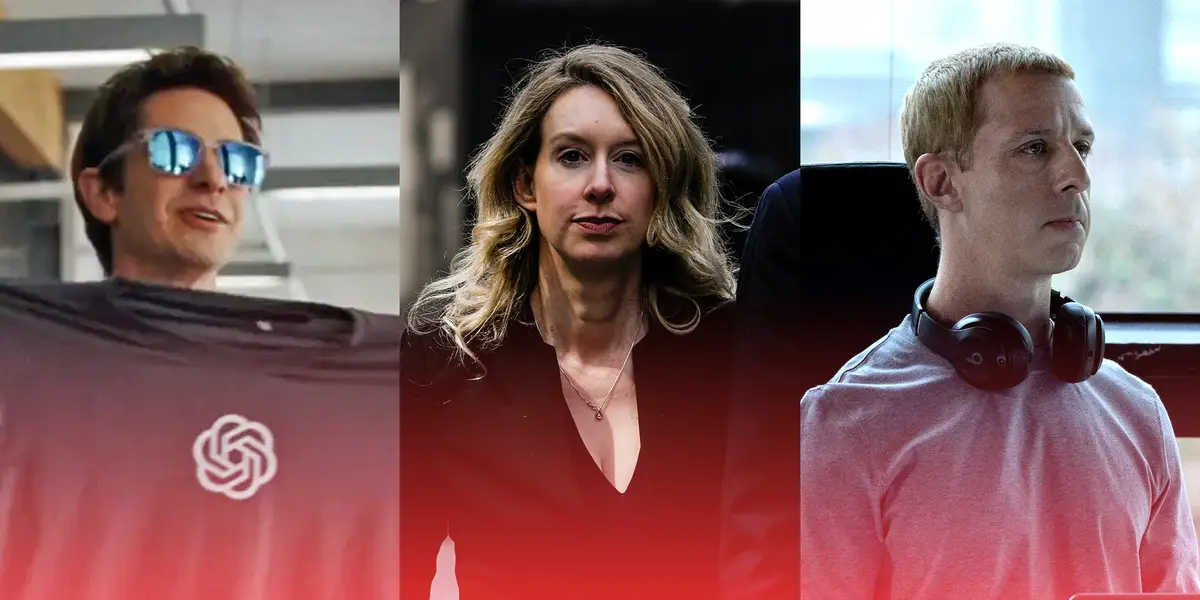
It’s far from the only movie this season to paint a tech titan’s rise to power as a sobering sign of the times. “The Social Reckoning” premieres the same day as “Musk,” Alex Gibney’s super-sized documentary about Tesla and SpaceX CEO Elon Musk, an incisive, nearly four-hour affair that Musk has decried as a “hit piece.” Next week, there’s “You Can See Everything,” a genre-bending documentary that locks co-director Nathan Fielder in a chilling tete-a-tete with Theranos founder Elizabeth Holmes as he probes her psyche before she reports to prison. On Christmas, you can enjoy Luca Guadagnino’s “Artificial,” a biopic that depicts OpenAI CEO Sam Altman as amoral, manipulative, and Machiavellian, according to early reviews. Don’t count TV out, either: Graham Moore’s “The Altruists,” a Netflix limited series that tracks the rise and fall of FTX founder Sam Bankman-Fried, is coming in November.
Unlike the movies that defined the 2010s wave of techno-optimism, like “The Social Network” and the 2013 Steve Jobs biopic “Jobs” — both Sorkin-penned stories that map a founder’s rise onto the classic beats of a hero’s journey — this new wave of tech movies courses with an undercurrent of dread.
If the 2010s proved tech companies have great power, these new movies are reaching for their subjects to recognize that they also hold great responsibility.
The next act of a billionaire’s origin story is about consequences — or lack thereof
Sony
During the climactic insurrection scene in “The Social Reckoning,” flickers of guilt and panic pass over Strong-as-Zuckerberg’s face as he hears the news. The Facebook CEO’s infamous “free-speech absolutism” is being put to the ultimate test, as President Donald Trump shares a slew of posts cheering on the rioters.
Although Zuckerberg ultimately agrees, at the urging of his inner circle, to suspend the president’s account amid the violence, the movie ends with a reality check: Meta has since abandoned fact-checking, not just for politicians and political ads, but for everything. Trump’s Facebook account was restored in 2023.
It’s a bleak postscript to the far more triumphant final title card of “The Social Network,” which is presented as a kiss-off to Harvard’s then-president scoffing at Facebook’s earning potential: “Mark Zuckerberg is the youngest billionaire in the world.” The end-credits song is “Baby You’re a Rich Man” by The Beatles.
While “The Social Network” wasn’t entirely kind to Zuckerberg, it reflected a sense of wonder about what he’d accomplished, and all the bigwigs he had to piss off in the process. There’s a reason “I’m CEO, bitch” became a cultural touchstone — that precocious, defiant swagger felt revelatory at the dawn of social media’s imperial age. For a generation of millennial founders, it was downright inspiring.
As a companion piece, “The Social Reckoning” is forced to grapple with the positive PR its predecessor gave Zuckerberg, whether intentionally or not. The real Zuckerberg has undergone his own evolution (or, some might argue, devolution) during his reign as CEO, accelerating his free-speech-at-all-costs rhetoric and cozying up to Trump in his second term as president.
Zuckerberg’s portraiture in pop culture has become more caustic and ominous to match. In “The Social Reckoning,” Strong-as-Zuckerberg insists that Facebook should not be a referee for hate speech and misinformation, but a “public square” for all self-expression to coexist. “It’s a business,” he declares in one scene. “You know why we don’t fact-check ads? Because we don’t have to.”
The movie makes the consequences of this policy clear. Most of the action centers on the whistleblower scandal of 2021, when former Facebook employee Frances Haugen leaked tens of thousands of internal documents. The trove included evidence that Facebook’s algorithm was designed to spread inflammatory content, push its users into extremist groups, and prioritize “profit over safety,” in Haugen’s words.
“Mark has been surrounded by people since he was 19 years old who told him he was doing a great job,” Haugen later told Bloomberg, calling for him to step down as CEO. She added, “We can demonize Zuckerberg, but it’s not going to make him heal faster.”
“The Social Reckoning” makes this point, too, dotting Zuckerberg’s orbit with preening yes-men, crisis PR experts, and wardrobe specialists. Still, the film doesn’t let him off the hook. In one scene, when he’s presented with an initiative to improve safety measures for 38% of Facebook users — in exchange for losing about 1% of engagement — Strong plays the CEO’s reaction with icy indifference. He opts to keep the engagement.
Big Tech’s promise is starting to look like a threat
A24
Trends in art and film often reflect the public’s appetite, and that applies to today’s techno-doomerism.
What does it say about our credulity that founders like Holmes and Bankman-Fried can make it so far on fawning media narratives and false promises? What does it say about our current structure that men like Zuckerberg, Musk, and Altman continue to wield stunning influence over what we see, how we feel, and even who we vote for?
To filmmakers like Sorkin, Gibney, Fielder, and Guadagnino — and their eager audiences — it says that we’re in deep trouble.
Particularly among young people, there’s a growing sense of anxiety about AI, tech overlords, and wealth distribution more broadly. A recent NBC News poll found that 47% of voters ages 18 to 29 held a negative view of capitalism, up from 22% in 2018. Last year, amid Musk’s tenure at the Department of Government Efficiency, a University of Massachusetts Amherst poll found that nearly half of all Americans would describe the US as an oligarchy.
Musk’s outsize role in the Trump administration underscores the reality that tech bros have become the main characters, both on and offscreen. Their inventions are affecting everything from teenagers’ mental health to international election results. Researchers believe they could bring about the doom of our species, with some comparing the likelihood to a coin flip.
Once upon a time, during the era of Obama hopecore, we were enthralled by the promise and potential of technological progress. Just think of what humans could do, given the tools!
Now, we have to take a good look at what we’ve done.