
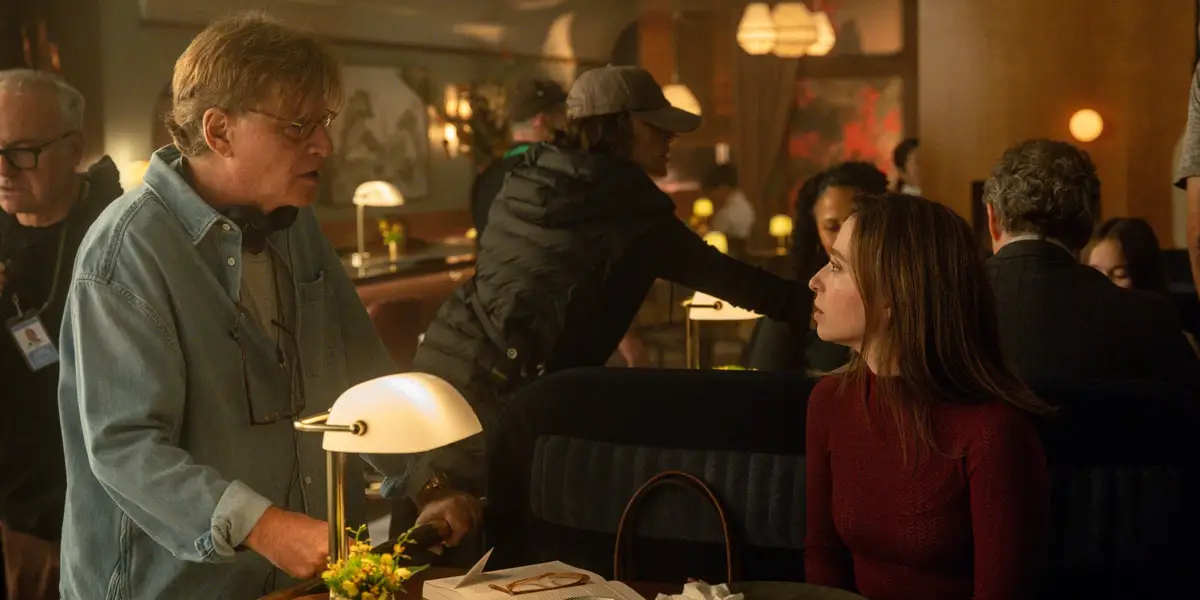
Aaron Sorkin was in a tough spot.
The writer and director best known for talky political dramas like “The West Wing” and “A Few Good Men” had ascended to a new level in his career in 2011: Oscar winner.
His script for David Fincher’s 2010 Facebook origin story “The Social Network” had earned him an Academy Award for best adapted screenplay. The movie had become an instant classic for a generation raised on social media. Surely he would have to write a sequel.
There was just one problem.
As the years went on, Facebook went from being a way to keep up with friends and post pictures your aunt would like to a toxic haven for hate speech. Sorkin had taken notice and wanted to stay away.
“Over the years, every time there would be a new Facebook scandal, I’d be approached to get back in there,” Sorkin told Business Insider of Hollywood’s desire for a “Social Network” sequel. “But I never felt there was a movie, until I met Frances Haugen.”
Dan MacMedan/WireImage/Getty
Haugen is a data scientist who was hired by Facebook in 2019 as a product manager on the civic integrity team, a division of the company that was tasked with mitigating political misinformation and hate speech on the platform. After her team was dissolved in the wake of the 2020 election, Haugen quit — but not before copying tens of thousands of internal documents and leaking them to Wall Street Journal reporter Jeff Horwitz.
The documents, which showed that Facebook’s algorithm was designed to spread misinformation, push users towards extremism, and was negatively impacting young peoples’ mental health, became a series of stories released by the Journal called “The Facebook Files.”
Sorkin had finally found his way into telling the next chapter, which he titled “The Social Reckoning.” But again, he got in a pinch.
With original director David Fincher not returning, Sorkin also took over directing duties. Then, Jesse Eisenberg declined Sorkin’s numerous attempts to get him to return to play Zuckerberg. So Sorkin turned to Jeremy Strong, whom he’d previously worked with on “The Trial of the Chicago 7” and “Molly’s Game,” to play an older and much more powerful version of Zuckerberg.
The resulting film is not a direct sequel to “The Social Network,” but rather a companion piece that shows the stark transformation of Zuckerberg and Facebook in the ensuing 16 years.
“The Social Reckoning” sets the action far away from the dorm rooms of the original movie. Facebook is at its zenith, used by close to 3 billion people and seemingly affecting every aspect of their lives. That’s high stakes for Facebook product manager Frances Haugen (played by Oscar winner Mikey Madison), who decides to reveal to Horwitz (“The Bear” star Jeremy Allen White) documents that show the company doesn’t care about integrity; it cares about reshares.
Sony
Sorkin believes this is his mea culpa. After making Zuckerberg’s nerdy determination cool with “The Social Network,” he sees “The Social Reckoning” as a way to sound the alarm about the dangers of social media and call for more regulation of powerful tech companies.
“We have to follow the breadcrumbs,” Sorkin said.
For the latest interview in Business Insider’s Director’s Chair series, Sorkin discussed diving back into the world of Facebook, debating Strong in-character as Zuckerberg, and why he hopes “The Social Reckoning” will be more than just a wake-up call to Facebook.
On finding the movie’s opening scene and Jeremy Strong’s extreme Method acting as Zuck
Business Insider: The last scene of “The Social Network” is Zuckerberg refreshing his page, waiting for his ex-girlfriend to follow him. Then the opening of “The Social Reckoning” is a prologue about a drunk motorist who goes on a hateful rant after being radicalized by Facebook. Was that jarring transition intentional, to show just how much of a sharp left turn we’ve taken with Facebook?
Aaron Sorkin: You know, I really love that it’s playing that way.
I’ll back up a bit. I spent a lot of hours speaking to Frances Haugen over many months, same with Jeff Horwitz, but I still wasn’t seeing the shape of a movie.
That is, until I asked Frances a simple question, which I wish I asked her at the beginning: What was the inciting action? One day you weren’t a Facebook whistleblower, the next day you were — what happened?
That’s when she told me about this friend she had that had been radicalized by spending too much time on Facebook. And that became the opening scene, the “White Girl Wasted” prologue. I’m very happy that it did what you just described.
Sony
So really, it was this opening that helped you push the wagon forward in terms of writing the movie.
That’s a great way of putting it. I really liked the idea of this opening scene. But you can’t just write an opening scene and show it to people. You have to write the hundred other scenes that come after that.
Jeremy Strong is amazing in this; he elevates the whole movie. But I’m shocked that in going Method, he also became a true believer in Zuckerberg, to the point that he would debate you about Zuck’s motivations. Were you prepared for him to take things to that level?
No. I knew he’s a very immersive actor. I never heard him use his own voice. He only spoke as Mark, he only behaved as Mark. But I didn’t expect that he was going to be a constant defender of Mark. Not just on the set, but the emails I would get at night at the hotel, even after we wrapped during post.
There was one line in particular that we kept going round and round about, in a good way.
What was the line?
It’s that scene where he’s been having this argument all morning with the character Bill Burr is playing, and he ends the debate by saying, “It’s a business, Charlie. You know why we don’t fact-check ads, because we don’t have to. Are you new?”
Jeremy felt that it was just about money. That Mark was saying this is a business, it’s about money, and that’s why we do it. But that was not the argument that Mark had been making for the entire movie, which is that it’s a free speech thing. That Facebook is the town square. So my feeling was Mark isn’t saying it’s about the money, Mark actually, in that moment, is making the same argument Frances is making at the end, which is, talk to the people who make the laws. I’m not your guy, talk to Congress.
Well, that line is in the movie, so I won the argument.
Sony
So Jeremy is going to do what Jeremy does, which is transform into who he is playing. Mikey Madison wanted to do that with Frances. She has said she wanted to dye her hair. You didn’t want that. Why?
Yes, Mikey did want to. That’s an actor’s instinct. I didn’t, because I didn’t want her worried about that in the performance.
But couldn’t that thinking backfire? If she doesn’t feel she’s fully prepared, you might not get what you want out of her.
There’s no doubt about it. Well, now you’re making me feel I made a mistake.
No. Just playing devil’s advocate.
[Laughs.] If she had said, “I really want to dye my hair, I’d like to talk like Frances,” I would have said, “Let’s give it a try.”
I always worry, like for instance, if I cast a British actor and they need to do an American accent, is that going to be your concern every moment of every day? Are you going to be able to do what I need you to do in terms of getting into the text if all you’re thinking about is the American accent?
Now, Mikey did cut her hair. Her hair had been very long, like how her hair was for “Anora.” It was down to her waist; that’s how she normally wears her hair. So we both agreed that that was kind of iconic “Anora” hair, and we didn’t want that for Frances, so she got a haircut.
On the wave of tech founder movies and why billionaires are ‘the new Russians’ in Hollywood
The movie has a fitting title, because we are in a tech reckoning as we speak, and Hollywood has a lot to say about it this year. There’s your movie, Alex Gibney’s “Musk” documentary, the Elizabeth Holmes documentary “You Can See Everything,” and “Artificial” later this year. Are these movies going to incite change, or does more need to be done?
More needs to be done.
Dimitrios Kambouris/Getty Images
Are these at least the opening salvo for change?
I hope so. I would love for it to be. I think there’s a bit of a correction going on. Just 10 or 15 years ago — and I’m as responsible for this as anybody with movies like “The Social Network” and “Steve Jobs” — these tech heroes, they were inspirational stories. We liked these guys who dropped out of school, and they had a crazy idea that nobody believed in, but they wouldn’t give up on it, and they made a billion dollars and changed the world by inventing the personal computer and social networking.
I think after seeing the results of their actions, that’s why we’re getting the Alex Gibney documentary, the Nathan Fielder documentary, why “Artificial” gets bounced by Amazon because it made a deal with OpenAI.
We are living in a moment where these tech billionaires have become Hollywood’s new Russians.
Am I crazy, or did you place some nods to your past work in “The Social Reckoning?” The conference room talk you mentioned between Jeremy Strong and Bill Burr is very similar to the auditorium scene between Michael Fassbender and Seth Rogen in “Steve Jobs.” Mikey Madison showing up soaking wet from the rain to Jeremy Allen White’s hotel room harkens back to Tom Cruise showing up soaking wet to Demi Moore’s doorstep in “A Few Good Men.” Were those similarities intentional?
The two instances you just described, it’s actually not a lack of imagination on my part, which usually it is. With this movie, I felt drawn to putting touchstones in the film that made it feel like a classic Hollywood movie. For instance, rather than using the Trent Reznor and Atticus Ross score from “The Social Network,” I went with Alexandre Desplat’s big symphonic score. Moments like coming in from the rain, that feels like a Hollywood movie.
Listen, before a movie can be anything else, before it can be relevant or thought-provoking, it has to be good. It has to work as a movie. It has to work as something that you watch while you’re eating popcorn. And I was determined that this film would do that.
This interview has been condensed and edited for clarity.
The Social Reckoning is in theaters now.