

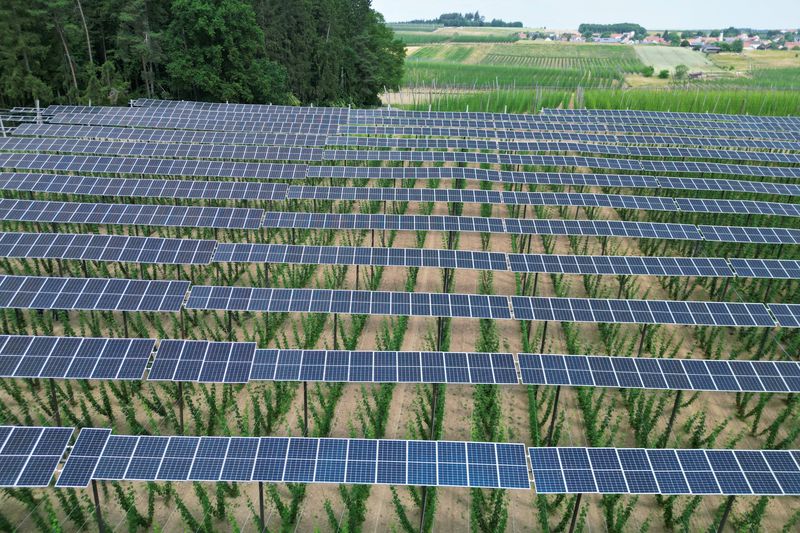
© Reuters. FILE PHOTO: Solar panels are seen atop a hops plantation in the Bavarian Holledau region in Au, Germany, June 19, 2023. REUTERS/Louisa Off/File Photo
By Jan Strupczewski
BRUSSELS (Reuters) – When the United States launched its massive green subsidies push a year ago, many in Europe feared it would be a fresh blow to their regional economy grappling with the knock-on effects of war in Ukraine and lingering aftershocks of the COVID-19 pandemic.
Yet while critics argue the European Union has yet to offer a coherent counter-plan to Joe Biden’s Inflation Reduction Act (IRA), Brussels appears to have done just enough to ease the most pressing concern that European companies would leave in search of dollar subsidies.
This week marks the first anniversary of the Biden administration’s IRA legislation which offers $369 billion in tax breaks over 10 years for the production of electric vehicles, batteries, hydrogen or solar panels in the United States.
The EU initially welcomed the climate-friendly shift by Biden, but became worried Europe’s best clean tech companies would up sticks to secure U.S. tax breaks, draining Europe of know-how, investment, new technologies and future jobs.
So far there is little evidence of that happening.
“There was a general anxiety that after the pandemic and the start of the war in Ukraine, a fear that the IRA would be a final blow to the EU economy,” said Niclas Poitiers, an economist at the Bruegel think tank in Brussels.
“The importance of the IRA for investment decisions was somewhat overstated,” he said, adding there was no data yet on whether there was any massive diversion of investment away from the EU and into the United States as a result of the IRA.
“There probably was some, there is some anecdotal evidence, but not massive.”
Key to allaying the IRA’s attraction for European firms was an EU decision in March to relax its state aid rules to allow every national government to match the subsidies a European company would get in the United States.
And already, those subsidies are flowing: German conglomerate Thyssenkrupp (ETR:) will invest around 3 billion euros ($3.27 billion) in a proposed green steel plant in Duisburg, Germany, including over 2 billion euros in state subsidies given EU approval in late July.
STRAINED BUDGETS
Officials also point out that the EU was supportive of green industries much earlier than the United States and that 37% of its massive post-pandemic recovery fund of 800 billion euros is earmarked for climate friendly investment.
“Much of the ‘reaction’ to IRA was already in place before President Biden launched (his) own climate package,” a policy brief for the European Parliament requested by the economic committee said.
To create longer-term, stable conditions for investment for companies involved with electric vehicles, batteries, hydrogen, solar panels, heat pumps or wind turbines, the EU is still working on a Net Zero Industry Act and the Critical Raw Materials Act that built on the Chips Act from 2022.
Many EU officials were disappointed the European Commission dropped plans in June to propose a European Sovereignty Fund, the size of which has never been specified, that was to finance Europe’s transition to a green economy.
But the plan faced resistance from national capitals reluctant to pump more money into EU coffers just as their budgets were strained by rising energy costs, migration challenges and support for Ukraine against Russian invasion.
The parliament paper said the option finally chosen – which includes using funds from an already-agreed pandemic recovery fund – was not ideal because those disbursements will end in 2026. But it noted the U.S. model also had uncertainty built in because a change of administration could end IRA subsidies.
However, the EU response is not without its critics.
The complexity of EU financing through the recovery fund means it is available only to bigger companies, leaving smaller firms struggling to benefit.
The EU approach also focuses on investment to build production and research capacity, helping at the start, whereas the U.S. tax break system means it pushes down running costs of production for the next 10 years.
Loosening the EU’s state aid framework, while solving the problem of quick support that would match U.S. levels, means large, rich economies like Germany, France or Itay can afford to subsidise corporate investments, while relatively poorer EU members cannot – creating a rift in the EU’s single market, one of the bloc’s most prized achievements.
The European Commission did not immediately respond to a request for comment.
It also remains the case that Europe is, for the near future at the very least, dependent on China for clean tech components ranging from solar panels to the elements required for EV batteries.
Now the race is on to pass the Critical Raw Materials and Net Zero Industry acts through the EU’s multi-layer legislative pipeline before the European Parliament dissolves itself in April 2024 ahead of new elections to the assembly.
If that race is lost, those laws would have to be passed on to the new parliament and probably not be agreed on until 2025.
($1 = 0.9184 euros)