
What's Hot

    CSX says extra companies are transport through rail to keep away from surging gasoline prices | Invesloan.com

    April 22, 2026

    WNBA Star Angel Reese Says Maturity Changed How She Uses Social Media | Invesloan.com

    April 22, 2026

    Helix Energy Solutions Group GAAP EPS of -$0.09 in-line, income of $287.95M beats by $24.04M | Invesloan.com

    April 22, 2026
    Facebook Twitter Instagram
    Finance Pro
    Facebook Twitter Instagram
    invesloan.cominvesloan.com
    Subscribe for Alerts
    • Home
    • News
    • Politics
    • Money
    • Personal Finance
    • Business
    • Economy
    • Investing
    • Markets
      • Stocks
      • Futures & Commodities
      • Crypto
      • Forex
    • Technology
    invesloan.cominvesloan.com
    Home » US Banks Moved $312B in Chinese Drug Money, But Crypto Gets the Blame | Invesloan.com
    Crypto

    US Banks Moved $312B in Chinese Drug Money, But Crypto Gets the Blame | Invesloan.com

    August 29, 2025
    Share
    Facebook Twitter LinkedIn Pinterest Email

    US financial institutions processed $312 billion in suspicious transactions linked to Chinese money laundering networks between January 2020 and December 2024, according to a new FinCEN analysis of 137,153 Bank Secrecy Act reports.

    These surprisingly unexpected big figures emerge as crypto exchanges face intensified regulatory scrutiny for money laundering, despite traditional banking systems handling vastly larger volumes of illicit funds.

    FinCEN has issued an Advisory and Financial Trend Analysis raising the alarm on Chinese money laundering networks, which pose a significant threat to the U.S. financial system.https://t.co/QejJmzQaYw

    — Financial Crimes Enforcement Network (FinCEN) (@FinCENnews) August 28, 2025

    Chinese money laundering networks have established sophisticated partnerships with Mexico-based drug cartels, exploiting currency restrictions in both countries.

    Mexican currency laws prevent large dollar deposits in local banks, while China’s currency controls limit overseas transfers by its citizens. This regulatory gap allows cartels to sell illicit dollars to Chinese nationals seeking to circumvent Beijing’s capital controls.

    The networks extend beyond drug trafficking into human trafficking, healthcare fraud, and real estate purchases worth $53.7 billion in suspicious activity.

    FinCEN identified 1,675 reports involving human trafficking and 43 reports covering $766 million in suspicious adult day care center activity in New York alone.

    Banks Handle Bulk of Criminal Money While Crypto Faces Heat

    Banks accounted for $246 billion of the total suspicious transactions, while money service businesses handled $42 billion and securities firms processed $23 billion.

    The average annual flow through US banking systems reached $62 billion from Chinese money laundering operations alone.

    Historical cases reveal systematic banking vulnerabilities to criminal exploitation.

    Wachovia Bank laundered $350 billion for Mexican drug cartels between 2007 and 2010, receiving only a $160 million penalty despite the massive scale.

    Danske Bank processed $228 billion in suspicious transactions from Russia between 2007 and 2015, ignoring internal warnings throughout the period.

    Similarly, HSBC paid $1.9 billion in 2012 for allowing drug cartels to transfer hundreds of millions through accounts, with criminals using specially designed cash deposit boxes that fit perfectly into bank slots.

    TD Bank agreed to pay over $3 billion after prosecutors found the institution had been used to launder more than $470 million through Chinese networks in New York and New Jersey.

    In fact, dating back to 2021, the 1MDB scandal involved over $1 billion stolen through global banking networks, with funds used to purchase luxury real estate, yachts, and artwork across major cities.

    Bank of Credit and Commerce International laundered billions for drug cartels and corrupt governments before its 1991 closure forced stricter international banking regulations.

    Criminal organizations recruit bank employees as complicit insiders and use counterfeit Chinese passports to facilitate account openings.

    Money mules often report occupations as “student,” “housewife,” or “retired” during onboarding to explain large transaction volumes that are inconsistent with their stated professions.

    Regulators Target Crypto Despite Minimal Illicit Activity Share

    Cryptocurrency transactions represent ‘less than 1%’ of total money laundering activity globally, according to TRM Labs.

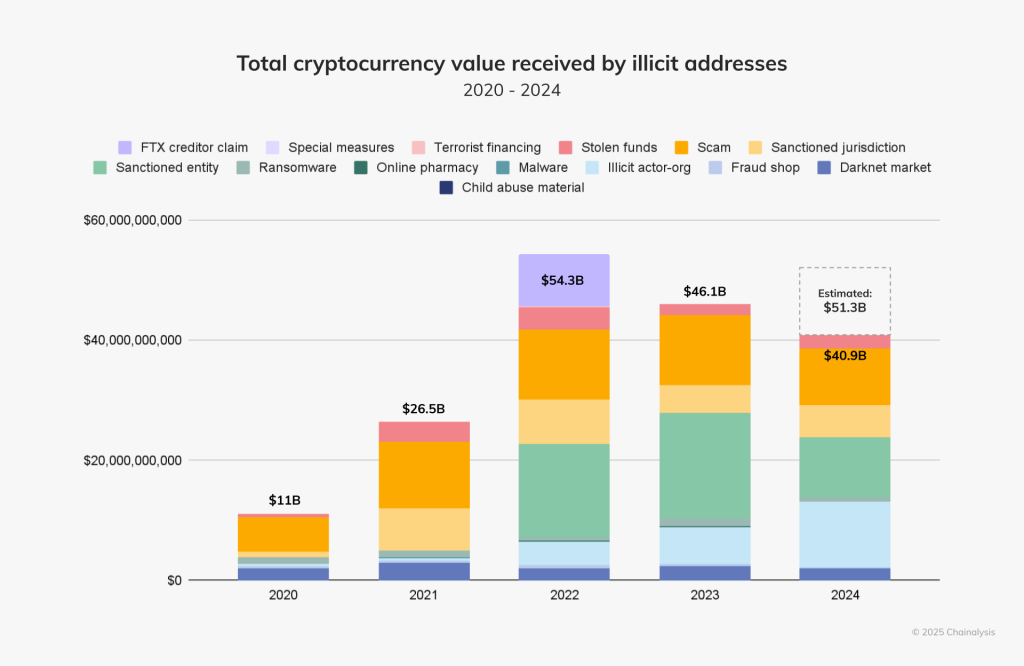
    In fact, Chainalysis data shows illicit crypto volumes totaled approximately $189 billion over five years, compared to over $2 trillion laundered annually through traditional financial systems worldwide.

    Source: Chainalysis

    Despite this disparity, regulators are intensifying their enforcement actions against crypto.

    Most recently, Binance Australia was required to appoint an external auditor within 28 days after AUSTRAC identified “serious concerns” with its anti-money laundering controls.

    French authorities have also launched investigations into Binance over alleged violations, while European regulators are considering penalties against OKX following $100 million in allegedly laundered funds.

    Australian enforcement expanded through systematic compliance reviews, with AUSTRAC targeting 13 remittance providers while investigating 50 additional platforms.

    The agency cancelled or refused renewals for nine providers that failed to comply with their obligations, contrasting sharply with the limited penalties imposed on the banking sector despite vastly larger suspicious transaction volumes.

    Senator Elizabeth Warren continues to demand tougher crypto regulations, stating, “Bad actors are increasingly turning to cryptocurrency to enable money laundering.”

    However, FinCEN data reveals that Chinese money laundering networks primarily operate through traditional banking channels rather than digital assets.

    Blockchain analytics firm Chainalysis reported illicit crypto transactions reached $51.3 billion in 2024, an 11.3% increase, but still representing a fraction of the $312 billion in suspicious banking transactions identified during the same period.

    The post US Banks Moved $312B in Chinese Drug Money, But Crypto Gets the Blame appeared first on Cryptonews.


    Share. Facebook Twitter Pinterest LinkedIn Tumblr Email

    Keep Reading

    Bitcoin Price Prediction: Major Miner Just Expanded in Texas: Is a Massive BTC Production Surge Coming? | Invesloan.com

    Crypto Price Prediction Today 25 February: XRP, Solana, Bitcoin | Invesloan.com

    Hong Kong to Link New Digital Bond Platform With Regional Crypto Tokenization Hubs | Invesloan.com

    An AI Crypto Agent Sent a ‘Beggar’ Six Figures, Then He Lost It All This Way | Invesloan.com

    Ethereum Locks In FOCIL for 2026 as Foundation Moves $6.8M ETH to Staking | Invesloan.com

    Bitcoin Price Prediction: $400 Million Suddenly Pulled From ETFs — Is Smart Money Quietly Exiting BTC? | Invesloan.com

    Crypto Price Prediction Today 24 February – XRP, Bitcoin, Ethereum | Invesloan.com

    XRP Price Prediction: Arizona Just Named XRP in a State Crypto Reserve Bill — Is Government Adoption Beginning? | Invesloan.com

    Bitpanda Offers €15 in Silver to New Users Trading €50 in Metals | Invesloan.com

    LATEST NEWS

    CSX says extra companies are transport through rail to keep away from surging gasoline prices | Invesloan.com

    April 22, 2026

    WNBA Star Angel Reese Says Maturity Changed How She Uses Social Media | Invesloan.com

    April 22, 2026

    Helix Energy Solutions Group GAAP EPS of -$0.09 in-line, income of $287.95M beats by $24.04M | Invesloan.com

    April 22, 2026

    Russians Turn Recon Drone Into Mothership for FPV Quadcopters | Invesloan.com

    April 22, 2026
    POPULAR

    China’s first passenger jet completes maiden commercial flight

    May 28, 2023

    Numbers taking US accountancy exams drop to lowest level in 17 years

    May 29, 2023

    Toyota chair faces removal vote over governance issues

    May 29, 2023
    Advertisement
    Load WordPress Sites in as fast as 37ms!
    Facebook Twitter Pinterest WhatsApp Instagram
    © 2007-2023 Invesloan.com All Rights Reserved.
    • Privacy
    • Terms
    • Press Release
    • Advertise
    • Contact

    Type above and press Enter to search. Press Esc to cancel.

    invesloan.com
    Manage Cookie Consent
    To provide the best experiences, we use technologies like cookies to store and/or access device information. Consenting to these technologies will allow us to process data such as browsing behavior or unique IDs on this site. Not consenting or withdrawing consent, may adversely affect certain features and functions.
    Functional Always active
    The technical storage or access is strictly necessary for the legitimate purpose of enabling the use of a specific service explicitly requested by the subscriber or user, or for the sole purpose of carrying out the transmission of a communication over an electronic communications network.
    Preferences
    The technical storage or access is necessary for the legitimate purpose of storing preferences that are not requested by the subscriber or user.
    Statistics
    The technical storage or access that is used exclusively for statistical purposes. The technical storage or access that is used exclusively for anonymous statistical purposes. Without a subpoena, voluntary compliance on the part of your Internet Service Provider, or additional records from a third party, information stored or retrieved for this purpose alone cannot usually be used to identify you.
    Marketing
    The technical storage or access is required to create user profiles to send advertising, or to track the user on a website or across several websites for similar marketing purposes.
    • Manage options
    • Manage services
    • Manage {vendor_count} vendors
    • Read more about these purposes
    View preferences
    • {title}
    • {title}
    • {title}