
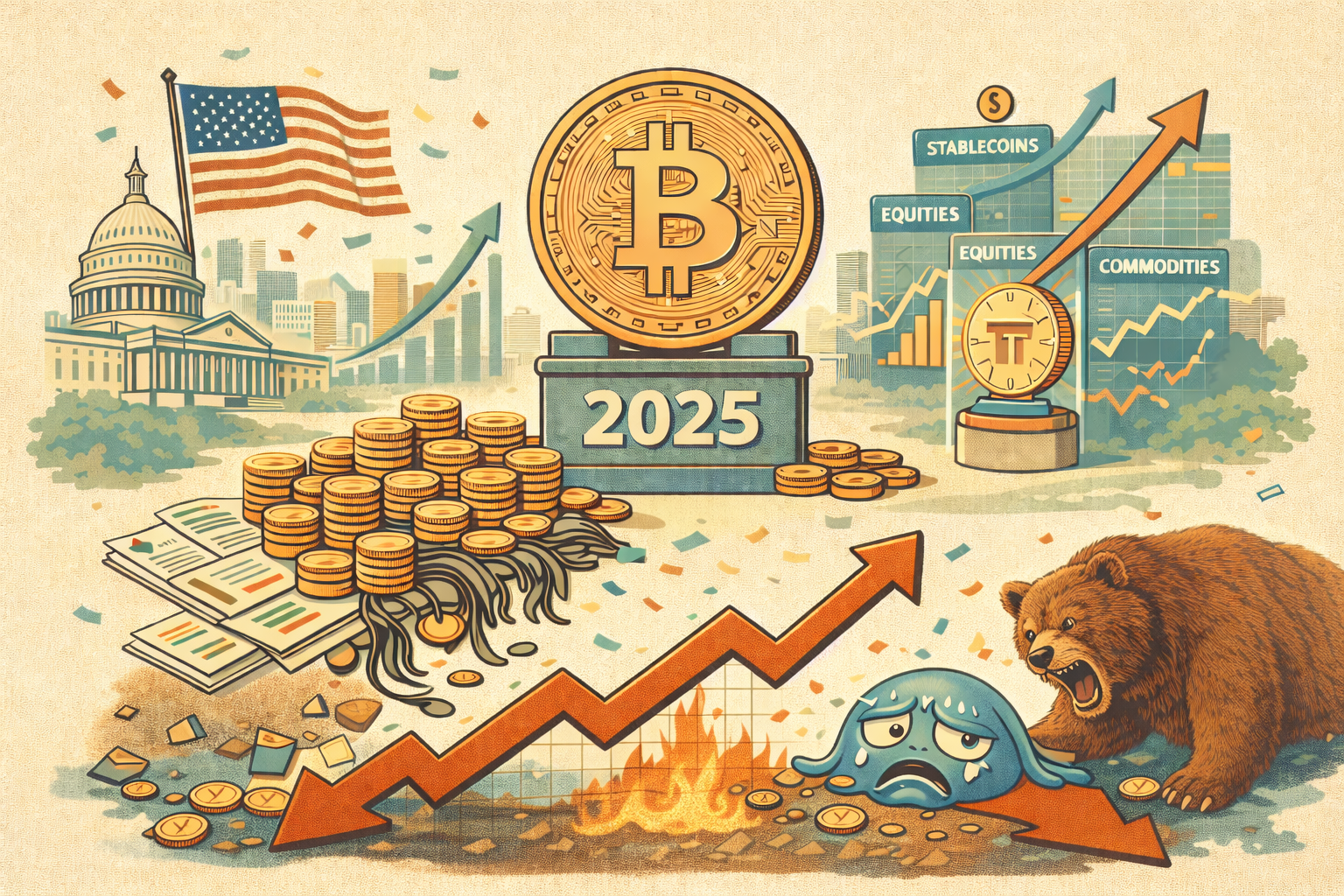

By most conventional measures, 2025 should have been remembered as crypto’s breakthrough year.
Regulation finally arrived in force. Institutional capital flowed through regulated channels. Bitcoin printed a new high.
Stablecoins crossed multi-trillion-dollar volumes. On-chain markets expanded beyond native tokens into equities and commodities.
And yet, as the year closes, the dominant mood is not triumph but unease.
Crypto ended 2025 having accumulated more “wins” than at any point in its history, and still failed to produce a convincing sense of victory.
Prices drifted lower after October, rallies faded quickly, and positive developments, including rate cuts and policy clarity, were largely ignored.
What emerged instead was a market that had matured structurally faster than its own confidence.
A promising start, and the first cracks
The year began with optimism. A political reset in Washington helped fuel a risk-on tone in January, lifting digital assets alongside equities.
Bitcoin rallied, sentiment improved, and the idea that crypto was entering a more stable, institution-friendly phase gained traction.
That confidence did not last long. February delivered an early reminder that crypto’s old vulnerabilities had not disappeared.
A sharp memecoin selloff wiped out speculative gains across smaller tokens.
Ignacio Aguirre Franco, CMO at BitGet, notes that this drop in meme coins was structural.
“Key risks that stood out included unhealthy tokenomics in many altcoins and increasing concentration in meme coins, which highlight the need for stronger fundamentals… [to] drive the industry toward more resilient, value-driven projects.”
This selloff was followed by a major security breach at Bybit rattled trust in centralized venues.
Together, the episodes reinforced how quickly liquidity could evaporate when speculation collided with weak risk controls.
April and the return of macro gravity
By April, crypto’s claim to macro independence was tested more seriously.
As Trump’s tariff rhetoric resurfaced and global risk assets sold off, digital assets fell in tandem.
Bitcoin dropped sharply, altcoins fared worse, and correlations with equities surged.
For some, the selloff was disappointing. For others, it was revealing. Crypto was no longer operating on the fringes of global finance — it was increasingly embedded within it.
That integration would become a defining theme of the year. As on-chain markets expanded and capital structures deepened, crypto became more sensitive to the same macro shocks that move traditional markets, from trade policy to interest-rate expectations.
Avinash Shekhar, Co-Founder & CEO of Pi42, emphasises this new tether to the global economy.
“This year reminded us that the crypto market is still closely linked to broader macroeconomic conditions. When global uncertainty rises, liquidity can tighten quickly and sentiment can shift in a matter of days.”
Mid-year: legitimacy, at last
If April exposed crypto’s vulnerabilities, the middle of the year showcased its strongest fundamentals to date.
The passage of the GENIUS Act marked a watershed moment for stablecoins, providing long-awaited regulatory clarity in the US and unlocking greater institutional confidence.
Around the same time, the rise of Digital Asset Treasury Companies allowed corporates to hold Bitcoin as part of their reserves, further blurring the line between crypto and mainstream finance.
“The most meaningful developments this year were the passage of the GENIUS Act, which provided a clear regulatory framework for stablecoins and boosted institutional confidence, alongside the rise of Digital Asset Treasury Companies that enabled corporations to integrate Bitcoin into their reserves,” Aguirre Franco told Invezz.
Institutional participation accelerated across the board. According to Shekhar, the crypto market crossed a psychological milestone as its global market capitalisation touched $4 trillion, underscoring its evolution from an experimental asset class to a credible part of the financial system.
“Adoption expanded meaningfully, with millions of new users entering through regulated and compliant platforms,” Shekhar told Invezz, pointing to deeper liquidity, improved market structure, and clearer regulatory signals across major economies.
Beneath the surface, crypto’s infrastructure was also changing. Onchain derivatives markets matured rapidly, moving beyond crypto-native assets.
“2025 marked a clear turning point for the digital asset ecosystem,” said Wenny Cai, COO of Synfutures.
“Decentralized perpetuals are no longer limited to crypto assets. Equity perps and commodity perps like gold and crude oil gained real traction on DEXs this year.”
That shift mattered. For the first time, traders were accessing exposure to traditional assets onchain, around the clock and without intermediaries, a sign that real-world assets were beginning to migrate into crypto’s orbit.
Despite intermittent geopolitical tensions — from flare-ups in the Middle East to renewed US–China trade fears — the broader trend held.
Institutional flows, regulatory progress, and expanding use cases helped offset macro anxiety.
Driven by the “Uptober” narrative and a surge of ETF inflows that finally overwhelmed the sellers, Bitcoin ripped to a new all-time high above $120,000.
October: what broke crypto?
The turning point came abruptly.
In October, a large-scale liquidation event ripped through derivatives markets, wiping out billions in leveraged positions within days.
Prices fell sharply, volatility spiked, and confidence evaporated.
This was not just another drawdown. It marked a psychological break.
The liquidation cascade exposed how interconnected crypto markets had become, and how fragile they still were under stress.
Forced selling overwhelmed spot demand, liquidity thinned, and traders became increasingly defensive.
Crucially, the market never fully recovered its footing.
When good news stopped working
After October, crypto entered an unfamiliar phase. Positive developments continued to arrive — rate cuts, policy progress, ongoing institutional interest — but price action remained subdued.
Rallies faded quickly. Volatility stayed elevated. Sentiment grew cautious.
Stablecoins illustrate the disconnect. Transaction volumes surged past $7 trillion in 2025, yet less than 1% of that activity reflected real-world payments, according to Boris Bohrer-Bilowitzki, CEO of Concordium.
“This highlights the main bottleneck for the growth of stablecoins: users’ lack of trust and concerns about safety,” he told Invezz.
“2026 is the year when hype gets separated from real-world utility.”
In other words, infrastructure had raced ahead of adoption. Regulation existed, but fragmentation across jurisdictions persisted.
Liquidity was deeper, but leverage remained a destabilising force. Use cases expanded, but everyday utility lagged behind the headlines.
Eric Piscini, CEO of Hashgraph, said 2025 set the stage for a growing divide between speculation and infrastructure.
“Projects that can deliver security, cost savings, and faster settlement will benefit the most,” he added.
“With the US effectively adopting a private-sector-led model, regulated and reserve-backed stablecoins will shape the future of programmable money,” Piscini told Invezz.
But globally, different jurisdictions are implementing their own frameworks. That fragmentation will be the defining challenge of 2026, the CEO added.
Was it crypto’s year?
By year-end, crypto had achieved what once seemed improbable. It had won regulatory recognition, institutional access, and a seat within global financial markets.
Yet it had also inherited the same vulnerabilities — macro sensitivity, leverage-driven volatility, and confidence shocks — that plague traditional systems.
The industry entered the year chasing validation and ended it grappling with maturity.
The lesson was not that crypto’s promise had faded, but that legitimacy alone does not guarantee momentum.
2025 may ultimately be remembered not as the year crypto conquered the world, but as the year it realised that conquest feels very different from victory.
The post Why 2025 was crypto’s year of wins, yet its least satisfying victory appeared first on Invezz