
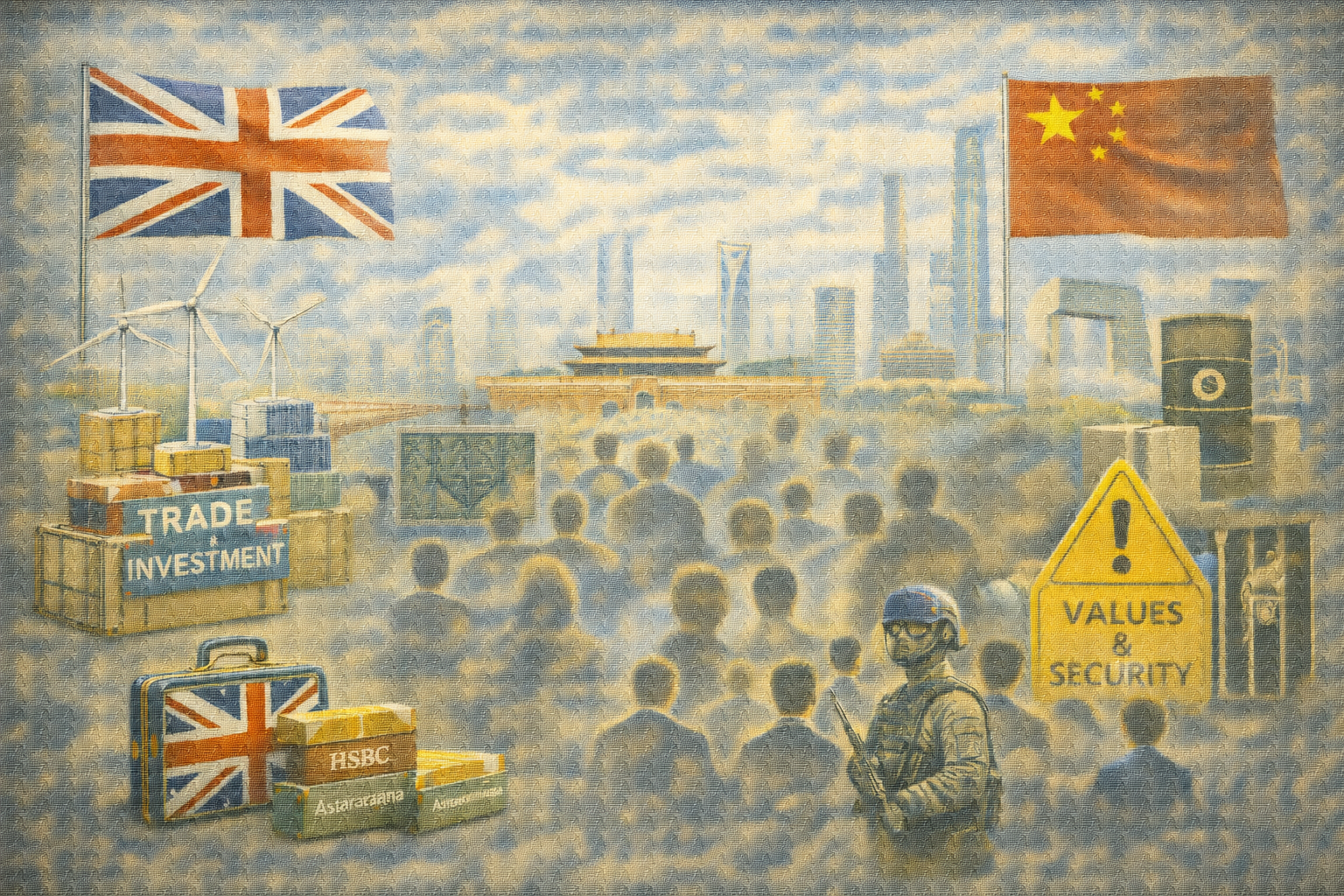

UK Prime Minister Keir Starmer arrived in Beijing on Tuesday on the first visit by a British leader to China since 2018, signalling a tentative reset in relations at a time of growing flux in the global political and economic order.
Starmer is scheduled to meet Chinese President Xi Jinping and Premier Li Qiang on Thursday, with discussions expected to centre on trade, investment and national security, according to an official UK readout.
The trip comes as traditional alliances are being tested by the United States’ increasingly transactional approach to diplomacy and trade, prompting many countries to reassess partnerships and diversify economic ties.
For London, the challenge lies in engaging China pragmatically without sidelining long-standing security and values-based concerns.
Trade, investment, and national security on the agenda
The delegation accompanying him underscores the economic focus of the visit, with around 60 British business and cultural leaders travelling to China.
Among them are representatives from HSBC, pharmaceutical companies GSK and AstraZeneca, Jaguar Land Rover and the National Theatre.
Senior aviation figures, including Airbus general counsel John Harrison and British Airways chief commercial officer Colm Lacy, are also part of the entourage.
In a statement released by his office, Starmer acknowledged the UK’s uneven approach to China in recent years.
“For years, our approach to China has been dogged by inconsistency – blowing hot and cold, from Golden Age to Ice Age. But like it or not, China matters for the UK,” Starmer said in a release put out by the UK administration on Tuesday.
“As one of the world’s biggest economic players, a strategic and consistent relationship with them is firmly in our national interest. That does not mean turning a blind eye to the challenges they pose – but engaging even where we disagree.”
A crowded diplomatic calendar for China
Starmer’s visit follows a flurry of high-level diplomatic engagements between China and European leaders.
On the first Monday of 2026, Xi met Ireland’s Prime Minister Michael Martin, marking the first such visit in 14 years, and later hosted South Korea’s President Lee Jae Myung.
Finnish Prime Minister Petteri Orpo also met Xi this week.
European Union leaders António Costa and Ursula von der Leyen held talks with Xi in July, while French President Emmanuel Macron was welcomed last month with a ceremonial visit.
German Chancellor Friedrich Merz is expected to travel to China in February.
For Beijing, the renewed engagement offers an opportunity to strengthen ties with US allies at a moment when Washington’s policies have unsettled partners.
President Donald Trump’s recent threat to impose steep tariffs on Canada if it pursued closer trade ties with China has amplified concerns over the reliability of the US-led order.
Economic priorities take centre stage
Analysts say Starmer’s trip aligns with his government’s emphasis on economic growth and inward investment.
“This week’s visit — and last week’s controversial decision to approve China’s new ‘super-embassy’ on the fringes of the City — must be seen in that context: it is a strategic imperative as Starmer’s government seeks to encourage inward investment,” writes senior journalist Ian King.
“It must also be seen in the context of some of Labour’s priorities in government, such as the race for net zero, in which China – as the biggest supplier of solar panels to the UK and an increasingly important supplier of wind turbine components – will play a crucial role,” King said.
However, the outreach is not without controversy.
Critics within the UK and abroad, including figures in the Trump administration, have warned that the new embassy could facilitate espionage.
The influential Daily Mail described the China trip as a “kowtowing” exercise, while some Labour lawmakers and security officials remain uneasy about closer ties with Beijing.
Balancing values and pragmatism
Human rights and security issues continue to cast a long shadow over the relationship.
China has been accused of committing crimes against humanity against Uyghurs and other Muslim minorities in Xinjiang, allegations that Beijing denies.
There has also been international concern over the prosecution of Hong Kong media tycoon Jimmy Lai, who faces a potential life sentence.
Downing Street has said Starmer will raise “challenging issues where interests and values differ,” though officials have indicated these topics will not dominate the visit.
The absence of Foreign Secretary Yvette Cooper from the delegation has reinforced perceptions that economic objectives are taking precedence.
There are also persistent concerns about espionage.
Britain’s domestic intelligence agency, MI5, has warned that Chinese state operatives pose a daily national security threat, adding to the sensitivity of any diplomatic thaw.
China’s expectations and Britain’s hedge
Experts say Beijing will likely expect Britain to welcome more Chinese investment and exports while seeking to depoliticise a relationship long shaped by security disputes and the status of Hong Kong.
“I don’t think China is trying to drive a wedge between the United States and its allies,” said Kerry Brown, a professor of Chinese studies at King’s College London, in a New York Times report.
“Mr. Trump is managing that very nicely on his own and needs no help from Beijing. But China is an opportunist, and if there are some favorable winds coming its way because of how everyone else is feeling about America now, then they will take these,” he said.
China has been positioning itself as a stable and predictable power, contrasting its approach with what it portrays as American volatility.
Chinese analysts argue that British firms want deeper access to China’s vast market, while UK consumers stand to benefit from affordable technologies such as electric vehicles and renewable energy equipment.
“This visit signifies a restart of China-UK relations under a new situation,” said Wu Xinbo, the dean at the Institute of International Studies at Fudan University in Shanghai, in the NYT report.
“Both sides hope, through this visit, to confirm the positioning and development path” so that bilateral relations can “reach a new high point.”
Whether that leads to a durable rapprochement will depend on how London balances economic opportunity with political risk in an increasingly fragmented world.
The post Why Keir Starmer’s China visit matters as Britain rethinks trade and diplomacy appeared first on Invezz