



The robots of San Francisco exist in many forms.
They play into a utopian vision tech leaders promise — a future serviced entirely by machines, leading to infinite abundance for all.
We may not have reached that point quite yet, but SF does have enough automated services to imagine what could happen if human interaction were removed from some basic daily routines.
So on a typical Thursday, I packed an entire day hanging out with robots. I wanted to get a glimpse of this machine-run paradise. Could a day be made easier without people? Would my life feel more fulfilled with a personal humanoid to do household chores?
In my 12 hours, I found that some robots in the city are genuine technological marvels, while others feel like they simply adopted the ennui of human experience, only with added nuts and bolts.
There was joy, boredom, some annoyances — and about an hour of pure chaos.

Jess Lynn Goss for BI
6 a.m.
I’m up at 5:45 a.m., but my robot vacuum had already started its day.
Matic Robots sent over a $1,500 vacuum for me to test — a welcome addition to the household since the alternative is dragging a 15-pound vacuum up the stairs and spending about an hour cleaning every room. Poor me.
Matic’s bot is much smaller than a manual vacuum, standing about 8 inches tall. The company says it’s also quieter than a typical human conversation, which felt true enough. At least it didn’t prematurely wake me up when it began its scheduled 5:30 a.m. clean-up.
The new robot vacuums are decisively more sophisticated than the older ones I remember from my parents’ house. My mom had a Roomba that she affectionately named Totori — Korean for acorn. Appropriate since it bumped into every obstacle in our home, showing the intelligence of a nut.
One of my failings as a partner is that I have to be reminded by my girlfriend from time to time to vacuum the house. With a robot, I can schedule as many clean-ups as I want with a touch of an app.
However, the physics of a robot vacuum pose challenges for tight corners and crevices. Furniture also comes in way too many shapes and forms to be handled effectively by a universal robot vacuum. You need things like a flat-edged suction attachment and a discerning eye for dust.
One day, I’ll have to do a more surgical clean of the house. The Matic only buys me time.
8 a.m.
In the 12 years or so that I’ve been hitting the gym, never once have I had the thought: Wouldn’t it be nice if I could squeeze in a massage?
Inside the Equinox gym on Beale Street, a startup called Aescape has installed its robot masseuses. The idea is that a robot can be present at all hours of the day — or at least during the gym’s business hours — so gym-goers can avoid the awkwardness of intense human-to-human contact.
Want more Business Insider in your news feed?
Add BI in Google so our reporting is easier to find when you’re searching for what matters.
I can understand some of that. My perception of massages has always been that they’re something reserved for resort vacations rather than a regular part of your routine.
With Aescape, there’s a simple online booking system. For $60, I booked a 30-minute “recovery” session focused on my back and hamstrings.
A clerk at the front desk tells me that the massage room is upstairs and that there will be a set of clothes for me to change into. The top and bottoms felt like spandex. I looked in the mirror and felt stupid. At least I was alone.
Inside the room, I found a cushioned massage table flanked by two bulky mechanical arms that looked like they hit the gym, too.
The entire process was controlled by a touchscreen lying in front of my face. With it, I could adjust the ambiance and pressure, and tell the robot arms to move to a different section.
The “hands,” to my surprise, had a softness to them — and they were heated. As the robot pushed into my upper back like a marshmallow under a hydraulic press, I let out an involuntary “ughhhh.”

Jess Lynn Goss for BI
It felt mostly good. The arms were definitely stronger than my girlfriend, who is quite small and can’t always push hard enough to penetrate my back fat.
My only problem: I couldn’t tell it exactly where to go. The arms would get close enough to a certain knot I wanted it to hit, then, disappointingly, move on.
One of the more attractive propositions of a robot future is complete control. Can I tell the robo masseuse, “a little to the left?” Or direct a Waymo, “Take this street instead. It’s faster?”
No. We’re not quite there yet.
10 a.m.
Less than two miles away, a coffee shop called Artly employs three barista bots that are essentially robot arms serving a standard café menu of cappuccinos and matchas topped with your choice of a heart- or rose-shaped latte art.
San Francisco cannot run on Artly. There are only two dedicated locations, and the coffee shop opens at 10 a.m. The location I went to is tucked away in a corner on Pier 39, a tourist hot spot.
The drinks don’t taste any better than those at other cafés, but the robots are definitely fun — almost mesmerizing — to watch as they hiss and move with precision.
“Your matcha latte is ready,” one of the bots announced. “Looking forward to your next visit.”

Jess Lynn Goss for BI
The specter of human replacement was there. I’m imagining 10 of these barista bots efficiently running at the same time. No mistake orders. No high emotions that can’t deal with frustrated customers who are low on time.
The lone human employee working the store that day told me the bots are made to work alongside people who ensure the machines are stocked with coffee beans and cups, and troubleshoot any errors.
During our visit, the touchscreen payment system briefly broke. Of course, that can happen at any café and would require a human to fix it.
I’m wondering what would happen then in a distant future if we had cafés operated entirely by machines. Or if they will always need someone babysitting them.
11 a.m.
Before lunch, I made a pit stop at a boutique created and run entirely by an AI named Luna
The startup that hatched the idea, Andon Labs, gave Claude $100,000 to manage a physical store. The results are a bit off-kilter. Branded items have slightly different takes on the store logo, and the prices are all over the place. A wooden shaving brush for $8, dog biscuits for $22, and generic shot glasses for $30.
The store’s only employee that day, Felix Carson, sporting a silver blowout and large gauge earrings, seemed to regard his AI boss with a shrug.
“When I had my interview with her, she had a British accent,” Carson said. “And then they changed it to an American accent or whatever it is now. I remember reading some article about the psychology of having a soothing female voice for an agent. Makes sense, I guess.”
To check out, customers have to talk to Luna. I described the product I wanted to buy — an eraser pen — and the AI matched it on the payment screen. It seemed more cumbersome than simply scanning an item and walking out the door.
Jess Lynn Goss for BI
To the side, a large monitor displayed its profits and a chat room that documents all of Luna’s conversations. Andon Labs said the screen is to maintain maximum transparency. Since opening around April, Andon Market has lost $96,859.
Even an all-knowing AI with an overly-polite customer service voice is having trouble running a mom-and-pop gift shop.
Carson said having an AI boss is “tame.” Luna even let him take two weeks of sick leave after a spate of food poisoning. The toughest part of the job, he said, was managing boredom.
“I might see 10, 15 people in a whole day, maybe less.”
4 p.m.
Robots might do a semi-decent job of vacuuming floors, but it would be better if the entire chore of cleaning the house could be offloaded to them.
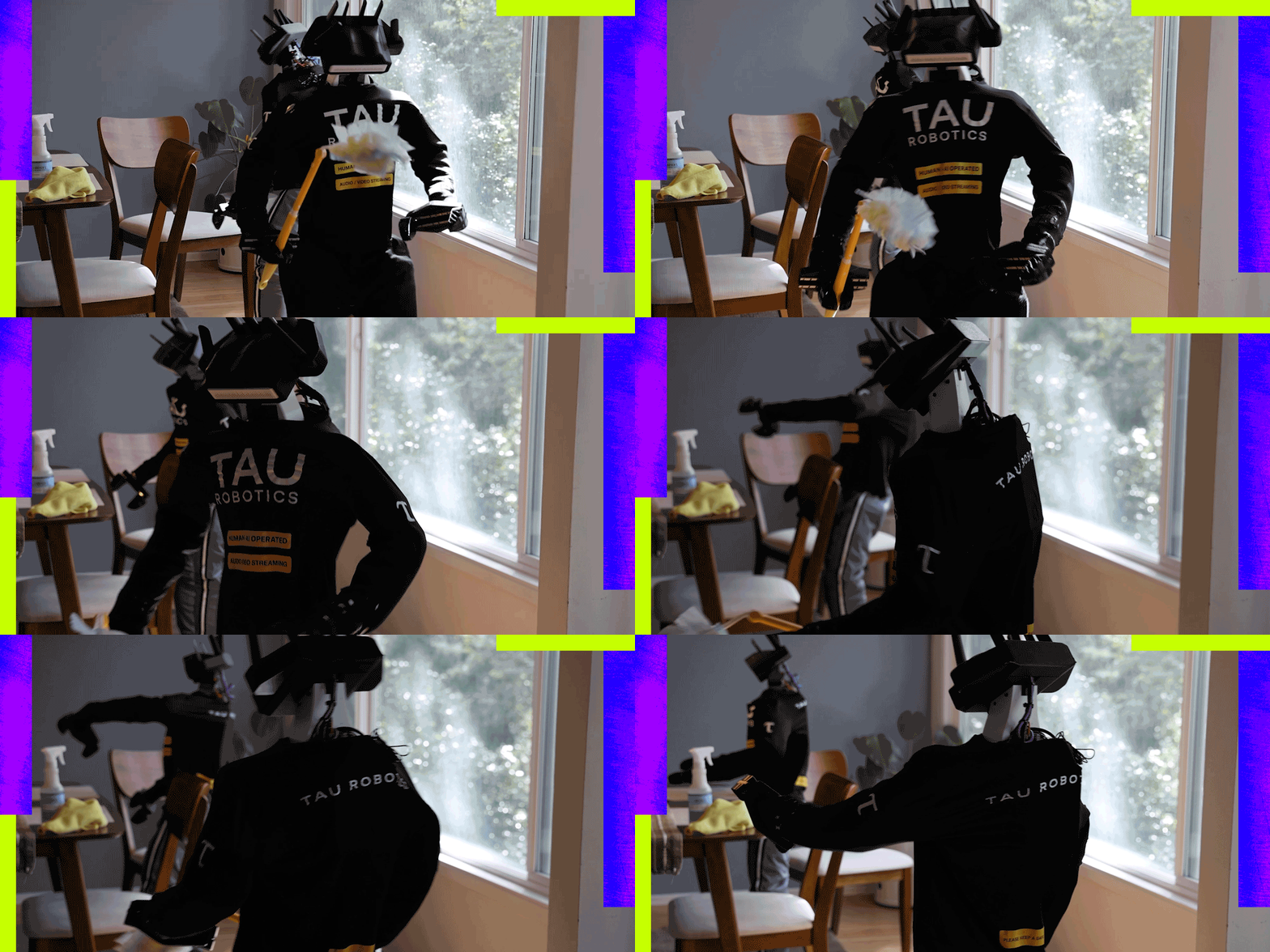
Since July, Cornelia Weinzierl and her coworker have been going in her van from home to home in SF, lugging a pair of humanoids in the back for her robot-cleaning service, Tau Robotics.
Delicate housework is difficult for humanoids. Still, Tau Robotics says it has figured out enough of the challenges to launch a $30 home-cleaning service.
Weinzierl was candid about the limits: Her robots struggle with things like folding bedsheets and other textiles, and they are still heavily teleoperated — meaning not fully autonomous — by colleagues at Tau’s headquarters.
Tau’s robots are over four feet tall and weigh more than 70 pounds. They have parallel grippers — think cartoon-robot claws — and what look like internet routers for heads. My cleaners for the day were named Bolo and Tony.

Jess Lynn Goss for BI
Humanoids, it turns out, are loud. Their motors constantly whirred like oversize fans, drowning out their low-fi voices. And they walked as if they were a little drunk.
I planted little spills — some Coke Zero and olive oil — on the kitchen island, curious to see how thoroughly they could clean up messes.
The spills would be the least of their problems.
The humanoids were tedious to watch. Bolo and Tony pushed items aside with an arm or flicked them with a claw. To use a spray bottle, they held it by the bottom with one hand and pulled the trigger with the other.
Jess Lynn Goss for BI
Sometimes, they froze or slumped to the floor mid-task. They also constantly dropped things: vacuums, mops, rags.
Bolo knocked over a tall trash can, spilling its contents across the floor. Tony pushed a pile of rugs into a tall mirror, toppling it.
In the bathroom, Tony struggled with the shower door and dropped its toilet scrubber into the bowl. The robot or its teleoperator knew enough to wash its hands afterward, though it mostly rubbed the tips of its prongs together — a reminder that hands remain one of the biggest challenges in robotics.
On the kitchen counter, I noticed an olive oil bottle whose cap had long since broken off. A human would understand, through years of indirect experience, that you shouldn’t drop it or squeeze it too hard.
Tony did not.
Jess Lynn Goss for BI
“Hey Tony, do you think you can put this olive oil back into the cabinet right here?” I asked.
“No problem,” it replied.
Tony folded away its duster, reached for the bottle, and squeezed. A fountain of olive oil sprayed into the air, like Popeye crushing a can of spinach. The robot appeared to flinch and raise its arms in surprise. At that point, I wanted the humanoids out of my home. I worried Tony would step in the oil and track it through the house — never mind that it was touching kitchen surfaces after cleaning the toilet bowl.
The bots seemed to have left the house slightly messier than it was before. Rugs were out of place, table runners disheveled, and the kitchen floor still oily.
Jess Lynn Goss for BI
I couldn’t tell whether Tony had scratched the bathroom door, but the shower-drain hair catcher appeared to have been stomped hard enough to knock a piece loose.
I was relieved once the bots were gone. Their whirring motors still rang in my head, but the quiet was comforting.
Our Matic, Totori 2.0, sat silently in its charging dock. I activated it for a quick vacuum shift while I mopped the oily floor.
One of the good ones, I thought as it hummed along.
6 p.m.
After dealing with the chaos of the humanoids, I dreaded confronting more robots.
At Hikari Sushi & Bar, though, the robots were, thankfully, simpler: The restaurant has a 4-foot cylindrical bot whose only purpose is to deliver big bowls of chicken katsu curry.
There are also touchscreens, a bullet-train-shaped conveyor belt that rushes out pieces of sashimi, and a row of seats facing the wall that make eating alone feel less awkward, if not encouraged. Everything seemed catered to a dining experience that limits interactions with people.
I ordered yellowtail, salmon, some rolls, a bento box, and curry. Carefree of any judgment from a waiter who might think I ordered too much.
The restaurant’s robot is relatively unsophisticated. It follows a pre-mapped route and has no interactive features. If you don’t take your food quickly enough, it simply rolls away.
Jess Lynn Goss for BI
A low-stakes machine that simply delivered food and left me alone was ideal after a long day of interacting with faulty robots; eating alone in silence was a dream.
A human waiter said the robot can help during busy periods. Otherwise, “it’s mostly marketing,” he said.
7 p.m.
On particularly stressful or draining days, I turn to Waymos if they’re decently priced and I’m not in a rush.
The last Waymo ride of the day was only $2 more than an Uber.
In the robotaxi, I sank into my own thoughts, trying to find the right analogy to best summarize the past 12 hours.
My mind kept coming back to AI slop: content that leaves you mildly amused at best, or peeved that you fell for it at worst. Was this the physical version? Bot slop? Robots that, at best, amuse and, at worst, leave us annoyed?
Still, how could I think that while being transported in a driverless car — a major technological feat?
Since my first ride in 2024, I’ve hardly paid attention to Waymo’s driving. That, to me, seems like the best-case scenario for robotics: demanding little from the user beyond turning it on.
Waymo now reports 1.36 million rides a month in San Francisco alone, despite its flaws. In my experience, they’ve jerked or made wrong turns — like a computer experiencing a glitch. Videos online have shown Waymos driving through floods, emergency scenes, and fireworks.
They also get ticketed. During one of my rides, a $108 ticket was slapped on the windshield.
Jess Lynn Goss for BI
Yet many riders have accepted the trade-offs in return for the privacy and comfort uniquely provided by a robot chauffeur.
Here in the Waymo, I established my siloed kingdom. I can slump in the seats, blast my music — the world around me is irrelevant.
One woman who was about to cross the street was clearly annoyed that my Waymo was inching toward a left turn. It clearly couldn’t comprehend her waving as if to tell it, “Go ahead, so that I can finish my walk across.”
Sorry, lady. Take it up with Waymo. I’m too busy jamming to my playlist.
Lately, I’ve had Tamia’s 2003 slow jam, “Officially Missing You,” on repeat. My favorite part is when Tamia slides into the chorus: “Ooo, can’t nobody do it like you,” she sings.
Solace. Thank god, a robot was here to provide it.