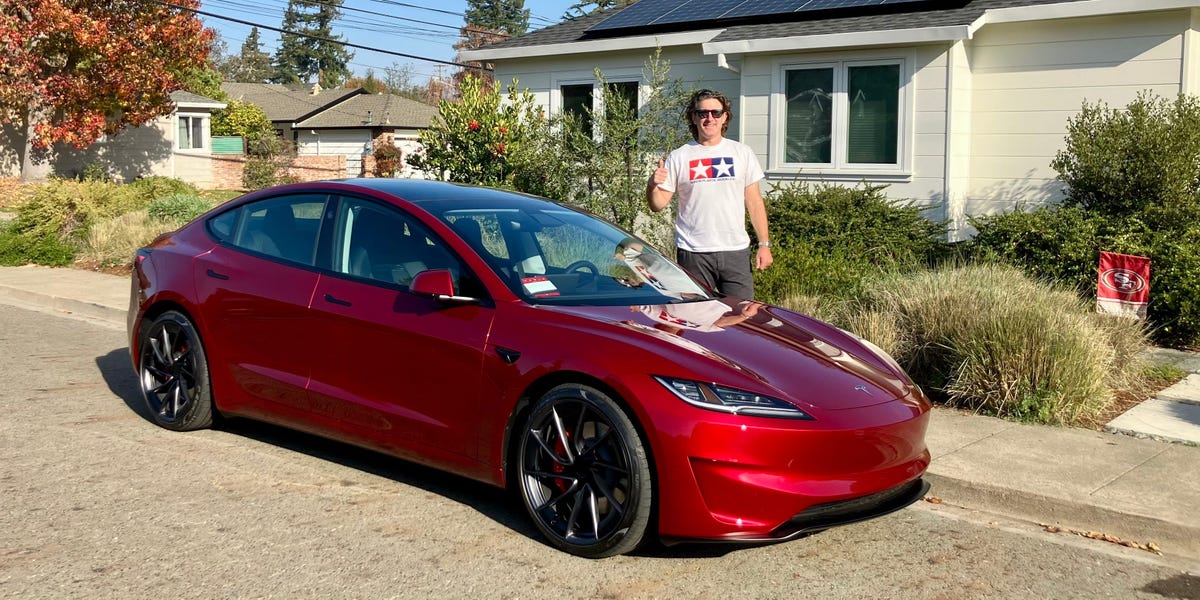
When I picked up my new Tesla Model 3 Performance in December, it came with a free trial of the company’s Full Self-Driving (FSD) software.
I originally made the purchase to enjoy driving a fast sports car. But I’ve also been fascinated by the promise of autonomous vehicles ever since I experienced Google’s early driverless technology as a reporter at The Wall Street Journal over a decade ago.
So, for the past five months, I’ve been using FSD (in “Chill” mode only) to see what it can and can’t do.
I still drive the car. Legally, functionally, and by necessity. Tesla calls this software Full Self-Driving, but it’s really an advanced driver-assistance system. Every moment it’s engaged, I am still the driver, and Tesla makes that very clear when you’re in the car in FSD mode.
The company is planning to launch a robotaxi service in Austin in June. That will come with fully autonomous software that requires no supervision. However, the reason for this diary is to give you a sense of what Tesla’s latest and greatest published driving software is capable of right now.
Here are my observations, feelings, and takeaways from driving more than 1,000 miles in FSD around Silicon Valley and beyond. I also shared this diary with Bryant Walker Smith, a lawyer who focuses on mobility, driver-assistance, and autonomous-vehicle technology. I’ve included some of his context and thoughts throughout. I also shared my diary with Tesla’s press office and CEO Elon Musk via email on
Wednesday. They didn’t respond.
More relaxing, especially in traffic
Let’s get this out of the way first: This is one of the best cars I’ve ever driven. On and off for over 20 years, I have test-driven cars from Hummers to Porsches to Alfa Romeos. The Model 3 Performance has incredible steering, high build quality, and incredible speed, for a lot less money than a BMW M4. It’s a great deal and I love it.
In early January, switching on FSD was a surprise at first. It handled way more situations than I expected — basically everything on most trips.
Driving in traffic, with a destination punched into Tesla’s onboard screen, is less stressful than handling stop-and-go congestion yourself and trying to decide which turn to take next. It’s a new, slightly more relaxing experience. I get to my destination in a better mood.
Tesla FSD always comes to a full stop at stop signs. Obviously, I do too. But maybe I don’t? This was annoying at first, but now I don’t notice, and it’s safer. I thought I would lose time, but really, there’s no difference. What started as an irritation became a reminder of how easily humans normalize cutting corners when driving themselves.
The FSD is a more efficient driver. It uses less battery power than I do driving the car. I know this because I look at the onboard map, which predicts the battery level upon arrival. Once I switch to FSD, that prediction drops and stays lower once I arrive.
Potholes and disengagements
Pothole avoidance, please! My Tesla in FSD drives straight over most potholes on the road. I try to (carefully!) avoid them while driving myself. Is this why some Tesla owners say they have to replace their tires so often?
I disengaged FSD in San Francisco a few months ago. There was a car parked on the side of a thin side road. I knew I could squeeze around it, but Tesla FSD just sat there. So I took over, drove around, and then restarted FSD.
I disengaged another time on Highway 80, going from Silicon Valley to Lake Tahoe with my wife. We were in FSD (Chill mode) in the slow lane. Traffic built up ahead, and the faster lanes started backing up. Another car darted into our lane, right in front of us. We screamed, and I grabbed the wheel. Maybe FSD would have handled it, but I wasn’t willing to find out.
Speaking of lanes: In Chill mode, FSD stays in the slow lane, and it’s slow to move across when a highway intersection is approaching. This gets me stuck behind cars merging onto the highway.
When I drive myself, I get over into the outside lanes before this stuff happens. I know a few blocks in advance that something is going to get snarled, so I adjust early. Tesla FSD doesn’t do that in Chill mode. So, we have to slow down and get into complex merge situations. I suspect being in other FSD modes, such as “Hurry” mode, would mean my Tesla drives in the faster, outer lanes of the highway.
A test and a change of heart
I was impressed during the first two to three months of using FSD. When my free trial ended in June, I thought I would probably start paying $99 a month for this technology. And I don’t even drive that much. I bought this car to drive a fast sports car. Now, I barely drive it.
That paragraph above was the thrust of the story I planned to write earlier this year.
Then, my colleague Lloyd Lee and I tested Tesla FSD against Waymo in San Francisco on May 1. You can read all about that here. TLDR: We ran a red light while in my Tesla’s FSD mode. Waymo refused to go that specific route, suggesting that Waymo’s software system can’t handle that specific intersection either. However, I was shocked by the experience.
Walker Smith says there’s “a huge difference between running a red light at an intersection and proactively avoiding the intersection.”
Please help BI improve our Business, Tech, and Innovation coverage by sharing a bit about your role — it will help us tailor content that matters most to people like you.
What is your job title?
(1 of 2)
What products or services can you approve for purchase in your role?
(2 of 2)
this data to improve your site experience and for targeted advertising.
By continuing you agree that you accept the
Terms of Service
and
Privacy Policy
.
Thanks for sharing insights about your role.
An uncomfortable U-turn
About two weeks after that aforementioned test, I was driving in FSD mode with a friend on Highway 280 north toward San Francisco on a sunny and clear day. Traffic built up ahead, so my Tesla pulled off on an exit lane. The onboard map showed that the car planned to wait by a traffic light and then go straight ahead — basically getting back on the highway to try to overtake a few other cars stuck in traffic. Similar to what the Waze app sometimes has drivers do.
Once the light turned green, my Tesla turned left under the highway instead, even though the Tesla map showed that we should have gone straight. Then it did a U-turn at a slightly uncomfortable speed (a little too fast, I felt). The worst part was that it did this U-turn from the outside lane on a multi-lane road rather than the designated left-turn lane. And it did this maneuver in front of several traffic police who were attending to a minor incident about 70 feet away.
Luckily, there were no cars in the left lane, which was the correct lane from which to do a U-turn or to just turn left. If there had been a car trying to turn left at that moment, we might have crashed into it. I’m not 100% sure of this, but that’s my feeling. There was a risk of this happening.
After doing the U-turn, the FSD system was going to try to turn left again, taking us, finally, back on Highway 280 north. But again, it was trying to turn from the center lane, not the left turn lane. I disengaged at this point and took over the driving.
My friend turned to me in shock. I blushed, which was a strange experience. It was as if I were embarrassed by my car.
“Your U-turn examples are new to me,” Walker Smith said. “They are wild!”
“It’s possible that, if another vehicle had been in the left-most lane, then your Tesla would not have attempted a turn,” he added. “But it’s also possible that it would have.”
To FSD or not to FSD
More recently, about 2 weeks ago, I was in FSD “Chill” mode in San Francisco, driving toward Ocean Beach. The car was on a two-lane road, and the Tesla map showed that it was supposed to pull into a left turn lane in the center of this road. The idea being that we would wait for oncoming traffic to clear and then turn left across the two lanes going the other way. The car put the left indicator on, but didn’t go into the left turn lane. I disengaged and pulled gently into the correct lane myself.
Please help BI improve our Business, Tech, and Innovation coverage by sharing a bit about your role — it will help us tailor content that matters most to people like you.
What is your job title?
(1 of 2)
What products or services can you approve for purchase in your role?
(2 of 2)
this data to improve your site experience and for targeted advertising.
By continuing you agree that you accept the
Terms of Service
and
Privacy Policy
.
Thanks for sharing insights about your role.
I still switch FSD on a lot, in “Chill” mode. On Tuesday, for instance, I drove on Highway 101 north to work from one of our WeWork office locations. This trip, and the return journey home, were uneventful and less stressful than driving myself in highway traffic.
My FSD free trial ends in June. I’m now less likely to pay $99 a month for this technology. However, when I’m expecting to drive a lot during a particular period, I might pay for it occasionally.
The key difference
The final words should go to Walker Smith. Having read my diary, he made a crucial point.
“Your (and every) version of so-called ‘FSD’ is merely a driver-assistance system,” he told me. “Accordingly, it only works unless and until it doesn’t. That’s why you have to supervise — indeed, why you are still the driver who is driving.”
This may seem like quibbling over slight language tweaks. But there’s a giant gap between “driver-assistance” systems that still need human supervision and fully autonomous technology that does not have anyone behind the wheel.
Walker Smith slapped me on the wrist for writing in my original diary that “I barely drive it.” He described this as “a fundamental misunderstanding and misrepresentation of driver-assistance systems.” (He also thinks BI should correct the wording of our San Francisco Waymo vs Tesla test story. I checked with my editor, who said no.)
Walker Smith described the difference between driver-assistance and automated driving as “climbing a 500-foot cliff with a rope or free-soloing it.” Or, the difference between hearing a pilot on a plane say “Hi folks, today we’ll be using autopilot” and hearing the pilot say “Hi folks, today you’ll be using autopilot because I’m getting off the plane.”
FSD is an incredible piece of software, until it’s not. When it works, it feels like the future. When it doesn’t, it reminds you we’re not there yet.