
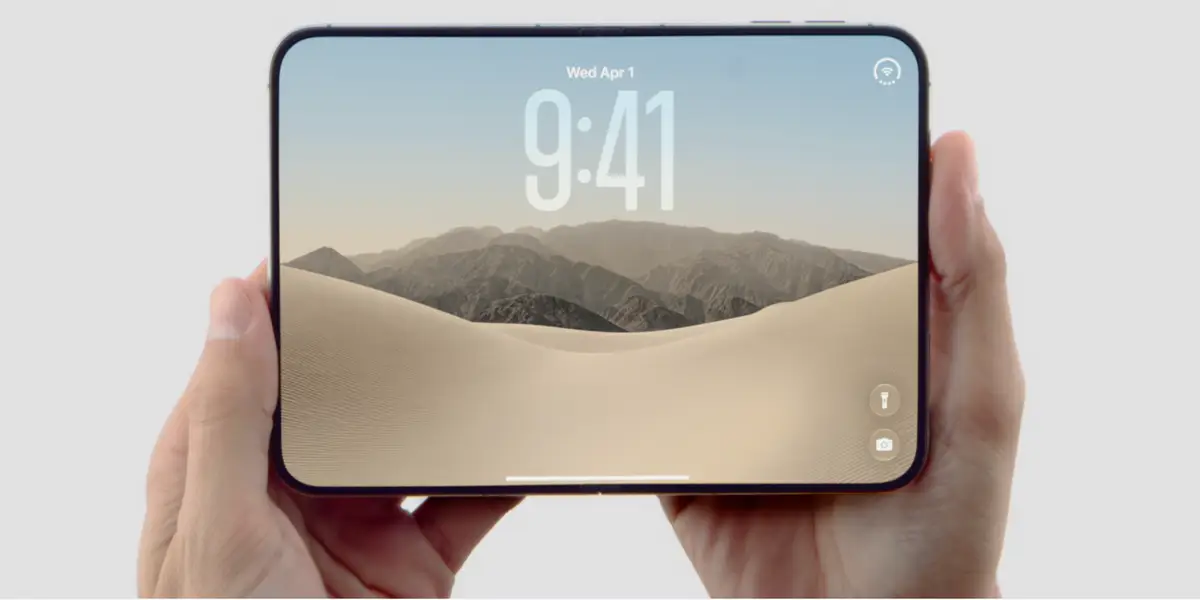
Since its 2007 launch, the iPhone has had the same basic design: a flat, rigid rectangle.
Now, Apple is folding on that form factor.
Apple debuted the new foldable iPhone Duo on Tuesday at its annual September hardware event, marking the biggest design change in the device’s history.
John Ternus, Apple’s CEO, critiqued other foldables that “feel like two phones awkwardly stuck together.” The company wanted a larger display, one that is “as natural and intuitive as an iPad,” he said.
The device has two displays: the closed front and the full-sized open screen. When opened, the phone can also have two displays on each side of the hinge.
It’s 50% larger than the iPhone 18 Pro Max and 80% larger than the 18 Pro.
Apple said it has set the iPhone Duo price for $1,999.
Breaking the iPhone’s design rut
Apple certainly isn’t the first company to put out a foldable. Samsung continues to expand its lineup, while Chinese companies like Honor and Oppo offer cheaper (and thinner) alternatives. One of Huawei’s phones folds not once, but twice.
Still, the move is seismic for Apple, which largely iterated and finessed the form factor Steve Jobs first unveiled in 2007.
Designer Christopher Stringer recounted the process of picking a shape during Apple’s 2012 lawsuit against Samsung. The company tested an “extrudo” model, which had a lozenge-like shape, he said. Then, it landed on the iPhone design we know and love.
At the end of the 2012 trial, Apple explicitly received its design patent: a rectangle with rounded corners.
For years after, Apple tinkered with elements of the design. It extended the display and removed the home button. It tried out new colors and side buttons. It tried lighter and thinner models.
Throughout it all, the basic rectangle design stayed flat.
The new foldable doesn’t stray too far from Apple’s roots. It does open into a rectangle with rounded corners, after all.
Still, the design brings something new to the market — and shows Apple can still mix it up.