
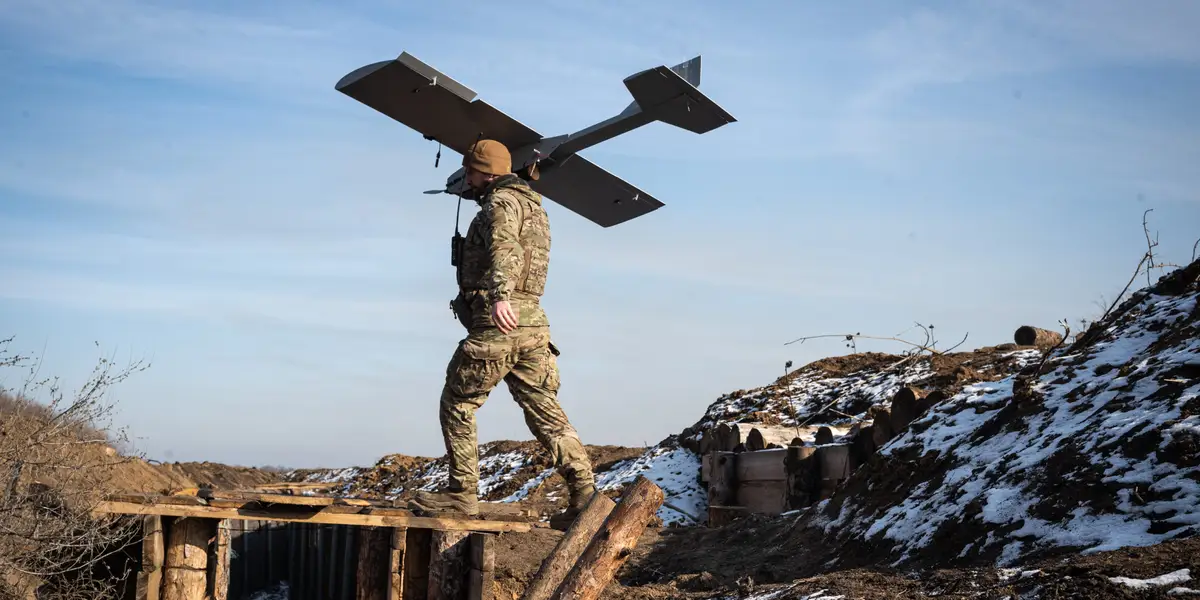
Western militaries are grappling with a growing drone threat their air-defense networks were not primarily built to handle: large numbers of small, low-flying, relatively cheap targets that can be difficult to detect, classify, and defeat cost-effectively.
Many traditional air-defense systems were designed around combating aircraft and missiles, threats that are usually larger, faster, higher-flying, and more distinct than small drones.
“You’ve got very, very different requirements from a radar point of view to be good at both of those things,” Justin Bronk, a top airpower expert at the UK-based Royal United Services Institute think tank, told Business Insider. The radar needs to be able to distinguish drones from birds, civilian aircraft, friendly aircraft, helicopters, and other objects, while the defenses need to be stacked.
Flying low, hostile drones can remain below the line of sight of some ground-based radars until they are relatively close, which is why Ukraine has had to rely on more dispersed sensors, mobile fire teams, acoustic detection, visual observers, and other defensive layers.
The advanced Western systems that Ukraine is using, such as Patriot, can detect and engage enemy drones, but they were not built primarily for that fight and are not particularly cost-effective. They are high-end defenses designed mainly for aircraft and missile threats, not cheap drones. While they can defeat drones, they are not considered the most efficient answer to the smaller, lower-flying drone technology appearing in increasing numbers on the battlefield.
SAM YEH/AFP via Getty Images
Integrating purpose-built counter-drone systems into the traditional defense architecture becomes key, which militaries are starting to recognize.
Robin Radar, a Dutch company making drone detection radars used by Ukraine and by US allies in the Middle East, said the challenge that drones present became very clear early in Ukraine’s fight against Russia’s invasion.
For many of the systems in Ukraine’s arsenal, “the radars were too big and not designed to detect drones, maybe to detect missiles and planes,” Kristian Brost, the head of the company’s US operations, told Business Insider.
Drones are being used in the war in Ukraine on a scale not seen before, pushing defense companies to develop solutions for detecting drone threats, even as the need to detect and stop powerful missiles remains a necessity as well.
Robin Radar’s CEO, Siete Hamminga, described the basic function of a radar, explaining that it “shouts and listens to the echo, which works fine if you want to detect hard ships or planes, which is what it was developed for.”
But he said detecting a small drone is “really a different ballgame,” as they are “typically relatively slow-moving and very small.”
The company had to upgrade its systems to keep up with the evolving threats, like Russia’s Iranian-designed Shaheds and Russian-made variants. That experience in Ukraine helped the company prepare its radars to help US allies detect Iranian drones in the Middle East.
Hamminga described detecting a drone as one challenge among many. Operators may see a dot on their screen and need to determine whether it is a drone rather than, say, a bird.
The company started out as a bird-detection operation protecting aircraft from bird strikes, but then it branched into drones in 2014. Now, it is assisting militaries in distinguishing between real threats and clutter.
After detection comes the challenge of defeating them. Militaries need to be able to visualize the target’s flight path and have the right mixture of interceptors or other weapons to take it down.
Russia’s war against Ukraine has sparked a surge in spending on air defenses across the NATO alliance, including on new types of air defenses that Ukraine is using and that were designed specifically to stop drones.
Francisco Richart Barbeira/NurPhoto via Getty Images
In the current threat environment, militaries need air defenses that can handle a wide range of threats at once, from small drones to cruise missiles, ballistic missiles, and aircraft. Mixed bombardments can put tremendous stress on a defensive system.
“You also need to be aware that there’s no silver bullet,” Hamminga said. “You need to combine multiple sensors, you need to integrate them with different forms of intervention, bring all of that together in a command and control setting.”
Bronk, the RUSI airpower expert, explained that air defense is “hugely complicated and requires linking together lots and lots of different types of sensors that are all kind of placed and optimized for covering different geographical areas, but also different altitude blocks and different, broadly speaking, speeds of threats.”
He said a highly effective air defense system that can deal with a host of threats “requires you to layer multiple types of air and missile defense systems around an object or area that you want to protect,” ranging from the high-end systems that can stop ballistic missiles to ones that can stop small drones, and systems in between.
That’s an expensive task, requiring many advanced systems along with operator training and maintenance.
However, it is not possible to stop everything. It’s usually harder and more expensive to defend than to attack, and it’s not possible to spend enough to protect everything from an attacker with a big drone and missile arsenal.
Having enough protection for a whole country against the modern missile and drone threat is “just not feasible,” Bronk said. So countries will have to plan out their protection strategies accordingly.